<?xml version="1.0" encoding="UTF-8"?><feed
	xmlns="http://www.w3.org/2005/Atom"
	xmlns:thr="http://purl.org/syndication/thread/1.0"
	xml:lang="en-US"
	>
	<title type="text">Alexander Thompson | The Verge</title>
	<subtitle type="text">The Verge is about technology and how it makes us feel. Founded in 2011, we offer our audience everything from breaking news to reviews to award-winning features and investigations, on our site, in video, and in podcasts.</subtitle>

	<updated>2014-01-14T16:00:02+00:00</updated>

	<link rel="alternate" type="text/html" href="https://www.theverge.com/author/alexander-thompson" />
	<id>https://www.theverge.com/authors/alexander-thompson/rss</id>
	<link rel="self" type="application/atom+xml" href="https://www.theverge.com/authors/alexander-thompson/rss" />

	<icon>https://platform.theverge.com/wp-content/uploads/sites/2/2025/01/verge-rss-large_80b47e.png?w=150&amp;h=150&amp;crop=1</icon>
		<entry>
			
			<author>
				<name>Alexander Thompson</name>
			</author>
			
			<title type="html"><![CDATA[How to build the world&#8217;s most amazing space telescope]]></title>
			<link rel="alternate" type="text/html" href="https://www.theverge.com/2014/1/14/5307582/james-webb-space-telescope-nasa" />
			<id>https://www.theverge.com/2014/1/14/5307582/james-webb-space-telescope-nasa</id>
			<updated>2014-01-14T11:00:02-05:00</updated>
			<published>2014-01-14T11:00:02-05:00</published>
			<category scheme="https://www.theverge.com" term="Features" /><category scheme="https://www.theverge.com" term="NASA" /><category scheme="https://www.theverge.com" term="Report" /><category scheme="https://www.theverge.com" term="Science" /><category scheme="https://www.theverge.com" term="Space" />
							<summary type="html"><![CDATA[The Hubble Telescope has given us astonishing images of distant stars, but despite its accomplishments, it has a limited view of the heavens. Scientists and engineers are hard at work on a larger, more powerful successor &#8212; the James Webb Space Telescope. Hubble has had an impressive run &#8212; it&#8217;s been used to detect clouds [&#8230;]]]></summary>
			
							<content type="html">
											<![CDATA[

						
<figure>

<img alt="" data-caption="" data-portal-copyright="" data-has-syndication-rights="1" src="https://platform.theverge.com/wp-content/uploads/sites/2/chorus/uploads/chorus_asset/file/13068729/webb-lead.1419980254.jpg?quality=90&#038;strip=all&#038;crop=0,0,100,100" />
	<figcaption>
		</figcaption>
</figure>
<p>The Hubble Telescope has given us <a href="http://www.theverge.com/2012/9/26/3410514/hubble-extreme-deep-field">astonishing images of distant stars</a>, but despite its accomplishments, it has a limited view of the heavens. Scientists and engineers are hard at work on a larger, more powerful successor &mdash; the <a href="http://www.theverge.com/2012/2/17/2804244/james-webb-space-telescope">James Webb Space Telescope</a>. Hubble has had an impressive run &mdash; it&rsquo;s been used to <a href="http://www.theverge.com/2014/1/1/5262368/hubble-telescope-finds-clouds-in-weather-study-of-exoplanet">detect clouds</a> on distant planets, find <a href="http://www.theverge.com/2013/7/11/4514196/blue-planet-rains-glass-uncovered-nasa-hubble">evidence of planets</a> with glass rain, and <a href="http://www.theverge.com/2012/5/1/2991092/hubble-telescope-egg-nebula-closeup">image a star</a> near the end of its life &mdash; but the Webb will be able to do more. The researchers behind Webb hope to probe the early universe by gathering some of the earliest, most distant light. And engineers building the telescope have recently completed a major milestone: finishing and delivering the mirrors that will be pieced together for Webb&rsquo;s huge primary mirror.</p>

<p>That mirror will be a stunning a 21 feet high, made of 18 smaller hexagonal mirrors. It&rsquo;ll be used to help the telescope capture images of the night sky and also break down the spectrum of the incoming light to analyze properties of galaxies, stars, and even exoplanet atmospheres. The Webb venture isn&rsquo;t just an American endeavor, but is part of an international collaboration that includes NASA, the European Space Agency, and the Canadian Space Agency.</p>
<div class="snippet-n"><div class="g10-2"> <div class="snippet-n float-right"><q>A telescope to probe the early universe</q></div> <!-- ######## END SNIPPET ######## --><p>The lead scientist on the project, Nobel laureate John Mather, says that agencies wanted a new telescope because &#8220;[researchers] believed when they built [Hubble], when they designed it, that it would be able to see the first galaxies forming in the early universe. They found a big surprise &mdash; they couldn&rsquo;t.&#8221; The reason being that the oldest light in the universe has undergone a doppler shift &mdash; much like the pitch of a car horn shifts as it passes you, light shifts due to the expansion of the universe. The Hubble telescope can detect the same colors the human eye can detect and a little beyond, but it can&rsquo;t detect this stretched-out, infrared light from the early universe.</p> <p>Indeed, detecting infrared light poses some daunting challenges. A telescope like Hubble generates its own heat and is exposed to the rays of the sun, both sources of of infrared light. These factors could drown out the weak infrared signals from far-away galaxies. To keep cool, the Webb will orbit a million miles from Earth &mdash; four times further than the moon. At its orbital point, the Earth, moon, and sun will all be in the same direction, so they can all be shaded with one sunshade.</p> <p>Each of the mirrors take a large amount of effort to construct, and it took years to actually make them. The Webb has to be very cold to operate, but materials can warp with temperature change. The researchers selected the metallic element beryllium because it will warp very little with falling temperatures. Even still, the process of constructing the mirrors required much care and many iterations: after polishing the mirrors at room temperatures, engineers cool it down to see how it warps, and then try another polish to compensate for this warping.</p> <p>The final versions of those mirrors have recently been delivered to the Goddard Space Flight Center. But despite that major milestone, Webb won&rsquo;t be ready for liftoff until 2018. There is still testing needed for the telescope&rsquo;s existing components, and construction for the rest of the parts that will comprise the observatory and the rockets, among other elements.</p> <p>Once in space, Webb will probe the first stars and galaxies, the birth of stars, and Earth-like planets. Scientists are looking for plenty of things, but Mather himself hopes to peer toward the unknown. &#8220;The real hope is we&rsquo;ll get some big surprises,&#8221; he said. And by looking where no other telescope can see, Webb has a good chance of surprising us.</p> </div></div><!-- ######## END SNIPPET ######## -->
<div class="image-slider">
	<div class="image-slider">
		<img src="https://platform.theverge.com/wp-content/uploads/sites/2/chorus/uploads/chorus_asset/file/2813320/james-webb-telescope-theverge-5_1020.1389711839.jpg?quality=90&#038;strip=all&#038;crop=8.8235294117647,0,82.352941176471,100" alt="James Webb Space Telescope" title="James Webb Space Telescope" data-has-syndication-rights="1" data-caption="" data-portal-copyright="After arriving at the Goddard Space Flight Center, Webb’s mirrors are inspected. The containers are hermetically sealed to protect against pressure changes that occur in transit. " />
<img src="https://platform.theverge.com/wp-content/uploads/sites/2/chorus/uploads/chorus_asset/file/2813332/james-webb-telescope-theverge-4_1020.1389711849.jpg?quality=90&#038;strip=all&#038;crop=0,0.14662756598241,100,99.706744868035" alt="James Webb Space Telescope" title="James Webb Space Telescope" data-has-syndication-rights="1" data-caption="" data-portal-copyright="Webb’s mirrors are inspected in a cleanroom at Goddard Space Flight Center. It is inspected in the cleanroom to avoid contamination from dust debris. " />
<img src="https://platform.theverge.com/wp-content/uploads/sites/2/chorus/uploads/chorus_asset/file/2813330/james-webb-telescope-theverge-2_1020.1389711849.jpg?quality=90&#038;strip=all&#038;crop=7.7205882352941,0,84.558823529412,100" alt="James Webb Space Telescope" title="James Webb Space Telescope" data-has-syndication-rights="1" data-caption="" data-portal-copyright="Still from a video comparing the 21-foot composite mirror of the James Webb Space Telescope to Hubble’s primary mirror as well as a person." />
<img src="https://platform.theverge.com/wp-content/uploads/sites/2/chorus/uploads/chorus_asset/file/2813322/james-webb-telescope-theverge-9_1020.1389711840.jpg?quality=90&#038;strip=all&#038;crop=3.4558823529412,0,93.088235294118,100" alt="James Webb Space Telescope" title="James Webb Space Telescope" data-has-syndication-rights="1" data-caption="" data-portal-copyright="A full scale model sits in front of the the Austin, Texas skyline. The model was brought to the South by Southwest festival in March. " />
<img src="https://platform.theverge.com/wp-content/uploads/sites/2/chorus/uploads/chorus_asset/file/2813326/james-webb-telescope-theverge-7_1020.1389711840.jpg?quality=90&#038;strip=all&#038;crop=0,0,100,100" alt="James Webb Space Telescope" title="James Webb Space Telescope" data-has-syndication-rights="1" data-caption="" data-portal-copyright="The sunshield membrane is necessary to allow the telescope to operate at very low temperatures. Here it is being inspected at Northrop Grumman to ensure it is up to spec." />
<img src="https://platform.theverge.com/wp-content/uploads/sites/2/chorus/uploads/chorus_asset/file/2813334/james-webb-telescope-theverge-3_1020.1389711849.jpg?quality=90&#038;strip=all&#038;crop=0,0.073421439060198,100,99.85315712188" alt="James Webb Space Telescope" title="James Webb Space Telescope" data-has-syndication-rights="1" data-caption="" data-portal-copyright="To test components of the telescope, scientists put them in a very cold vacuum chamber. These gold colored aluminized kapton blankets insulate the testing equipment to keep the chamber cold." />
<img src="https://platform.theverge.com/wp-content/uploads/sites/2/chorus/uploads/chorus_asset/file/2813324/james-webb-telescope-theverge-8_1020.1389711840.jpg?quality=90&#038;strip=all&#038;crop=0.073529411764703,0,99.852941176471,100" alt="James Webb Space Telescope" title="James Webb Space Telescope" data-has-syndication-rights="1" data-caption="" data-portal-copyright="Shining a light inside a thermal vacuum chamber, used to simulate the cold vacuum of space for testing Webb’s cameras and spectrographs." />
<img src="https://platform.theverge.com/wp-content/uploads/sites/2/chorus/uploads/chorus_asset/file/2813318/james-webb-telescope-theverge-6_1020.1389711840.jpg?quality=90&#038;strip=all&#038;crop=0,3.360768175583,100,93.278463648834" alt="James Webb Space Telescope" title="James Webb Space Telescope" data-has-syndication-rights="1" data-caption="" data-portal-copyright="The Near Infrared Camera can capture a range of light, from orange and red to the near infrared. It, along with the Mid-Infrared Instrument, will capture images of the universe aboard the Webb." />
<img src="https://platform.theverge.com/wp-content/uploads/sites/2/chorus/uploads/chorus_asset/file/2813328/james-webb-telescope-theverge-10_1020.1389711840.jpg?quality=90&#038;strip=all&#038;crop=0,2.3141654978962,100,95.371669004208" alt="James Webb Space Telescope" title="James Webb Space Telescope" data-has-syndication-rights="1" data-caption="" data-portal-copyright="An artistic interpretation of what the Webb Telescope will look like after being fully deployed in space. (All images courtesy of NASA)" />
	</div>
</div>
<p><br id="1389712516034"></p>
						]]>
									</content>
			
					</entry>
			<entry>
			
			<author>
				<name>Alexander Thompson</name>
			</author>
			
			<title type="html"><![CDATA[Water on the red planet: more findings point to flowing liquid on Mars]]></title>
			<link rel="alternate" type="text/html" href="https://www.theverge.com/2013/12/10/5195388/liquid-water-flows-on-mars" />
			<id>https://www.theverge.com/2013/12/10/5195388/liquid-water-flows-on-mars</id>
			<updated>2013-12-10T13:05:01-05:00</updated>
			<published>2013-12-10T13:05:01-05:00</published>
			<category scheme="https://www.theverge.com" term="Report" /><category scheme="https://www.theverge.com" term="Science" />
							<summary type="html"><![CDATA[Dark streaks in images from Mars, seen above, suggest flowing water. (NASA) During spring months on Earth, the ground thaws and new life abounds. On Mars, scientists have observed activity of a different sort &#8212; water that seems to bleed from the ground. Mars is thought to have been much wetter in the past with [&#8230;]]]></summary>
			
							<content type="html">
											<![CDATA[

						
<figure>

<img alt="" data-caption="" data-portal-copyright="" data-has-syndication-rights="1" src="https://platform.theverge.com/wp-content/uploads/sites/2/chorus/uploads/chorus_asset/file/14555750/pia16156.0.1415411363.jpeg?quality=90&#038;strip=all&#038;crop=0,0,100,100" />
	<figcaption>
		</figcaption>
</figure>
<p><em><em>Dark streaks in images from Mars, seen above, suggest flowing water. (NASA)</em></em></p>

<p>During spring months on Earth, the ground thaws and new life abounds. On Mars, scientists have observed activity of a different sort &mdash; water that seems to bleed from the ground.</p>
<p><!-- extended entry --></p><hr class="widget_boundry_marker hidden page_break">
<p>Mars is thought to have been much wetter in the past with <a href="http://www.theverge.com/2013/11/13/5101278/what-mars-looked-like-4-billion-years-ago-nasa">oceans, rivers</a>, and even lakes that <a href="http://www.theverge.com/2013/12/9/5192350/mars-yellowknife-bay-capable-supporting-microorganisms">could have supported life</a>. By now, those bodies of water <a href="http://www.theverge.com/2013/11/18/5117312/maven-nasa-mission-to-mars-what-to-know">are long gone</a>. But despite the dry, desolate picture we have of modern Mars, scientists in 2011 spotted what appeared to be <a href="http://www.uahirise.org/sim/science-2011-aug-4.php">seasonal melts of water</a> flowing down gullies. These appear in <a href="http://%20http://www.uahirise.org/sim/2013-12-10/">photographs</a> as dark streaks of what is likely to be water, and while the flows are only a few yards wide, they stretch for over a half a mile. In new research published in<em> Nature Geoscience</em>, scientists have discovered even more of these flowing features in surprising locations, and they say that some of the water might be habitable for microbes. &#8220;There is a lot more water near the surface at the equator of Mars than anyone expected or really knows how to explain,&#8221; says Alfred McEwen, the lead researcher on the project.</p>
<p><q class="right">&#8220;There is a lot more water &#8230; than anyone really knows how to explain.&#8221;</q></p>
<p>The scientists call these features &#8220;recurring slope lineae&#8221; (RSL). That name is intentionally clunky in an effort to eliminate any tantalizing assumptions about the origins of these features. But despite their caution in naming the flows, researchers feel increasingly confident that RSL indicate flowing water. The RSL are found in warm places and during hotter periods on Mars: they seem to appear in warmer equatorial regions and are active in spring and summer months before fading away when temperatures drop. The flows also only appear on darker surfaces that absorb more heat.</p>
<p><img src="http://cdn1.sbnation.com/assets/3701219/mars-water.jpg" class="photo" alt="Mars-water"><br id="1386709614425"></p>
<p><em><em>A time lapse of images showing flowing and drying liquid. (Credit: NASA/JPL/University of Arizona)</em></em></p>

<p>There&#8217;s no way to know the salt content of the flows, but it&#8217;s possible that some of it might even be freshwater. As a consequence, scientists are concerned about the protection of these sites. Liquid, fresh water is important for the habitability of these sites &mdash; both for Earth-based microbes that may have hitched a ride to Mars and for <a href="http://www.theverge.com/2013/3/14/4100578/life-on-mars-still-elusive-after-curiosity-viking-other-discoveries">potential Martian microbes</a>. So if rovers do explore nearby, extra precautions must be taken to ensure the water isn&#8217;t inadvertently contaminated.</p>
<p><q class="left">The source of the water is still a mystery</q></p>
<p>But the source of the water is still a mystery. When RSL were first spotted, they were in regions where there&#8217;s probably shallow ice left over from a more moist climate. But this latest research seems to have found RSL in areas that aren&#8217;t likely to have any ice &mdash; leading scientists to speculate that the flows come from deep, salty groundwater in the planet&#8217;s crust. In fact, these equatorial regions of Mars were thought to be very dry, so any water there is a surprise, and difficult to explain.</p>

<p>For now, the investigations continue. &#8220;[The water] still needs some mechanism to replenish, so we haven&#8217;t figured all of this out,&#8221; McEwen says. In addition to the questions surrounding the origins of RSL, there&#8217;s one big asterisk next to this whole discovery &mdash; while water is the most likely cause of the flows, scientists don&#8217;t have the ability to directly prove it. And in the near term, that&#8217;ll remain a challenge: Martian rovers aren&#8217;t near any of these sites, which are comprised of tough terrain. &#8220;These are very steep, rocky slopes. These are the most difficult places to land,&#8221; McEwen says. &#8220;We&#8217;ve never gone close to landing near one of these kind of sites.&#8221;</p>

<p>For now, the best chance to definitively identify water is through monitoring from the Mars Reconnaissance Orbiter, which might one day yield more robust data. &#8220;This does not fit anybody&#8217;s model of the water cycle on Mars,&#8221; McEwen says. &#8220;This is a surprise, and we&#8217;re still being surprised by what we see on Mars. There&#8217;s clearly a lot more that we have to learn.&#8221;</p>
						]]>
									</content>
			
					</entry>
			<entry>
			
			<author>
				<name>Alexander Thompson</name>
			</author>
			
			<title type="html"><![CDATA[New research maps the secret structure of the sun]]></title>
			<link rel="alternate" type="text/html" href="https://www.theverge.com/2013/12/5/5178708/giant-cell-structure-of-the-sun" />
			<id>https://www.theverge.com/2013/12/5/5178708/giant-cell-structure-of-the-sun</id>
			<updated>2013-12-05T14:02:02-05:00</updated>
			<published>2013-12-05T14:02:02-05:00</published>
			<category scheme="https://www.theverge.com" term="Report" /><category scheme="https://www.theverge.com" term="Science" />
							<summary type="html"><![CDATA[The phenomenon of solar flares, as seen above, might be better understood thanks to the discovery of giant cells. Nearly half a century ago, scientists started to unravel the structure of the sun and determine how solar material flowed on its surface. At the time, they predicted that the star should have massive cell structures, [&#8230;]]]></summary>
			
							<content type="html">
											<![CDATA[

						
<figure>

<img alt="" data-caption="Sun solar flare" data-portal-copyright="" data-has-syndication-rights="1" src="https://platform.theverge.com/wp-content/uploads/sites/2/chorus/uploads/chorus_asset/file/14550328/sun-lead-use.1419980142.png?quality=90&#038;strip=all&#038;crop=0,0,100,100" />
	<figcaption>
	Sun solar flare	</figcaption>
</figure>
<p><em><em>The phenomenon of solar flares, as seen above, might be better understood thanks to the discovery of giant cells.</em></em></p>

<p>Nearly half a century ago, scientists started to unravel the structure of the sun and determine how solar material flowed on its surface. At the time, they predicted that the star should have massive cell structures, some 16 times the width of Earth, that carry currents across its surface. But these giant cells, despite their size, have remained elusive. Now, a researcher who 30 years ago worked on the problem as an intern has managed to solve the puzzle &mdash; moving this phenomenon from theory to reality.</p>
<p><!-- extended entry --></p><hr class="widget_boundry_marker hidden page_break">
<p>Our sun, like many stars, is in part comprised of a convective layer that transports heat from its core to its surface. This transportation, in turn, creates pockets of solar currents that are constantly evolving (much like currents in the Earth&#8217;s atmosphere). Scientists have known about some of the cells carrying these currents for centuries. Namely, they&#8217;ve been aware of relatively small &#8220;granules,&#8221; which are about the size of Texas and only endure for about 10 minutes, as well as so-called &#8220;supergranules,&#8221; which are about three times the width of Earth and last for about a day. Both discoveries led scientists to think that granules and supergranules were part of a hierarchy of currents, which pointed to the existence of giant cells.</p>
<p><q class="right">If only those cells were easy to find</q></p>
<p>If only those cells were easy to find. In large part, they&#8217;ve eluded scientists because the motion caused by giant cells is relatively slow, and therefore tough to detect. Granules have flow velocities (a measure of how quickly the material within the cells move) of about 3,000 meters per second (almost double the speed of <a href="http://www.theverge.com/2013/5/4/4298270/x-51a-waverider-hypersonic-missile-successfully-hits-mach-5-1-in">a X-51A scramjet</a>) and supergranules flow at 500 meters per second. In contrast, giant cells have flow velocities of just 10 meters per second (about the speed of Usain Bolt), meaning the motion is subtle and difficult to tease out.</p>
<p><img src="http://cdn3.sbnation.com/assets/3678953/sun.jpg" class="photo" alt="Sun"><br id="1386267415003"></p>
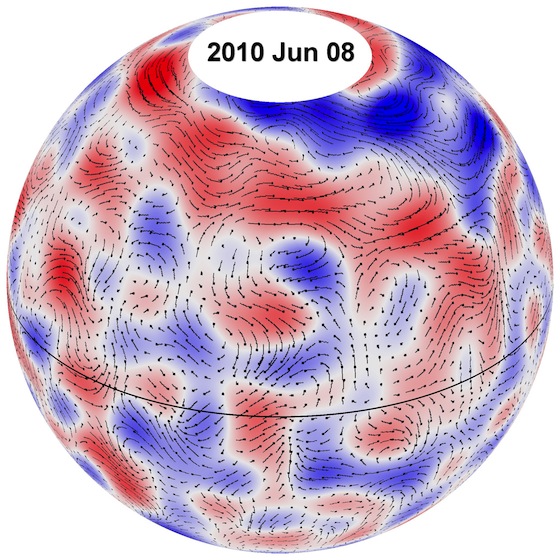
<p><em><em>An illustration of giant-cell flow trajectories in 2010. Credit: Hathaway/NASA</em></em></p>

<p>But David Hathaway, a NASA scientist whose new paper in <em>Science</em> confirms the existence of giant cells, was able to find the structures by tracking supergranules over time. Hathaway and fellow researchers used NASA&#8217;s Solar Dynamics Observatory to monitor the sun every 45 seconds for a few months. With careful averaging, they were able to determine that large groups of supergranules were being moved by an underlying presence &mdash; the long-sought giant cells.</p>
<p><q class="left">These giant cells have a very visible consequence</q></p>
<p>They may have been tough to detect, but these giant cells have a very visible consequence: they cause the equatorial region of the sun to rotate faster than the poles. The cells are also important to understanding <a href="http://www.theverge.com/2013/5/6/4304890/lights-out-why-the-us-government-is-worried-about-solar-storms">the sun&#8217;s weather</a>. &#8220;The analogy with Earth weather systems is very close,&#8221; Hathaway says. &#8220;The same way weather systems carry moisture in the Earth&#8217;s atmosphere, these things are carrying magnetic fields in the sun&#8217;s surface and interior.&#8221; Both granules and supergranules move magnetic fields around, and Hathaway thinks giant cells won&#8217;t be any different. This phenomenon may have an impact on the strength of the magnetic field at the poles of the sun, which determines how intense the 11-year solar cycle of increasing and decreasing <a href="http://www.theverge.com/2013/8/8/4601020/sun-telescope-nst-clearest-photo-sunspot">sunspots</a> is going to be.</p>

<p>Hathaway also hopes that this finding yields a better understanding of where sunspots form. &#8220;The observation we&#8217;re dying to get is whether there is any indication in these flows about where new sunspots are going to emerge,&#8221; he says. Despite several theories on where sunspots might form with respect to these giants cells, pinning down the connection between won&#8217;t be easy.</p>
<p><q class="right">&#8220;Everything interesting about the sun is related to magnetic fields.&#8221;</q></p>
<p>The next step for Hathaway and other experts will be to observe how magnetic fields respond to flows within the giant cells. &#8220;Everything interesting about the sun is related to magnetic fields &mdash; coronal heating, flares, coronal mass ejections,&#8221; Hathaway says. Pinpointing the connection between flow and magnetism would allow scientists to better predict the behavior of solar storms and how they&#8217;ll affect the solar system (like <a href="http://www.theverge.com/2013/11/18/5117312/maven-nasa-mission-to-mars-what-to-know">stripping away the Martian atmosphere</a>), the Earth, and our satellites. &#8220;What does the solar wind look like? If you do produce a flare and a coronal mass ejection, how is it going to move through the interplanetary space? All of that is given by what this magnetic field does at the surface,&#8221; Hathaway says. &#8220;I think we will get a better hand on that given the fact that we now see these flows.&#8221;</p>
						]]>
									</content>
			
					</entry>
			<entry>
			
			<author>
				<name>Alexander Thompson</name>
			</author>
			
			<title type="html"><![CDATA[Off the grid: Walgreens opens self-powered pharmacy of the future]]></title>
			<link rel="alternate" type="text/html" href="https://www.theverge.com/2013/11/26/5143202/off-the-grid-walgreens-opens-self-powered-pharmacy-of-the-future" />
			<id>https://www.theverge.com/2013/11/26/5143202/off-the-grid-walgreens-opens-self-powered-pharmacy-of-the-future</id>
			<updated>2013-11-26T10:10:53-05:00</updated>
			<published>2013-11-26T10:10:53-05:00</published>
			<category scheme="https://www.theverge.com" term="Features" /><category scheme="https://www.theverge.com" term="Report" /><category scheme="https://www.theverge.com" term="Tech" />
							<summary type="html"><![CDATA[It&#8217;s been said that sunshine is the best disinfectant, but might it also be good medicine? Walgreens is betting on it with the opening of its solar-powered drugstore of the future &#8212; America&#8217;s first dedicated retail space that generates all of the energy it needs to operate on-site. Built just north of Chicago in Evanston, [&#8230;]]]></summary>
			
							<content type="html">
											<![CDATA[

						
<figure>

<img alt="" data-caption="Walgreens net zero lead" data-portal-copyright="" data-has-syndication-rights="1" src="https://platform.theverge.com/wp-content/uploads/sites/2/chorus/uploads/chorus_asset/file/13068379/Outside.1419980116.jpg?quality=90&#038;strip=all&#038;crop=0,0,100,100" />
	<figcaption>
	Walgreens net zero lead	</figcaption>
</figure>
<p>It&rsquo;s been said that sunshine is the best disinfectant, but might it also be good medicine? Walgreens is betting on it with the opening of its solar-powered drugstore of the future &mdash; America&rsquo;s <a href="http://www.theverge.com/2013/3/12/4093090/walgreens-zero-energy-evanston-retail-store">first dedicated retail space</a> that generates all of the energy it needs to operate on-site.</p>

<p>Built just north of Chicago in Evanston, Illinois, the new &ldquo;net zero&rdquo; energy store is a sort of test bed for developing sustainable strategies that could power new drugstores going forward. To capture adequate energy &mdash; the store needs around 200,000 kWh each year &mdash; designers combined myriad different technologies. Among them are solar panels and wind turbines, as well as the use of geothermal energy and LED lighting.</p>

<p>The store will serve as an educational platform as well as a promotional tool &mdash; Walgreens has put major emphasis on making their eco-friendly status both visible and informative. All around this eco-flagship store there are placards describing the store&rsquo;s environmentally friendly features, and curious shoppers can take tours to see some of the high-tech geothermal efforts. The location of the store is in close proximity to both the Walgreens headquarters in Deerfield, Illinois as well as the Northwestern University campus, making it accessible as a learning tool for people from both places. &ldquo;It&rsquo;s a proof of concept and a pilot. It&rsquo;s also our living learning lab. Everything in the store is monitored so that we can learn from it,&rdquo; says Walgreens&#8217; manager of engineering, Jason Robins.</p>

<p>So what does a net zero store of the future look like?</p>

<div class="image-slider">
	<div class="image-slider">
		<img src="https://platform.theverge.com/wp-content/uploads/sites/2/chorus/uploads/chorus_asset/file/2800980/windowsandlights.1385423769.jpg?quality=90&#038;strip=all&#038;crop=0,0,100,100" alt="Walgreens net zero energy store in Evanston, Illinois" title="Walgreens net zero energy store in Evanston, Illinois" data-has-syndication-rights="1" data-caption="" data-portal-copyright="The store features large windows to allow in natural light, and white paint to let that light diffuse through the building. All of the artificial lighting is provided by LED, meaning the electricity requirement is much lower than it would be with typical fluorescent lights." />
<img src="https://platform.theverge.com/wp-content/uploads/sites/2/chorus/uploads/chorus_asset/file/2800970/Windmill_below.1385423767.jpg?quality=90&#038;strip=all&#038;crop=0,0,100,100" alt="Walgreens net zero energy store in Evanston, Illinois" title="Walgreens net zero energy store in Evanston, Illinois" data-has-syndication-rights="1" data-caption="" data-portal-copyright="While the sun gives the store nearly all the energy it needs, two 35-foot-tall wind turbines outside offer a little extra energy. Store designers had originally intended to make more use of the wind, but discovered that amount of solar energy they would be able to get exceeded initial expectations. The turbines now supply around 10 percent of the store’s needs. " />
<img src="https://platform.theverge.com/wp-content/uploads/sites/2/chorus/uploads/chorus_asset/file/2800972/StatTracker.1385423768.jpg?quality=90&#038;strip=all&#038;crop=0,0,100,100" alt="Walgreens net zero energy store in Evanston, Illinois" title="Walgreens net zero energy store in Evanston, Illinois" data-has-syndication-rights="1" data-caption="" data-portal-copyright="Inside, a television serves to display the energy statistics of the building and how they compare to the store’s goal of generating enough electricity to meet all energy needs. " />
<img src="https://platform.theverge.com/wp-content/uploads/sites/2/chorus/uploads/chorus_asset/file/2800976/SolarCells.1385423768.jpg?quality=90&#038;strip=all&#038;crop=7.7941176470588,0,84.411764705882,100" alt="Walgreens net zero energy store in Evanston, Illinois" title="Walgreens net zero energy store in Evanston, Illinois" data-has-syndication-rights="1" data-caption="" data-portal-copyright="The store roof is covered in 850 solar panels, which will supply Walgreens with most of the electricity it needs. The officials at Walgreens estimate that between 95 and 100 percent of their energy needs will be met by the solar panels atop the store’s distinctive, multilayered roof, sloped towards the south in order to get more direct sunlight. (Walgreens)" />
<img src="https://platform.theverge.com/wp-content/uploads/sites/2/chorus/uploads/chorus_asset/file/2800974/Sign.1385423768.jpg?quality=90&#038;strip=all&#038;crop=0,0,100,100" alt="Walgreens net zero energy store in Evanston, Illinois" title="Walgreens net zero energy store in Evanston, Illinois" data-has-syndication-rights="1" data-caption="" data-portal-copyright="Even the sign is solar powered. And as an additional eco-friendly measure, landscaping is comprised of species native to the area, meaning these plants require only rainwater without additional watering to flourish." />
<img src="https://platform.theverge.com/wp-content/uploads/sites/2/chorus/uploads/chorus_asset/file/2800978/ribboncutting.1385423768.jpg?quality=90&#038;strip=all&#038;crop=0,0,100,100" alt="Walgreens net zero energy store in Evanston, Illinois" title="Walgreens net zero energy store in Evanston, Illinois" data-has-syndication-rights="1" data-caption="" data-portal-copyright="Several Walgreens officials and dignitaries, including the mayor of Evanston, Elizabeth Tisdahl, cut a ribbon using novelty-sized scissors." />
<img src="https://platform.theverge.com/wp-content/uploads/sites/2/chorus/uploads/chorus_asset/file/2800982/pipes.1385423778.jpg?quality=90&#038;strip=all&#038;crop=0,0,100,100" alt="Walgreens net zero energy store in Evanston, Illinois" title="Walgreens net zero energy store in Evanston, Illinois" data-has-syndication-rights="1" data-caption="" data-portal-copyright="The geothermal pipes tap 550 feet into the ground below for a constant temperature source — about 53 degrees Fahrenheit. These pipes can be tapped in the summer for cooling or the winter for heating." />
<img src="https://platform.theverge.com/wp-content/uploads/sites/2/chorus/uploads/chorus_asset/file/2800994/Piperoom.1385423781.jpg?quality=90&#038;strip=all&#038;crop=0,0,100,100" alt="Walgreens net zero energy store in Evanston, Illinois" title="Walgreens net zero energy store in Evanston, Illinois" data-has-syndication-rights="1" data-caption="" data-portal-copyright="The geothermal piping, as well as heating and cooling pipes, are displayed in a room overlooking the store. The geothermal pipes are integrated with the heating and cooling systems, which reduce overall power consumption." />
<img src="https://platform.theverge.com/wp-content/uploads/sites/2/chorus/uploads/chorus_asset/file/2800988/nissanleaf.1385423780.jpg?quality=90&#038;strip=all&#038;crop=0,0,100,100" alt="Walgreens net zero energy store in Evanston, Illinois" title="Walgreens net zero energy store in Evanston, Illinois" data-has-syndication-rights="1" data-caption="" data-portal-copyright="There are two parking spots reserved for electric vehicles. Walgreens was making use of the charging station with its own security car, a Nissan Leaf." />
<img src="https://platform.theverge.com/wp-content/uploads/sites/2/chorus/uploads/chorus_asset/file/2800990/bladeLEDs.1385423781.jpg?quality=90&#038;strip=all&#038;crop=0,0,100,100" alt="Walgreens net zero energy store in Evanston, Illinois" title="Walgreens net zero energy store in Evanston, Illinois" data-has-syndication-rights="1" data-caption="" data-portal-copyright="The beauty section of the store features distinctive, blade-shaped LED light fixtures. The plastic blades contain micro-optics that redirect the light to shine on the shelves rather than the floor." />
<img src="https://platform.theverge.com/wp-content/uploads/sites/2/chorus/uploads/chorus_asset/file/2800986/batterykiosk.1385423781.jpg?quality=90&#038;strip=all&#038;crop=0,4.3624161073826,100,91.275167785235" alt="Walgreens net zero energy store in Evanston, Illinois" title="Walgreens net zero energy store in Evanston, Illinois" data-has-syndication-rights="1" data-caption="" data-portal-copyright="The store prominently displays a kiosk for dropping off old batteries of various chemistries — alkaline, nickel-metal hydride, and lithium. It is rare to see anyone willing to recycle alkaline batteries — even Duracell &lt;a href=&quot;http://www.duracell.com/en-us/battery-care-and-disposal/disposing-of-general-purpose-and-alkaline-batteries&quot;&gt;recommends you simply throw them in the trash&lt;/a&gt;." />
	</div>
</div>
<p><br id="1385424775655"></p>
						]]>
									</content>
			
					</entry>
			<entry>
			
			<author>
				<name>Alexander Thompson</name>
			</author>
			
			<title type="html"><![CDATA[Walgreens net zero energy store in Evanston, Illinois]]></title>
			<link rel="alternate" type="text/html" href="https://www.theverge.com/2013/11/26/5145746/walgreens-net-zero-energy-store-in-evanston-illinois" />
			<id>https://www.theverge.com/2013/11/26/5145746/walgreens-net-zero-energy-store-in-evanston-illinois</id>
			<updated>2013-11-26T10:10:42-05:00</updated>
			<published>2013-11-26T10:10:42-05:00</published>
			<category scheme="https://www.theverge.com" term="Tech" />
			
							<content type="html">
									</content>
			
					</entry>
			<entry>
			
			<author>
				<name>Alexander Thompson</name>
			</author>
			
			<title type="html"><![CDATA[MAVEN takes off: what you need to know about NASA’s new mission to Mars]]></title>
			<link rel="alternate" type="text/html" href="https://www.theverge.com/2013/11/18/5117312/maven-nasa-mission-to-mars-what-to-know" />
			<id>https://www.theverge.com/2013/11/18/5117312/maven-nasa-mission-to-mars-what-to-know</id>
			<updated>2013-11-18T10:32:02-05:00</updated>
			<published>2013-11-18T10:32:02-05:00</published>
			<category scheme="https://www.theverge.com" term="NASA" /><category scheme="https://www.theverge.com" term="Report" /><category scheme="https://www.theverge.com" term="Science" /><category scheme="https://www.theverge.com" term="Space" />
							<summary type="html"><![CDATA[The idea of humans one day colonizing Mars is a tantalizing one, but there are some obvious obstacles to our long-term residency on the red planet. Chief among them? The absence of water. Research has established that Mars used to have liquid water on its surface, but now it&#8217;s a dry, dusty, inhospitable desert. Today, [&#8230;]]]></summary>
			
							<content type="html">
											<![CDATA[

						
<figure>

<img alt="" data-caption="NASA Maven" data-portal-copyright="" data-has-syndication-rights="1" src="https://platform.theverge.com/wp-content/uploads/sites/2/chorus/uploads/chorus_asset/file/14530035/maven-final-use.1419980094.png?quality=90&#038;strip=all&#038;crop=0,0,100,100" />
	<figcaption>
	NASA Maven	</figcaption>
</figure>
<p>The idea of humans one day colonizing Mars is a tantalizing one, but there are some obvious obstacles to our long-term residency on the red planet. Chief among them? The absence of water. Research has established that <a href="http://www.theverge.com/2013/11/13/5101278/what-mars-looked-like-4-billion-years-ago-nasa">Mars used to have liquid water</a> on its surface, but now it&#8217;s a dry, dusty, inhospitable desert.</p>

<p>Today, NASA will launch a new mission &mdash; one that cost $671 million and has been in development for 10 years &mdash; to determine what happened to the water on Mars. The Curiosity rover has given us some insight into the conundrum, such as confirming that Mars used to host liquid water by <a href="http://www.theverge.com/2012/9/27/3419724/nasa-curiosity-rover-mars-water-stream">spotting visible stream beds</a>. Curiosity also established, via chemical analysis, that water still exists in Martian soil. It could be that some of the missing water has been absorbed into the soil or simply frozen. But scientists are intrigued by another possibility &mdash; water on Mars may have evaporated and been lost to space.</p>
<p><q class="left">Water on Mars may have evaporated and been lost to space</q></p>
<p>The agency will now investigate that exact hypothesis with a new probe, called MAVEN, which will orbit around our red neighbor. MAVEN stands for Mars Atmosphere and Volatile EvolutioN, and as the name implies, MAVEN&#8217;s mission is to characterize the Martian atmosphere. Researchers will use the data gathered by MAVEN to construct a history of the climate on Mars and paint a picture of how Mars lost its water.</p>

<p>Of course, this is no simple task. &#8220;It keeps you up at night,&#8221; says Janet Luhmann, the deputy principal investigator of the MAVEN project. Luhmann is excited about how this mission will further our knowledge of Mars, but the exuberance at what she hopes MAVEN will reveal is tempered by the costs of bringing the project to fruition. &#8220;It&#8217;s an investment financially. It&#8217;s an investment in human energy and effort, and you want to make sure it succeeds, so it&#8217;s stressful.&#8221;</p>

<p>Weather permitting, MAVEN will launch today at 1:28PM ET from Cape Canaveral in Florida. So what does it take in order to peer into the distant past of the Martian atmosphere?</p>
<h2 class="wp-block-heading" id="the-mission">The mission</h2><p><img src="http://cdn0.sbnation.com/assets/3590695/mavenparts.png" class="photo" alt="Mavenparts"><br id="1384782984846"></p>
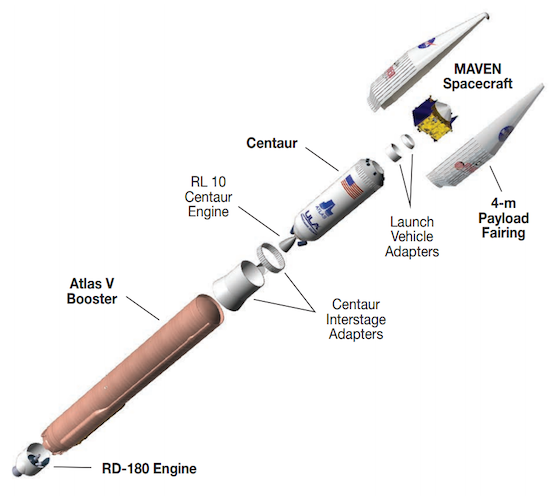
<p>The MAVEN mission is an exercise in collaboration, and the instruments onboard reflect that fact. The devices necessary for the venture have been provided by three different groups &mdash; the University of California, Berkeley; the University of Colorado; and NASA&#8217;s Goddard Space Flight Center. And each of these groups will use data provided by the equipment to glean insights into long-lost Martian water.</p>

<p>An Atlas V rocket will blast the nearly 3-ton MAVEN probe into space. Once MAVEN&#8217;s solar arrays are fully extended, the craft will be as long as a school bus. When it arrives on Mars, it won&#8217;t travel in a traditional circular orbit that would keep MAVEN at a constant distance from the planet. Instead, MAVEN will orbit in an elliptical path that will alternately bring it close to and far from the planet. At its furthest point from Mars, MAVEN will be 3,900 miles away in order to better measure the effects of the sun. MAVEN&#8217;s elliptical orbit will also bring it within 93 miles of the planet to characterize the upper atmosphere. In addition to these regular close sweeps, MAVEN will perform five &#8220;deep dives&#8221; where it will dip even further &mdash; 78 miles from the surface &mdash; to profile the atmosphere at a lower altitude.</p>
<p><q class="right">A holistic picture of the Martian atmosphere</q></p>
<p>The probe contains a suite of instruments that will give researchers a holistic picture of the Martian atmosphere, how it changes, and the role the sun has played in removing the planet&#8217;s atmosphere: scientists think there&#8217;s an important, but complex, relationship between the loss of water on Mars and other atmospheric gases and solar activity. MAVEN&#8217;s instruments will characterize the gases and ions that are leaving the planet, and determine the extent to which these losses are due to energetic particles in solar wind &mdash; essentially <a href="http://www.theverge.com/2013/10/24/5024520/nasa-video-captures-breathtaking-canyon-of-fire-on-the-surface-of-the">a spew of material</a> emitted by the sun &mdash; kicking the gases out of the atmosphere.</p>

<p>The Earth is largely protected from these events due to strong magnetic fields from its iron core, but Mars has a much weaker magnetic field, making the planet more susceptible to the effects of solar storms. Researchers speculate that when the Martian atmosphere is hit with solar wind, some of its gases are removed. That drier atmosphere then creates a driving force for water to evaporate. If scientists can track the evolution of the atmosphere, and corresponding solar activity, over the yearlong mission, they might be able to project the state of the atmosphere back in time to test the hypothesis as an explanation for Mars&#8217; loss of water.</p>

<p>That tracking remains a ways off: it will take about 10 months for the probe to arrive at the red planet, and researchers hope to start gathering useful information around November of 2014. But the mission could have taken much longer to get moving: the recent US government shutdown threatened MAVEN&#8217;s launch window, meaning NASA would have had to wait for the planets to align, so to speak, to select another departure date.</p>
<h2 class="wp-block-heading" id="the-payoff">The payoff</h2><p><img alt="Mars_before_and_after" class="photo" src="http://cdn2.sbnation.com/assets/3590703/Mars_before_and_after.png"><br id="1384783059639"></p>
<p><em><em>Mars today, shown at left, is dry and inhospitable. But as indicated in the right, the planet may once have been a much more watery place.</em></em></p>

<p>The MAVEN mission is expected to change how we think of and interact with Mars, both in the near and long term. Having another satellite orbiting the planet will immediately aid other Mars-oriented research. MAVEN contains a relay, for instance, that will increase the data-transfer capabilities of missions like Curiosity and <a href="http://www.theverge.com/2012/8/20/3256303/insight-lander-mars-geology-2016">the InSight lander</a>, expected to launch in 2016 with plans to probe for seismic activity.</p>
<p><q class="left">How to one day colonize the Red Planet</q></p>
<p>This research will also aid investigators as they continue to study exoplanets. Teams <a href="http://www.theverge.com/2013/11/4/5064830/earth-size-planets-habitable-zones-research">have been scouting for planets</a> that orbit in the not-too-hot, not-too-cold region around our sun called the habitable zone, in hopes of finding planets that may harbor life. However, while there are three planets around our sun considered to be in this zone, only Earth &mdash; and not Venus or Mars &mdash; seems to harbor life. Learning more from Mars will help scientists understand why, and offer them new clues as they hunt for life across the universe.</p>

<p>MAVEN might also help us figure out how to one day colonize the Red Planet. When asked about a far-off future where we might terraform the thin Martian atmosphere to be breathable, Luhmann speculates that Mars&#8217; atmospheric history will make that impractical. Instead, humans may live in biospheres and produce a local atmosphere within them. &#8220;I think a limited, controlled, enclosed environment would be the way you would have to go,&#8221; Luhmann says. &#8220;Doing the whole planet is science fiction.&#8221;</p>
<p><q class="right">&#8220;Part of the treasure trove of the science of humankind.&#8221;</q></p>
<p>For those keen to track MAVEN&#8217;s progress, NASA will be posting to <a href="https://twitter.com/MAVEN2Mars">Twitter</a>, allowing anyone to follow the project as a spectator. And scientists are hoping to see more active citizen involvement too: the data gathered by MAVEN will be released to the public through their <a href="http://pds.nasa.gov/">Planetary Data System</a> portal. &#8220;We&#8217;re going to make unique measurements and have a unique dataset that will be part of the treasure trove of the science of humankind,&#8221; Luhmann says. &#8220;The rewards are potentially huge. The rewards are ultimately that you&#8217;re going to increase human understanding [of the universe] forever.&#8221;</p>
						]]>
									</content>
			
					</entry>
			<entry>
			
			<author>
				<name>Alexander Thompson</name>
			</author>
			
			<title type="html"><![CDATA[Violence gone viral: new study plots how crime spreads like a disease]]></title>
			<link rel="alternate" type="text/html" href="https://www.theverge.com/2013/11/15/5107876/social-network-and-risk-of-getting-shot" />
			<id>https://www.theverge.com/2013/11/15/5107876/social-network-and-risk-of-getting-shot</id>
			<updated>2013-11-15T11:59:23-05:00</updated>
			<published>2013-11-15T11:59:23-05:00</published>
			<category scheme="https://www.theverge.com" term="Report" /><category scheme="https://www.theverge.com" term="Science" />
							<summary type="html"><![CDATA[When gun violence makes the news, it&#8217;s often described as an&#160;epidemic, implying that the violence is out of control on a massive scale, akin to a rampant disease. The term is used largely as a buzzword &#8212; but new research out of Yale University suggests that there&#8217;s more than just a semantic connection between gun [&#8230;]]]></summary>
			
							<content type="html">
											<![CDATA[

						
<figure>

<img alt="" data-caption="guns (shutterstock nomad_soul)" data-portal-copyright="" data-has-syndication-rights="1" src="https://platform.theverge.com/wp-content/uploads/sites/2/chorus/uploads/chorus_asset/file/14527045/guns1_1020.1419980091.jpg?quality=90&#038;strip=all&#038;crop=0,0,100,100" />
	<figcaption>
	guns (shutterstock nomad_soul)	</figcaption>
</figure>
<p>When gun violence makes the news, it&#8217;s often described as an&nbsp;<a href="http://www.theverge.com/2013/1/12/3867398/joe-biden-video-game-industry-statement">epidemic</a>, implying that the violence is out of control on a massive scale, akin to a rampant disease. The term is used largely as a buzzword &mdash; but new research out of Yale University suggests that there&#8217;s more than just a semantic connection between gun violence and the behavior of diseases.</p>
<p><!-- extended entry --></p><hr class="widget_boundry_marker hidden page_break">
<p>Stray bullets, while tragic, are relatively rare &mdash; meaning you can&#8217;t exactly &#8220;catch a bullet&#8221; the way you would an airborne disease, explains study leader Andrew Papachristos, an associate professor of sociology at Yale. Rather, &#8220;the vast majority of gun violence, the everyday violence that we see in our streets, is actually passed on person to person, much more like a blood-borne pathogen.&#8221; The idea behind Papachristos&#8217; study, essentially, is that if you spend time with people who have been shot, carry a gun, or engage in risky behaviors, your own risk of being shot increases.</p>
<p><q class="right">You can&#8217;t exactly &#8216;catch a bullet.&#8217;</q></p>
<p>The study, published this week in the&nbsp;<a href="http://ajph.aphapublications.org/doi/abs/10.2105/AJPH.2013.301441?prevSearch=papachristos&amp;searchHistoryKey="><em>American Journal of Public Health</em></a>, pulled public arrest and homicide records to look at a social network of people who were linked by being arrested together for the same crime &mdash; indicating that they tend to be involved in risky activities, and share social connections with others who do the same (you&#8217;re more likely to rob a bank with someone you know well, for instance, than a complete stranger). The data was taken from a six-square-mile, high-crime area in Chicago.</p>
<p><img alt="Arrest_network" class="photo" src="http://cdn0.sbnation.com/assets/3576465/arrest_network.PNG"><br id="1384532245457"></p>
<p><em><em>The arrest network of the study&#8217;s Chicago neighborhood. Homicide victims are shown in black, with many connected in a large cluster.</em></em></p>

<p>While it may seem that gun violence and its victims are spread randomly, Papachristos&#8217; network analysis shows that much of the violence is highly concentrated. In Chicago, the homicide rate is around 14.7 deaths per 100,000 people, and the neighborhood in the study has a rate of 55.2. Just being arrested increases the rate of being killed by a gun by almost 50 percent. While these numbers are high, geography and being arrested don&#8217;t tell the whole story about one&#8217;s risk of being shot. By simply being connected to a homicide victim via this network, a person&#8217;s risk of dying at the hand of a gun rockets up 900 percent.</p>
<p><q class="left">A person&#8217;s risk of dying &#8230; rockets up 900 percent</q></p>
<p>Looked at another way, the largest group of people that are connected to one another via this arrest network contains just 4 percent of the people in the neighborhood &mdash; and yet represents 41 percent of the homicide victims for the area. Additionally, there are many smaller clusters in the arrest network that also contain homicide victims. The violence in this neighborhood is concentrated to a small fraction of the people who share these particular social connections and risky behaviors. However, the risk for becoming a victim in this network is not uniform. As the degrees of separation between an individual and a homicide victim increase, the risk of becoming a victim decreases: each additional connection separating the two individuals lowers one&#8217;s risk by 57 percent.</p>

<p>It seems simple in hindsight: your risk of being shot increases if you know someone else who&#8217;s been shot. But according to John Hollywood, a crime researcher at RAND Corporation, the research &#8220;could be a really useful contribution&#8221; towards preventing gun-related violence. &#8220;It was just good to see that some people have an idea and they go outside the box,&#8221; Hollywood said. &#8220;And in this case, going outside the box really paid off.&#8221;</p>
<p><q class="right">&#8220;You&#8217;re aware you&#8217;re at risk. What are you going to do?&#8221;</q></p>
<p>In fact, the findings are already being used by Chicago law enforcement to track networks of people at risk and offer educational interventions. &#8220;The typical reaction is that they are riveted,&#8221; Papachristos said of those alerted by the Chicago Police Department. &#8220;What it does is it kind of gives them a little warning that says &lsquo;You&#8217;ve got to be careful. There&#8217;s shooting going on around you, and you should probably be aware of it.'&#8221;</p>

<p>For Papachristos, data like this offers the opportunity for proactive interventions &mdash; in the same way that public health experts can intervene to mitigate the spread of illness. &#8220;You can condemn certain behaviors,&#8221; he said, likening the scenario to the spread of HIV. &#8220;Or you can figure out how to get clean needles, condoms, and education to the people who are most at risk.&#8221; At the very least, Papachristos points out, more information makes people aware of their choices. &#8220;You&#8217;re aware you&#8217;re at risk,&#8221; he said. &#8220;What are you going to do?&#8221;</p>
						]]>
									</content>
			
					</entry>
			<entry>
			
			<author>
				<name>Alexander Thompson</name>
			</author>
			
			<title type="html"><![CDATA[The Milky Way might harbor 20 billion Earth-sized planets]]></title>
			<link rel="alternate" type="text/html" href="https://www.theverge.com/2013/11/4/5064830/earth-size-planets-habitable-zones-research" />
			<id>https://www.theverge.com/2013/11/4/5064830/earth-size-planets-habitable-zones-research</id>
			<updated>2013-11-04T15:05:03-05:00</updated>
			<published>2013-11-04T15:05:03-05:00</published>
			<category scheme="https://www.theverge.com" term="Report" /><category scheme="https://www.theverge.com" term="Science" />
							<summary type="html"><![CDATA[Gazing up at the stars is something of a shared human experience. We look and we wonder. Are those stars like ours? Do they have planets around them? Are we alone? While ET hasn&#8217;t phoned home yet, a new study from astronomers at the University of California at Berkeley and the University of Hawaii at [&#8230;]]]></summary>
			
							<content type="html">
											<![CDATA[

						
<figure>

<img alt="" data-caption="Habitable zones" data-portal-copyright="" data-has-syndication-rights="1" src="https://platform.theverge.com/wp-content/uploads/sites/2/chorus/uploads/chorus_asset/file/14513343/habitable-zones.1419980055.png?quality=90&#038;strip=all&#038;crop=0,0,100,100" />
	<figcaption>
	Habitable zones	</figcaption>
</figure>
<p>Gazing up at the stars is something of a shared human experience. We look and we wonder. Are those stars like ours? Do they have planets around them? Are we alone? While ET hasn&#8217;t phoned home yet, a new study from astronomers at the University of California at Berkeley and the University of Hawaii at Manoa sheds light on how many planets could resemble our own.</p>
<p><!-- extended entry --></p><hr class="widget_boundry_marker hidden page_break">
<p>Finding Earth-sized planets that are in an Earthlike orbit is a challenge. The larger a planet is and the closer it is to a star, the <a href="http://www.theverge.com/2013/6/25/4462744/habitable-planets-more-common-certain-solar-systems">easier</a> it is to detect. So it isn&#8217;t a <a href="http://www.theverge.com/2012/12/19/3784860/researchers-find-five-planets-around-tau-ceti-one-in-habitable-zone">surprise</a> that some of the first exoplanets found were gas giants, such as Jupiter, that were fairly close to their star. But scientists have gotten better at spotting planets outside of our solar system. In large part, they do this by detecting when a planet moves in front of its star, which causes the light from that star to dim. A larger planet, or one closer to its host star, will yield a more pronounced drop in light.</p>
<p><q class="left">Spotting planets outside of our solar system</q></p>
<p>Unfortunately, Earth-sized planets are relatively small and won&#8217;t block much light from a star. And while scientists have just identified an <a href="http://www.theverge.com/2013/10/30/5044096/exoplanet-kepler-78b-discovery">Earth-sized planet</a> with an Earthlike composition, that planet isn&#8217;t in what&#8217;s known as the habitable zone &mdash; it&#8217;s too hot for life. The habitable zone is the not-too-hot, not-too-cold distance from a star where water can exist in liquid form.</p>

<p>In their new study, scientists wanted to find out how many planets are the size of Earth and orbit in the habitable zone of their sunlike stars. To do that, they created a computer program to analyze starlight gathered by the <a href="http://www.theverge.com/2013/4/22/4244122/forever-alone-nasa-kepler-spacecraft-hunts-other-earths-expolanets">Kepler space observatory</a>, in an effort to find the characteristic dimming of planets crossing in front of their stars.</p>
<p><q class="right">For every planet researchers do see, there could be 100 more</q></p>
<p>Of the 42,000 stars analyzed, researchers detected only 10 that harbored Earth-sized planets. While this may seem disappointingly small, these few planets actually point to a host of other, undetected ones. As it turns out, most planets will not cross in front of their star, so this dimming is uncommon. For every planet researchers do see, there could be 100 more in orbits that keep them hidden. And that&#8217;s not the only way the planets are undercounted.</p>

<p>In an effort to boost the accuracy of their estimation, the team then created a test set of &#8220;mock&#8221; dimmings &mdash; essentially allowing them to distinguish between how many planets their program should find and how many it actually did. They concluded that the program only isolates a small number of dimmings, meaning that the 10 Earthlike planets directly detected may represent over 9,000 similarly sized planets in habitable zones. &#8220;The high abundance of Earth-sized planets appears to be a general feature of nature,&#8221; says lead study author Erik Petigura. &#8220;With about 100 billion stars in our Milky Way galaxy, that&#8217;s about 20 billion such planets.&#8221;</p>
<p><q class="center">&#8220;The high abundance of Earth-sized planets appears to be a general feature of nature.&#8221;</q></p>
<p>Of course, being both Earth-sized and within the habitable zone aren&#8217;t the only factors that matter. &#8220;Some significant share of those planets are going to be uninhabitable for lots of different reasons,&#8221; says study co-author Andrew Howard. A planet might be uninhabitable because of a gas-giant composition or an elliptical orbit, for instance. This latest research, however, ensures scientists will have plenty of planets to study more closely.</p>
						]]>
									</content>
			
					</entry>
			<entry>
			
			<author>
				<name>Alexander Thompson</name>
			</author>
			
			<title type="html"><![CDATA[Scientists discover Earth’s fiery doppelganger]]></title>
			<link rel="alternate" type="text/html" href="https://www.theverge.com/2013/10/30/5044096/exoplanet-kepler-78b-discovery" />
			<id>https://www.theverge.com/2013/10/30/5044096/exoplanet-kepler-78b-discovery</id>
			<updated>2013-10-30T14:05:03-04:00</updated>
			<published>2013-10-30T14:05:03-04:00</published>
			<category scheme="https://www.theverge.com" term="Report" /><category scheme="https://www.theverge.com" term="Science" />
							<summary type="html"><![CDATA[The sci-fi worlds of Star Wars and Star Trek have trained us to think there are rocky, solid planets orbiting far away stars that are so similar to Earth we could walk upright and breathe their atmosphere. In reality, scientists have yet to identify a single planet outside of our solar system that&#8217;s comparable to [&#8230;]]]></summary>
			
							<content type="html">
											<![CDATA[

						
<figure>

<img alt="" data-caption="Kepler 78-b" data-portal-copyright="" data-has-syndication-rights="1" src="https://platform.theverge.com/wp-content/uploads/sites/2/chorus/uploads/chorus_asset/file/14506870/kepler-use.1419980040.png?quality=90&#038;strip=all&#038;crop=0,0,100,100" />
	<figcaption>
	Kepler 78-b	</figcaption>
</figure>
<p>The sci-fi worlds of <em>Star Wars</em> and <em>Star Trek</em> have trained us to think there are rocky, solid planets orbiting far away stars that are so similar to Earth we could walk upright and breathe their atmosphere. In reality, scientists have yet to identify a single planet outside of our solar system that&#8217;s comparable to the size and composition of Earth.</p>

<p>Until now, that is.</p>
<p><!-- extended entry --></p><hr class="widget_boundry_marker hidden page_break">
<p>Two independent research groups, reporting in <em>Nature</em>, have found that a far-off planet, Kepler-78b, has a similar mass and composition to Earth. While previous observations of Kepler-78b had estimated the size of the planet to be 1.2 times wider than Earth, these latest measurements focused on observing the gravitational interactions between the planet and its star. The result? Researchers can combine the previously known size of the planet with the newly measured mass to determine its makeup.</p>
<p><q class="left">The gravitational interactions between the planet and its star</q></p>
<p>Of course a star has a strong gravitational pull on a planet &mdash; that&#8217;s why planets orbit stars. But planets also exert a gravitational force on their host star, causing a small wobble in the star&#8217;s position. This wobble can be seen as a change in the wavelength of the light coming from the star, which is analogous to the change in sound of a train passing you &mdash; the pitch drops (the wavelength changes) because of the motion of the train. Researchers used this wobble to conclude that Kepler-78b has a mass 1.69 times larger than that of Earth. The combination of the size and mass of the planet yields the planet&#8217;s density, allowing researchers to determine what combination of materials comprise the planet. The density of Kepler-78b, they found, corresponds to an Earth-like makeup of rock and iron.</p>
<p><q class="right">An Earthlike makeup of rock and iron</q></p>
<p>&#8220;Having a planet made largely of rock and iron, like our Earth, means that we have a good surface for life to evolve on,&#8221; says Andrew Howard, one of the researchers behind <a href="http://www.nature.com/doifinder/10.1038/nature12768">the new findings</a>. Unfortunately, the composition of Kepler-78b doesn&#8217;t necessarily make it hospitable to life. &#8220;From an Earth-centric perspective, we&#8217;d like to have liquid water on the surface [and] this planet is obviously way too hot.&#8221;</p>
<p>Indeed, Kepler-78b is about 100 times closer to its star than we are to the sun, and it orbits the star in a blazingly fast 8.5 hours. As a consequence, the planet&#8217;s surface temperature is somewhere between 3700 and 5100&ordm;F. That heat, combined with huge amounts of UV radiation, means the planet could not support an Earthlike atmosphere, nor any liquid surface water. &#8220;It&#8217;s probably a lava planet, so the surface is just red lava flowing. It&#8217;s completely different [from Earth],&#8221; said Francesco Pepe, lead author of <a target="_blank" href="http://www.nature.com/doifinder/10.1038/nature12767">the second study</a>. &#8220;The sun would occupy half of the sky.&#8221;</p><p><q class="left">&#8220;The surface is just red lava flowing.&#8221;</q></p>
<p>Kepler-78b might not be habitable, but scientists aren&#8217;t done studying the mysterious planet. &#8220;We have now more questions we have to answer,&#8221; Pepe says, noting that the particular geometry of this planet&ndash;star pair remains puzzling. &#8220;Theories cannot really explain why this planet did not fall into the star at some point.&#8221;</p>

<p>The planet might also help find answers for broader questions in the search for exoplanets. Scientists continue to wonder, for instance, whether an iron and rock composition is the rule or an exception for Earth-sized planets. To help address these questions, NASA has <a href="http://www.theverge.com/2013/4/6/4189952/nasa-launches-tess-nicer-missions-to-find-new-planets">a planned mission in 2017</a> that will provide better tools for finding more exoplanets and will help put planets like Kepler-78b and Earth in context.</p>
						]]>
									</content>
			
					</entry>
			<entry>
			
			<author>
				<name>Alexander Thompson</name>
			</author>
			
			<title type="html"><![CDATA[Math matters: how big data is building the future of everything]]></title>
			<link rel="alternate" type="text/html" href="https://www.theverge.com/2013/9/26/4766486/materials-genome-initiative-mit-and-harvard" />
			<id>https://www.theverge.com/2013/9/26/4766486/materials-genome-initiative-mit-and-harvard</id>
			<updated>2013-09-26T10:25:06-04:00</updated>
			<published>2013-09-26T10:25:06-04:00</published>
			<category scheme="https://www.theverge.com" term="Report" /><category scheme="https://www.theverge.com" term="Science" />
							<summary type="html"><![CDATA[New materials lead to new innovations. Gorilla Glass is a big selling point for smartphones. Kevlar saves lives and has worked its way into consumer products. Lithium-ion batteries have enabled a host of energy-storage applications, from planes to cars to computers. But there&#8217;s a problem. Actually creating a new, game-changing material is a glacially slow [&#8230;]]]></summary>
			
							<content type="html">
											<![CDATA[

						
<figure>

<img alt="" data-caption="Materials Genome Initiative" data-portal-copyright="" data-has-syndication-rights="1" src="https://platform.theverge.com/wp-content/uploads/sites/2/chorus/uploads/chorus_asset/file/14466045/bigmaterials.1419979932.png?quality=90&#038;strip=all&#038;crop=0,0,100,100" />
	<figcaption>
	Materials Genome Initiative	</figcaption>
</figure>
<p>New materials lead to new innovations. Gorilla Glass is a big selling point for smartphones. Kevlar saves lives and has worked its way into consumer products. Lithium-ion batteries have enabled a host of energy-storage applications, from planes to cars to computers. But there&#8217;s a problem.</p>

<p>Actually creating a new, game-changing material is a glacially slow process &mdash; especially when compared to the rate at which new products relying on those materials hit the market. It took just under nine years for the Boeing 787 Dreamliner to go from a concept to commercial flight. The development of the iPhone began in 2005; the phone was on store shelves by 2007. In contrast, the creation of new materials moves far more slowly, taking about 20 years for all of the necessary research and development.</p>
<p><!-- extended entry --></p><hr class="widget_boundry_marker hidden page_break"><p><q class="left">An attempt to gain a deeper understanding of how the elements interact</q></p>
<p>In an effort to overcome this innovation bottleneck, the White House two years ago announced the <a href="http://www.whitehouse.gov/mgi">Materials Genome Initiative</a>. The venture aims to halve development time for new materials and slash the monetary investment required. And if the name sounds familiar, it should: in the same way the Human Genome Project set out to map the underlying structure of human genes, the Materials Genome Initiative is an attempt to gain a deeper understanding of how the elements interact to give us a diverse set of materials and materials properties. With that foundation of knowledge, scientists and engineers will hopefully be able to create new materials tuned to the exact properties needed for a particular application &mdash; and be able to do it much, much faster.</p>
<p><img alt="Cep_logo_480x167" class="photo" src="http://cdn0.sbnation.com/assets/3279279/CEP_logo_480x167.png"><br id="1380044141286"></p>
<p>A huge number of atomic combinations and arrangements may have useful properties. However, most arrangements won&#8217;t be useful, or even able to be synthesized. Trying to explore the vast world of potential materials in a lab would be both impractical and just plain impossible. So to map out that enormous number of possible materials, several research groups working on the Materials Genome Initiative are using computers to model known and unknown materials. They mine the resulting data to find areas that deserve a more careful examination.</p>

<p>In <a href="http://www.whitehouse.gov/blog/2013/06/24/two-years-later-bold-new-steps-materials-genome-initiative">the years since its inception</a>, the initiative has brought together several successful ventures. Among them are the <a href="https://materialsproject.org/">Materials Project</a> at MIT and the <a href="http://www.molecularspace.org/">Harvard Clean Energy Project</a>. These two projects have similar theoretical underpinnings for different end goals. MIT&#8217;s Materials Project is focused on inorganic solids, especially those for battery materials, while the Clean Energy Project is examining molecules for solar cell applications. Both are powered by huge databases that are populated with information gleaned from Density Functional Theory (DFT) calculations. DFT uses quantum mechanics to predict many properties of the real, physical substances being modeled.</p>
<p><q class="left">A dataset of over 100,000 known and theoretical materials</q></p>
<p>MIT&#8217;s Materials Project started about eight years ago, and was catalyzed by the work of Professor Gerbrand Ceder. As a consultant to several companies, Ceder would screen a large number of materials for particular applications. But working with individual companies left the data siloed and locked up. &#8220;People would be able to do really creative things with this if we gave this to the world, and this became Materials Project,&#8221; he says. Now, MIT&#8217;s dataset consists of over 100,000 known and theoretical materials. To make sense of the data and design new materials, MIT researchers use a combination of human intuition and machine learning designed to understand the laws of chemistry.</p>

<p>Similarly, the Harvard Clean Energy Project has created a huge database that can be explored by man and machine for potential solutions to materials problems. The venture started as a small proof of concept examining potential organic solar cell materials. Researchers calculated the properties of about 15 compounds to predict how well these new substances might perform in the real world without having to synthesize them first. These calculations eventually yielded a new compound with near record-breaking electrical properties. But that success was just from a few chemicals calculated by a single graduate student. What could be discovered if you increased available computing power by distributing the calculations to an army of volunteers?</p>
<p><q class="center">Researchers have calculated millions of potential solar cell compounds</q></p>
<p>Today, the Harvard Clean Energy Project is doing just that: anyone across the globe can download a program that performs scientific calculations on their PCs and reports back the results. With this massive resource at their disposal, researchers have calculated millions of potential solar cell compounds &mdash; and they&#8217;re only getting started. &#8220;Right now is an interesting time for the project,&#8221; says Dr. Hachmann, a research associate involved in the Harvard project. &#8220;We are at the point where we can harvest the fruits of our hard work and hopefully get some nice results.&#8221;</p>

<p>Currently, Harvard investigators have released <a href="https://cepdb.molecularspace.org/">2.3 million compounds online</a> for anyone to search through. And while these compounds have been calculated with solar cells in mind, other scientists who mine the data will be able to use the information to research other classes of materials. Similarly, researchers working on MIT&#8217;s Materials Project have an <a href="https://materialsproject.org/apps/materials_explorer/">online portal</a> for anyone to explore their data.</p>
<p><q class="right">&#8220;You cannot anticipate what people will do with it.&#8221;</q></p>
<p>The greater Materials Genome Initiative aims to reduce costs and time for material development, and Ceder hopes to see it accomplish that bold goal. In fact, he&#8217;s already seen it work: Ceder is in the process of patenting new materials for use in batteries, a big win for the burgeoning Initiative and the field of materials discovery. And with heaps of data being shared in online databases, those successes are likely to keep coming. Ceder hopes to see the Materials Genome Initiative will lead to big innovations in materials science in the same, unpredictable way the web transformed many facets of modern life. &#8220;When you make stuff like this available,&#8221; he says, &#8220;you cannot anticipate what people will do with it.&#8221;</p>
						]]>
									</content>
			
					</entry>
	</feed>