<?xml version="1.0" encoding="UTF-8"?><feed
	xmlns="http://www.w3.org/2005/Atom"
	xmlns:thr="http://purl.org/syndication/thread/1.0"
	xml:lang="en-US"
	>
	<title type="text">Ben Popper | The Verge</title>
	<subtitle type="text">The Verge is about technology and how it makes us feel. Founded in 2011, we offer our audience everything from breaking news to reviews to award-winning features and investigations, on our site, in video, and in podcasts.</subtitle>

	<updated>2017-12-22T15:28:36+00:00</updated>

	<link rel="alternate" type="text/html" href="https://www.theverge.com/author/ben-popper" />
	<id>https://www.theverge.com/authors/ben-popper/rss</id>
	<link rel="self" type="application/atom+xml" href="https://www.theverge.com/authors/ben-popper/rss" />

	<icon>https://platform.theverge.com/wp-content/uploads/sites/2/2025/01/verge-rss-large_80b47e.png?w=150&amp;h=150&amp;crop=1</icon>
		<entry>
			
			<author>
				<name>Ben Popper</name>
			</author>
			
			<title type="html"><![CDATA[2017 was YouTube’s best year ever. It was also its worst.]]></title>
			<link rel="alternate" type="text/html" href="https://www.theverge.com/2017/12/22/16805410/youtube-business-scandals-best-worst-year" />
			<id>https://www.theverge.com/2017/12/22/16805410/youtube-business-scandals-best-worst-year</id>
			<updated>2017-12-22T10:28:36-05:00</updated>
			<published>2017-12-22T10:28:36-05:00</published>
			<category scheme="https://www.theverge.com" term="Verge Archives" />
							<summary type="html"><![CDATA[2017 was a wild year for YouTube. It continued to extend its dominance as the world&#8217;s biggest video platform: in June it announced that 1.5 billion people now log in each month, a user base second only to Facebook&#8217;s and one that can earn successful creators a substantial windfall. According to recent analysis by Forbes, [&#8230;]]]></summary>
			
							<content type="html">
											<![CDATA[

						
<figure>

<img alt="" data-caption="" data-portal-copyright="" data-has-syndication-rights="1" src="https://platform.theverge.com/wp-content/uploads/sites/2/chorus/uploads/chorus_asset/file/9914167/01_youtube.jpg?quality=90&#038;strip=all&#038;crop=0,0,100,100" />
	<figcaption>
		</figcaption>
</figure>
<p>2017 was a wild year for YouTube. It continued to extend its dominance as the world&rsquo;s biggest video platform: in June <a href="https://www.theverge.com/2017/6/22/15855570/youtube-red-originals-250-million-views">it announced</a> that 1.5 billion people now log in each month, a user base second only to Facebook&rsquo;s and one that can earn successful creators a substantial windfall. According to <a href="https://www.forbes.com/sites/maddieberg/2017/12/07/the-highest-paid-youtube-stars-2017-gamer-dantdm-takes-the-crown-with-16-5-million/#55de77211397">recent analysis by Forbes</a>, the top ten channels on YouTube earned $127 million in 2017, an increase of 80 percent from the year before.</p>

<p>But in terms of its public image, 2017 was also the worst year YouTube has ever had. It began with <a href="https://www.theverge.com/2017/2/14/14608518/youtube-cancels-scare-pewdiepie-season-2">the downfall</a> of the platform&rsquo;s biggest star, PewDiePie. After a Wall Street Journal report about his use of Nazi imagery and anti-semitic humor, the Swedish vlogger lost his deal with Disney and YouTube cancelled his original series. Just one month later, big brands threatened a <a href="https://www.theverge.com/2017/3/24/15053990/google-youtube-advertising-boycott-hate-speech">full scale boycott of YouTube</a> after learning that their advertising was being played alongside racist and offensive videos.</p>

<p>And yet the service&rsquo;s growth has been largely unaffected by these problems. The string of scandals hasn&rsquo;t impacted investors&rsquo; enthusiasm for Google&rsquo;s stock, says Brian Wieser, an analyst with Pivotal Research. There was <a href="https://www.marketwatch.com/story/youtube-advertiser-boycott-appears-to-be-over-2017-10-11">no impact</a> on the company&rsquo;s earnings. Big brands <a href="http://www.adweek.com/digital/months-removed-from-a-brand-safety-boycott-youtube-is-winning-over-top-advertisers-again/">returned quickly</a>. And in fact, the company plans to <a href="http://www.businessinsider.com/youtube-raising-ad-prices-in-2018-even-after-a-brand-safety-complaints-2017-12">raise the rates</a> it charges advertisers in the coming year.</p>
<div class="youtube-embed"><iframe title="THE POLICE SHUT IT DOWN" src="https://www.youtube.com/embed/jm1xRdV4HAA?rel=0" allowfullscreen allow="accelerometer *; clipboard-write *; encrypted-media *; gyroscope *; picture-in-picture *; web-share *;"></iframe></div>
<p>Marketers&rsquo; hunger for YouTube is understandable. It&rsquo;s <em>the</em> place for music videos from traditional acts, of course, but it&rsquo;s also minting a new kind of icon. Take Jake Paul, one of the fastest growing creators this year. The tweens want to <a href="https://www.thedailybeast.com/youtuber-jake-paul-builds-a-multimillion-dollar-empirewith-the-help-of-thousands-of-tween-fans">date him, be him, or die trying</a>, and plenty of parents are willing to pay big bucks to keep their kids happy. Paul brought in over 10 million subscribers and more than 2 billion views during the course of 2017. His channel is a mashup of daily vlogging, JackAss style pranks and stunts, inspirational advice, and raps that would make Vanilla Ice cringe. He annoyed his neighbors and the local police by <a href="http://www.tubefilter.com/2017/07/18/jake-paul-neighbors/">starting a bonfire</a> of furniture in his empty pool. But his transgressive antics are a tried and true piece of the pop star life.</p>

<p>The voraciousness of its young audience is the root of YouTube&rsquo;s success, and one of its biggest problems. YouTube is tremendously popular not just with Jake Paul-watching tweens, but with a cohort that hasn&rsquo;t <a href="https://youtube.googleblog.com/2015/02/youtube-kids.html">yet learned to read</a>. Children&rsquo;s content is now one of the most popular genres on the entire platform. Since it was introduced in 2015, YouTube Kids has been downloaded by tens of millions of users, and collected <a href="https://techcrunch.com/2017/11/02/youtube-kids-update-gives-kids-their-own-profiles-expands-controls/">over 70 billion views</a>. Recent data from SocialBlade, which tracks online video, showed that five of the top 15 channels worldwide were dedicated to kid&rsquo;s content. Driving this trend is the fact that YouTube&rsquo;s audience is increasingly global, with 80 percent of video views coming from outside the United States. Many of the most popular kid&rsquo;s channels rely on pre-verbal cues, bright colors, funny sounds, and simple cartoons, giving them broad appeal.</p>

<p>Nazis and racists were a bad start to the year, but unbelievably, things got worse from there. In early November, YouTube was forced to apologize for surfacing <a href="https://www.theverge.com/2017/11/9/16629788/youtube-kids-distrubing-inappropriate-flag-age-restrict">inappropriate and disturbing videos</a> on its kid&rsquo;s app. The company vowed to crack down on bad actors, but the scandal kept mutating and growing. A week later the focus turned to videos of children <a href="https://www.theverge.com/2017/11/15/16656706/youtube-videos-children-comments">plagued by sexual comments</a>, and a week after that, a second <a href="https://www.thetimes.co.uk/article/youtube-adverts-fund-paedophile-habits-fdzfmqlr5">advertising boycott</a> began around this issue. That same week, <a href="https://www.buzzfeed.com/charliewarzel/youtube-is-addressing-its-massive-child-exploitation-problem?utm_term=.muJWo9JDJ2#.uqM7891P1R">new reports</a> raised questions about <a href="http://www.tubefilter.com/2017/12/01/toy-freaks-dad-investigation-disturbing-videos/">child endangerment</a> and exploitation in videos ostensibly aimed at family friendly audiences.</p>
<figure class="wp-block-pullquote alignleft"><blockquote><p>2017 was a year of reckoning with the power and scale of online platforms</p></blockquote></figure>
<p>2017 was a year of reckoning with the power and scale of online platforms. With Facebook and Google, both hauled before Congress for questioning, the main problem was disinformation. YouTube, owned by Google, has its own vibrant misinformation ecosystem, but the most difficult truth that came to light about the world&rsquo;s largest video service was not its role in our politics, but in our parenting.</p>

<p>Very young children are not just a big audience, they are an especially lucrative one. &ldquo;From what I&rsquo;ve seen, the reason they are getting these massive views is because kids, especially very young kids, have a tendency to want to watch one thing over and over,&rdquo; says Phil Ranta, who represents what was, at the time, one of the top superhero channels, Webs &amp; Tiaras. &ldquo;Some of these are probably seen by the same child 50 times. It really helps to juice those numbers.&rdquo;</p>

<p>As a parent and a journalist, I feel a little embarrassed that I didn&#8217;t quite understand exactly how bad this kind of video could be. In the spring of this year, before any scandal had broken, I wrote about the <a href="https://www.theverge.com/2016/12/22/14031288/ryan-toys-review-biggest-youngest-youtube-star-millions">popularity of toy review channels</a> featuring performers under the age of five, and of the increasing popularity of <a href="https://www.theverge.com/2017/2/20/14489052/youtube-kids-videos-superheroes-disney-characters-fart-jokes">superhero themed accounts</a> that sometimes featured bizarre, sexual, or scatological content.</p>
<div class="youtube-embed"><iframe title="HUGE EGGS Surprise Toys Challenge with Inflatable water slide" src="https://www.youtube.com/embed/jjd-BeTX6U0?rel=0" allowfullscreen allow="accelerometer *; clipboard-write *; encrypted-media *; gyroscope *; picture-in-picture *; web-share *;"></iframe></div>
<p>I raised questions about some potentially disturbing elements of this trend. With the accounts like <a href="https://www.youtube.com/channel/UChGJGhZ9SOOHvBB0Y4DOO_w">Ryan ToysReview</a> &nbsp;making an estimated $11 million in a single year, who was deciding how often Ryan worked, and who would speak up if he decided he wanted to quit? He began making videos at age 3, and <a href="https://www.youtube.com/watch?v=NAwHnvx-BJ8">his little sisters </a>have been part of the family&rsquo;s YouTube efforts since birth.</p>

<p>With the superhero channels, I noted that many of them focused on gross or violent content. But I saw this as something strange and hilarious, not deeply troubling. Kids love talking about poop, blood, death, and where babies come from. They play-act traumatic scenarios, like getting a shot at the doctor&rsquo;s office, in preparation for handling stressful situations in real life. It didn&rsquo;t surprise me that the most popular videos keyed into those same themes.</p>

<p>But I should&rsquo;ve seen where the trend was headed. Months later, it became clear that there were lots of channels jumping on the kid&rsquo;s content bandwagon that went too far. Videos of children tied up and gagged by adults, of cartoon characters committing suicide or having sex. At the peak, accounts were <a href="https://youtu.be/701xgdCzExo?t=1m44s">using the trapping of children&rsquo;s videos</a> &mdash; adding colorful banners of cartoon superheroes and names like Kids Toys UTube Brazil &mdash; on channels that consisted exclusively of women in lingerie smoking cigarettes and french kissing one another.</p>
<div class="youtube-embed"><iframe title="This Video is for KIDS ONLY" src="https://www.youtube.com/embed/701xgdCzExo?rel=0&#038;start=104" allowfullscreen allow="accelerometer *; clipboard-write *; encrypted-media *; gyroscope *; picture-in-picture *; web-share *;"></iframe></div>
<p>ElsaGate, a Reddit community devoted to finding and reporting disturbing or inappropriate kid&rsquo;s videos, has many members who believe some darker, larger conspiracy must be at work. Why else would you combine children&rsquo;s characters with what amounts to <a href="https://www.youtube.com/watch?time_continue=189&amp;v=Jrvw7Au4u2U">soft-core pornography</a>? But many others are aware that the market is simply responding to demand interpreted by an algorithm. &ldquo;They&rsquo;re using what children find attractive,&rdquo; <a href="https://www.theverge.com/2017/12/8/16751206/elsagate-youtube-kids-creepy-conspiracy-theory">said one of Elsagate&rsquo;s moderators</a>.</p>

<p>The same dynamic was happening at other platforms, elegantly expressed in a <a href="https://www.thedailybeast.com/facebooks-algorithm-hijacked-this-dollar8-billion-company-to-sell-cat-blindfolds">recent story</a> about e-commerce ads on Facebook. Wish, an online retailer, uploaded 170 million products to Facebook as potential ads. Users gravitated towards the sex toys, animal torture, and hard drugs. &ldquo;It&rsquo;s a consequence of Facebook&rsquo;s ad system,&rdquo; the company&rsquo;s CEO told The Daily Beast. &ldquo;It&rsquo;s basically rewarding high shock value items that people will click on.&rdquo; The same principle holds true for YouTube videos aimed at children. The ones that frighten and excite them will always perform the best. When we let demand-driven algorithms guide our consumption, we end up with <a href="https://www.wired.com/2017/02/veles-macedonia-fake-news/">fake news farms</a>, <a href="https://twitter.com/WishAdGuesses/status/931222323155341313?ref_src=twsrc%5Etfw&amp;ref_url=https%3A%2F%2Fwww.thedailybeast.com%2Ffacebooks-algorithm-hijacked-this-dollar8-billion-company-to-sell-cat-blindfolds">USB pregnancy sticks</a>, and Elsagate.</p>

<p>Thinking about the distance between YouTube&rsquo;s business and its public image, I was reminded of the early days of television. In 1961, Newton Minow, the new chairman of the Federal Communications Commission, <a href="http://time.com/4315217/newton-minow-vast-wasteland-1961-speech/">gave a historic speech</a> before the Senate. He warned that television was becoming a &ldquo;vast wasteland,&rdquo; a medium rotten with &ldquo;blood and thunder, mayhem, violence, sadism, murder.&rdquo; Over the next decade Minow was instrumental in carving out space for public television and educational programming that was intended to be safe and edifying for children, including iconic series like Sesame Street. The last year on YouTube shows what happens when your structure is the total opposite, when you combine accessible monetization at a massive scale with a very young audience and largely automated editorial oversight.</p>
<figure class="wp-block-pullquote alignleft"><blockquote><p>YouTube is adding staff and tightening rules</p></blockquote></figure>
<p>Videos of iconic children&rsquo;s characters engaged in violent or sexualized behavior is still <a href="https://www.youtube.com/results?search_query=mickey+mouse+love+story">trivially easy to find</a>. To YouTube&rsquo;s credit, none of the clips I reviewed this morning contained advertising. Youtube might not be able to stamp out the existence of this content entirely, but if it can remove the economic incentive, the supply will dry up.</p>

<p>YouTube has vowed to ramp up its protections, increasing its moderation team by 25 percent to more than 10,000 employees and turning the machine learning techniques it uses to identify extremist content towards hate speech and kid&rsquo;s videos. It has promised to strengthen the review process around what videos can make money off advertising and to help small creators who have had their income hurt by waves of demonetization.</p>

<p class="has-end-mark">2018 will test whether these new efforts can effectively regulate the more than 400 hours of video uploaded each minute to the service. If scandalous content continues slipping through the cracks, will advertisers hold YouTube accountable in a meaningful way? And if neither of those things come to pass, will regulators follow Minow&rsquo;s example, demanding that more be done to police what is arguably the world&rsquo;s most popular platform for children&rsquo;s entertainment?</p>
						]]>
									</content>
			
					</entry>
			<entry>
			
			<author>
				<name>Ben Popper</name>
			</author>
			
			<title type="html"><![CDATA[Amazon is planning to end support for its online MP3 locker]]></title>
			<link rel="alternate" type="text/html" href="https://www.theverge.com/2017/12/20/16803024/amazon-shutting-down-music-storage-subscriptions-autorip" />
			<id>https://www.theverge.com/2017/12/20/16803024/amazon-shutting-down-music-storage-subscriptions-autorip</id>
			<updated>2017-12-20T16:17:46-05:00</updated>
			<published>2017-12-20T16:17:46-05:00</published>
			<category scheme="https://www.theverge.com" term="Amazon" /><category scheme="https://www.theverge.com" term="Culture" /><category scheme="https://www.theverge.com" term="Entertainment" /><category scheme="https://www.theverge.com" term="Music" /><category scheme="https://www.theverge.com" term="Tech" />
							<summary type="html"><![CDATA[Once upon a time the future of streaming music looked like this: you bought&#8230; or acquired&#8230; MP3 files. Maybe you purchased them through an online service, maybe you ripped them from a compact disc you owned, maybe you downloaded them off Napster (shame on you.) They lived locally on your computer and you could play [&#8230;]]]></summary>
			
							<content type="html">
											<![CDATA[

						
<figure>

<img alt="" data-caption="" data-portal-copyright="" data-has-syndication-rights="1" src="https://platform.theverge.com/wp-content/uploads/sites/2/chorus/uploads/chorus_asset/file/3533076/primeradio.0.jpg?quality=90&#038;strip=all&#038;crop=0,0,100,100" />
	<figcaption>
		</figcaption>
</figure>
<p>Once upon a time the future of streaming music looked like this: you bought&#8230; or acquired&#8230; MP3 files. Maybe you purchased them through an online service, maybe you ripped them from a compact disc you owned, maybe you downloaded them off Napster (shame on you.) They lived locally on your computer and you could play them with software like WinAmp and iTunes. If you wanted to access them elsewhere, you could upload them to a cloud service, then stream them from any device with an internet connection.</p>

<p>These days most consumers use services like Spotify, YouTube, and Apple Music. You don&rsquo;t store any files on a local device, you just stream from a massive library of tracks. If you want to take some songs offline, you can download them to your device, but you don&rsquo;t actually own them.</p>

<p>So it makes sense that Amazon plans to <a href="https://www.slashgear.com/amazon-music-scraps-storage-subscriptions-for-mp3-imports-19512374/">kill off support for Amazon Music Storage</a>, a service that let you upload MP3s to the cloud so that you could download or stream them later. As first noticed by Slashgear and then <a href="https://techcrunch.com/2017/12/20/amazon-music-to-end-support-for-streaming-your-uploaded-mp3s/">reported out in <em>TechCrunch</em></a>, you can no longer upload tracks as of this week. If you have a subscription plan and music in the cloud locker, you won&rsquo;t be able to stream or download your MP3s after January 2019.</p>

<p>There is one caveat. A spokesperson told <em>TechCrunch</em> that &ldquo;This change will only impact music imported by customers from other sources, and does not impact music purchased from Amazon (MP3s or AutoRip) &mdash; those will remain in the Cloud and will be available on mobile and desktop devices.&rdquo; <a href="https://www.theverge.com/2013/1/10/3859544/amazons-new-autorip-service-will-mine-your-cd-purchase-history">AutoRip</a> was a service that added MP3s to your collection for any albums you had purchased on Amazon.</p>

<p>Well, watcha&rsquo; gonna do. I miss my MP3s y&rsquo;all.</p>
						]]>
									</content>
			
					</entry>
			<entry>
			
			<author>
				<name>Ben Popper</name>
			</author>
			
			<title type="html"><![CDATA[Shervin Pishevar exits Sherpa Capital for good following sexual assault allegations]]></title>
			<link rel="alternate" type="text/html" href="https://www.theverge.com/2017/12/14/16778226/shervin-pishevar-exits-sherpa-capital-sexual-assault-allegations" />
			<id>https://www.theverge.com/2017/12/14/16778226/shervin-pishevar-exits-sherpa-capital-sexual-assault-allegations</id>
			<updated>2017-12-14T16:31:47-05:00</updated>
			<published>2017-12-14T16:31:47-05:00</published>
			<category scheme="https://www.theverge.com" term="Verge Archives" />
							<summary type="html"><![CDATA[In 2013, the venture firm Sherpa Capital was founded by Shervin Pishevar and Scott Stanford. Today, Pishevar announced he would &#8220;end his association&#8221; with the organization, as the fallout continues from multiple allegations of sexual misconduct and assault. Last month, Bloomberg reported on accusations from five different women who said that Pishevar had abused his [&#8230;]]]></summary>
			
							<content type="html">
											<![CDATA[

						
<figure>

<img alt="" data-caption="" data-portal-copyright="Photo by Steve Jennings / Getty Images for TechCrunch" data-has-syndication-rights="1" src="https://platform.theverge.com/wp-content/uploads/sites/2/chorus/uploads/chorus_asset/file/9872585/605728390.jpg.jpg?quality=90&#038;strip=all&#038;crop=0,0,100,100" />
	<figcaption>
		</figcaption>
</figure>
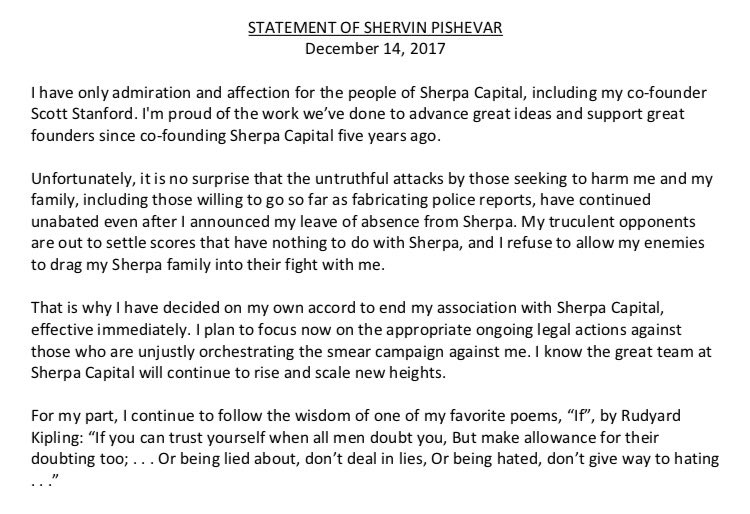
<p>In 2013, the venture firm Sherpa Capital was founded by Shervin Pishevar and Scott Stanford. Today, Pishevar <a href="https://pbs.twimg.com/media/DRCJH9aU8AAeZqA.jpg">announced</a> he would &ldquo;end his association&rdquo; with the organization, as the fallout continues from multiple allegations of sexual misconduct and assault.</p>

<p>Last month, <a href="https://www.bloomberg.com/news/articles/2017-12-01/uber-investor-shervin-pishevar-accused-of-sexual-misconduct-by-multiple-women"><em>Bloomberg</em> reported</a> on accusations from five different women who said that Pishevar had abused his power as a prominent investor and Uber board member and that he has harassed or sexually assaulted them. Earlier this year, Pishevar was also detained, but not charged, in connection with a complaint about sexual assault in London, an incident that was captured by a police report that was later revealed as a fabrication.</p>

<p>Pishevar has maintained his innocence and also <a href="https://www.theverge.com/2017/12/5/16738696/shervin-pishevar-hyperloop-one-uber-investor-sexual-misconduct-leave-of-absence">filed lawsuits for defamation</a>. In today&rsquo;s statement announcing his split from Sherpa Capital, Pishevar wrote:</p>
<blockquote class="wp-block-quote has-text-align-none is-layout-flow wp-block-quote-is-layout-flow">
<p><em>&ldquo;Unfortunately, it is no surprise that the untruthful attacks by those seeking to harm me and my family, including those willing to go so far as fabricating police reports, have continued unabated even after I announced my leave of absence from Sherpa. My truculent opponents are out to settle scores that have nothing to do with Sherpa, and I refuse to allow my enemies to drag my Sherpa family into their fight with me. That is why I have decided on my own accord to end my association with Sherpa Capital, effective immediately. I plan to focus now on the appropriate ongoing legal actions against those who are unjustly orchestrating the smear campaign against me.&rdquo;&nbsp;</em></p>
</blockquote>
<p>Pishevar has also taken a leave of absence from Virgin Hyperloop One, a startup he co-founded.</p>

<p>Along with establishing himself as a name in tech, Pishevar was a major donor to various politicians in the Democratic Party. A recent <a href="https://www.forbes.com/sites/bizcarson/2017/12/11/star-venture-capitalist-ron-conway-warned-clinton-campaign-about-shervin-pishevar/#3caef82360b4">report from <em>Forbes</em></a> indicates that another tech investor had tried to warn the Hillary Clinton campaign about associating with Pishevar before any public reporting on his conduct had surfaced, a sign that his darker reputation within Silicon Valley was already established.</p>
						]]>
									</content>
			
					</entry>
			<entry>
			
			<author>
				<name>Ben Popper</name>
			</author>
			
			<title type="html"><![CDATA[Spotify and Deezer ask EU regulators to stop Apple from abusing its dominance]]></title>
			<link rel="alternate" type="text/html" href="https://www.theverge.com/2017/12/13/16773806/spotify-deezer-eu-regulators-apple" />
			<id>https://www.theverge.com/2017/12/13/16773806/spotify-deezer-eu-regulators-apple</id>
			<updated>2017-12-13T16:39:34-05:00</updated>
			<published>2017-12-13T16:39:34-05:00</published>
			<category scheme="https://www.theverge.com" term="Culture" /><category scheme="https://www.theverge.com" term="Entertainment" /><category scheme="https://www.theverge.com" term="Spotify" />
							<summary type="html"><![CDATA[A group of European tech companies have asked EU regulators to put a stop to what they see as anti-competitive practices from companies like Apple and Amazon. According to a report in the Financial Times, &#8220;Spotify co-founder Daniel Ek and Deezer chief executive Hans-Holger Albrecht called on Brussels to ensure &#8216;a level playing field&#8217; by [&#8230;]]]></summary>
			
							<content type="html">
											<![CDATA[

						
<figure>

<img alt="" data-caption="" data-portal-copyright="Photo: James Bareham / The Verge" data-has-syndication-rights="1" src="https://platform.theverge.com/wp-content/uploads/sites/2/chorus/uploads/chorus_asset/file/9672115/jbareham_171113_2140_0002.jpg?quality=90&#038;strip=all&#038;crop=0,0,100,100" />
	<figcaption>
		</figcaption>
</figure>
<p>A group of European tech companies have asked EU regulators to put a stop to what they see as anti-competitive practices from companies like Apple and Amazon. According to a <a href="https://www.ft.com/content/b6a2714a-e00d-11e7-a8a4-0a1e63a52f9c">report in the<em> Financial Times</em></a>, &ldquo;Spotify co-founder Daniel Ek and Deezer chief executive Hans-Holger Albrecht called on Brussels to ensure &lsquo;a level playing field&rsquo; by reining in platforms that are &lsquo;regularly abusing their advantaged position&rsquo;.&rdquo;</p>

<p>Spotify and Deezer are upset that Apple takes a 30 percent cut of the subscription fee when people sign up for its service through Apple&rsquo;s App Store, even as Apple offers a competing music service of its own. The European Commission is preparing new regulations that will govern how big tech companies interact with the developers and merchants who rely on their platforms.</p>

<p>In June, EU regulators levied a record <a href="https://www.theverge.com/2017/6/27/15872354/google-eu-fine-antitrust-shopping">&euro;2.4 billion fine against Google</a> for demoting rivals and unfairly promoting its own services. Europe&rsquo;s premier music services are clearly hoping that lawmakers in Brussels might bring a similarly aggressive approach to platforms run by other American tech titans.</p>

<p>The letter sent to the commission, which was also signed by a number of European game developers and digital publishers, asked that any new rules &ldquo;go beyond mere transparency requirements, which alone will not ensure platforms act as gateways rather than become gatekeepers to the digital economy.&rdquo;</p>
						]]>
									</content>
			
					</entry>
			<entry>
			
			<author>
				<name>Ben Popper</name>
			</author>
			
			<title type="html"><![CDATA[New law reinstates small drone registration in the US]]></title>
			<link rel="alternate" type="text/html" href="https://www.theverge.com/2017/12/12/16768960/new-law-reinstates-small-drone-registration-in-the-us" />
			<id>https://www.theverge.com/2017/12/12/16768960/new-law-reinstates-small-drone-registration-in-the-us</id>
			<updated>2017-12-12T16:28:35-05:00</updated>
			<published>2017-12-12T16:28:35-05:00</published>
			<category scheme="https://www.theverge.com" term="Drones" /><category scheme="https://www.theverge.com" term="Tech" />
							<summary type="html"><![CDATA[Back in December 2015, the FAA announced that drone owners had to register any device over 0.55 pounds. The new rule was actually championed by big tech companies like Amazon and Google, and by drone industry players like Intel and DJI. Sensible regulations, they argued, would pave the way for faster growth of the industry [&#8230;]]]></summary>
			
							<content type="html">
											<![CDATA[

						
<figure>

<img alt="" data-caption="" data-portal-copyright="Photo by Vjeran Pavic / The Verge" data-has-syndication-rights="1" src="https://platform.theverge.com/wp-content/uploads/sites/2/chorus/uploads/chorus_asset/file/9577995/vpavic_171026_2101_0184.jpg?quality=90&#038;strip=all&#038;crop=0,0,100,100" />
	<figcaption>
		</figcaption>
</figure>
<p>Back in December 2015, the FAA announced that <a href="https://www.theverge.com/2015/12/14/10104996/faa-drone-registration-register-february-19th">drone owners had to register</a> any device over 0.55 pounds. The new rule was actually championed by big tech companies like Amazon and Google, and by drone industry players like Intel and DJI. Sensible regulations, they argued, would pave the way for faster growth of the industry overall.</p>

<p>But lots of consumers, especially veteran hobbyists who had decades of experience flying RC aircraft under their belt, were upset. One drone owner took the FAA to court, arguing that Congress had already decided the FAA had no jurisdiction over toy aircraft. In May of this year, a federal appeals court <a href="http://thehill.com/policy/transportation/334233-appeals-court-strikes-down-federal-registration-rule-for-toy-drones">struck down</a> the registration requirement.</p>

<p>The registration rule got a second life today, when it was <a href="https://techcrunch.com/2017/12/12/trump-signs-bill-reinstating-the-faas-drone-registration-requirement/">signed into law</a> as part of the National Defense Authorization Act. Count that as a win for industry, which got legislators to write broader powers for the FAA as a footnote in a much larger bill. Any future court cases will have to proceed from the premise that Congress has now explicitly endorsed the FAA&rsquo;s jurisdiction over these small unmanned aircraft.</p>
<div class="video-container"><iframe src="https://volume.vox-cdn.com/embed/9be5bf653?player_type=youtube&#038;loop=1&#038;placement=article&#038;tracking=article:rss" allowfullscreen frameborder="0" allow=""></iframe></div>
<p>One of the industry&rsquo;s biggest trade groups, the Association for Unmanned Vehicle Systems International (AUVSI), had <a href="http://www.auvsi.net/blogs/auvsi-advocacy/2017/06/23/auvsi-statement-on-senate-faa-reauthorization-bill">already embraced</a> the new legislation. Brian Wynne, AUVSI&rsquo;s president and CEO, said in a statement: &ldquo;Congress has clearly embraced the need to propel the country forward on the march toward full UAS integration, including beyond-line-of-sight operations, flights over people, access to higher altitudes and even package delivery. We look forward to working with both the House and the Senate to realize the full potential of UAS.&rdquo;</p>
						]]>
									</content>
			
					</entry>
			<entry>
			
			<author>
				<name>Ben Popper</name>
			</author>
			
			<title type="html"><![CDATA[Instagram gets more #interesting]]></title>
			<link rel="alternate" type="text/html" href="https://www.theverge.com/2017/12/12/16763502/instagram-hashtag-follow-new-feature-announced" />
			<id>https://www.theverge.com/2017/12/12/16763502/instagram-hashtag-follow-new-feature-announced</id>
			<updated>2017-12-12T11:15:27-05:00</updated>
			<published>2017-12-12T11:15:27-05:00</published>
			<category scheme="https://www.theverge.com" term="Apps" /><category scheme="https://www.theverge.com" term="Facebook" /><category scheme="https://www.theverge.com" term="Features" /><category scheme="https://www.theverge.com" term="Instagram" /><category scheme="https://www.theverge.com" term="Meta" /><category scheme="https://www.theverge.com" term="Tech" />
							<summary type="html"><![CDATA[The glass facade of the SuperMoon Bakehouse (#newforkcity, #eatingnyc) has a pleasing symmetry to it. Two black rectangles sit on either side of a square, a neon smiley face suspended upside down in the center. Inside, a few small cylinders of pink marble serve as tables, but seating for customers is limited. Most of the [&#8230;]]]></summary>
			
							<content type="html">
											<![CDATA[

						
<figure>

<img alt="" data-caption="" data-portal-copyright="" data-has-syndication-rights="1" src="https://platform.theverge.com/wp-content/uploads/sites/2/chorus/uploads/chorus_asset/file/9851519/akrales_171206_2144_0030_lede.jpg?quality=90&#038;strip=all&#038;crop=0,0,100,100" />
	<figcaption>
		</figcaption>
</figure>
<p>The glass facade of the SuperMoon Bakehouse (<a href="https://www.instagram.com/explore/tags/newforkcity/">#newforkcity</a>, <a href="https://www.instagram.com/explore/tags/eatingnyc/">#eatingnyc</a>) has a pleasing symmetry to it. Two black rectangles sit on either side of a square, a neon smiley face suspended upside down in the center. Inside, a few small cylinders of pink marble serve as tables, but seating for customers is limited. Most of the shop is dedicated to a massive counter, along which the day&rsquo;s selection of colorful, decorative pastries are carefully spaced (<a href="https://www.instagram.com/explore/tags/foodgasm/">#foodgasm</a>, <a href="https://www.instagram.com/explore/tags/dessertporn/">#dessertporn</a>). Behind the counter are rows of tightly packed boxes, stacked to shoulder height, and coated in a reflective silver that produces a rainbow sheen (<a href="https://www.instagram.com/explore/tags/iridescent/">#iridescent</a>, <a href="https://www.instagram.com/explore/tags/myunicornlife/">#myunicornlife</a>).</p>

<p>The croissants and donuts on offer are quite tasty, but for many customers, that isn&rsquo;t the main attraction. For the steady stream of tourists and bloggers who stopped in while I was there, the shop is first and foremost a visual treat, offering itself up as a backdrop for user&rsquo;s to craft a winning Instagram post. The content of your photo is important, but as any serious Instagrammer knows, the hashtags you attach are equally important (<a href="https://www.instagram.com/explore/tags/postitfortheaesthetic/">#postitfortheaesthetic</a>). Someone may have just a few dozen followers, but by grouping their post through hashtags, they can get their images in front of thousands, even millions of potential viewers, all of whom tune in each day for hashtags about food, fashion, and sparkly colors.</p>
<div class="facebook-embed"><iframe loading="lazy" src="https://www.facebook.com/plugins/post.php?href=https://www.facebook.com/verge/videos/1645183288851341/&#038;show_text=true&#038;width=500" width="500" height="712" frameborder="0" allowfullscreen="true" allow="autoplay; clipboard-write; encrypted-media; picture-in-picture; web-share"></iframe></div>
<p>Up until now, there were two ways to interact with a hashtag. You could click through a hashtag on a post, or you could search for a specific tag in the Explore section of the app. Today, Instagram is introducing a new way to interact with hashtags. You can now &ldquo;follow&rdquo; a hashtag the same way you would follow an account. Instagram&rsquo;s algorithms will then pick and choose some of the highlights from that collection and surface them in your main feed. It&rsquo;s a fundamental change to one of the largest social media platforms in the world, elevating your interest in adorable dogs or expensive automobiles to equal status with your friends and family.</p>

<p>I&rsquo;ve been testing out the feature for the last two weeks, and I find myself spending more time with Instagram as a result. I have always avoided the Explore tab. It felt like a random mishmash of posts personalized for me and generic viral content optimized to be popular. Take a recent experience I had with the &ldquo;videos you might like&rdquo; channel: it started with a highlight from a UFC fight, perfect for me, before segueing to a clip of random teens slapping each other at a party, Beyonc&eacute; accepting an award, a volcano erupting against the night sky, and a strange-looking fence post that turns out to be a well-camouflaged bird, shared by an account named &ldquo;ifyouhigh.&rdquo; It was as discordant as flipping through channels on your cable box.</p>

<p>By contrast, the posts injected into my main feed based on the hashtags I chose to follow (<a href="https://www.instagram.com/explore/tags/modernart/">#modernart</a>, <a href="https://www.instagram.com/explore/tags/bjj/">#bjj</a>, <a href="https://www.instagram.com/explore/tags/ancient/">#ancient</a>) felt carefully curated. There is a lot of variety, even within those categories, but you can train the algorithm on what you do and don&rsquo;t like. Engage with the post by leaving a heart or a comment, and Instagram will assume you want more. Click the menu button on the top right of the post, and you can downvote the offending image by asking Instagram not to show you similar content for that hashtag again. After a few days of this, the art in my feed, both martial and modern, felt fine-tuned to my taste.</p>
<img src="https://platform.theverge.com/wp-content/uploads/sites/2/chorus/uploads/chorus_asset/file/9806799/akrales_171130_2144_0389.jpg?quality=90&#038;strip=all&#038;crop=0,0,100,100" alt="" title="" data-has-syndication-rights="1" data-caption="&lt;em&gt;Matthew Ogle, product manager at Instagram, photographed at SuperMoon Bakehouse.&lt;/em&gt; | Photo by Amelia Holowaty Krales" data-portal-copyright="Photo by Amelia Holowaty Krales" />
<p>The man at the helm of this new product is Matthew Ogle (<a href="https://www.instagram.com/explore/tags/brutalism/">#brutalism</a>, <a href="https://www.instagram.com/explore/tags/chinatownnyc/">#chinatownnyc</a>, <a href="https://www.instagram.com/explore/tags/goatsofinstagram/">#goatsofinstagram</a>) a British-Canadian who cut his teeth working at music services like Last.fm and Spotify. He was the product manager most directly responsible for <a href="https://www.theverge.com/2015/9/30/9416579/spotify-discover-weekly-online-music-curation-interview">Discover Weekly</a>, which serves up a personalized playlist to each of Spotify&rsquo;s 140 million listeners every Monday. That product elegantly combined human curation with machine learning, delivering recommendations that felt intimate across a massive audience. Ogle&rsquo;s goal now is to do the same for the interest communities and visual culture of Instagram, which is <a href="https://www.theverge.com/2017/9/25/16361356/instagram-500-million-daily-active-users">rapidly approaching</a> 1 billion monthly active users.</p>

<p>Hashtags and playlists share a number of sensibilities. People use them to collect media under broad umbrellas, making it easier for others to find jazz or rock tracks, or fitness or travel photographs. But they also use them to invent subgenres and forge new tribes. That makes them the perfect fuel for machine learning systems that rely on data labeled by humans.</p>
<img src="https://platform.theverge.com/wp-content/uploads/sites/2/chorus/uploads/chorus_asset/file/9806795/akrales_171130_2144_0327.jpg?quality=90&#038;strip=all&#038;crop=0,0,100,100" alt="" title="" data-has-syndication-rights="1" data-caption="&lt;em&gt;SuperMoon Bakehouse, New York.&lt;/em&gt; | Photo by Amelia Holowaty Krales / The Verge" data-portal-copyright="Photo by Amelia Holowaty Krales / The Verge" />
<p>&ldquo;Discover Weekly wasn&rsquo;t about teaching an algorithm to understand and then recommend music. We taught an algorithm to look at what the community was already doing with this building block, the playlist, and to take the best of what the community was doing and extend it in a new direction,&rdquo; says Ogle. &ldquo;Hashtags are kind of the same way. You have something that is working organically on the platform, how do we add just enough additional structure so that more people can participate.&rdquo;</p>

<p>Right now, exploring your interests on Instagram requires active work on your part. You can manually search a hashtag each day, or ask around for recommendations of good accounts to follow. You can scroll through Explore, which is guessing about what you want to see based on accounts you follow and posts you engage with. But you can&rsquo;t give the Explore page any instructions about what exactly you want to see more of. &ldquo;My job was to find ways to take the friction out of that process, to bring discovery and community-led goodness to where people already are,&rdquo; says Ogle. &ldquo;Hashtags have some really nice properties, because they are already this bottom-up, community-led aggregation.&rdquo;</p>
<img src="https://platform.theverge.com/wp-content/uploads/sites/2/chorus/uploads/chorus_asset/file/9806787/akrales_171130_2144_0293.jpg?quality=90&#038;strip=all&#038;crop=0,0,100,100" alt="" title="" data-has-syndication-rights="1" data-caption="" data-portal-copyright="Photo by Amelia Holowaty Krales / The Verge" />
<p>Of course, hashtags have some properties that make them tricky to work with as well. &ldquo;Hashtags can have multiple valid meanings,&rdquo; says Ogle. I might be interested in #barracuda because I like to fish, while you might follow the tag for images of the classic American muscle car. &ldquo;There&rsquo;s also a rich tradition of using hashtags for jokes, sarcasm, and memes. That is something we don&rsquo;t want to disrupt,&rdquo; he notes. Ideally, you and I can follow #cougar for very different reasons and both come away with a satisfying experience.</p>

<p>To help solve this problem, any image that appears in your main feed because you follow a hashtag will have a prominent button above it, allowing you to easily tell the service that you don&rsquo;t want to see more images like this. It won&rsquo;t unfollow the tag, but it will help to train the system on what aspects of a certain tag appeal to you. The hashtag #dirtykids is used by parents who want to highlight cute photos of their messy toddler. It&rsquo;s also used by a community of young, homeless adults who ride the rails across the US. &ldquo;So one of the ways through all that is, over time, personalize the rankings of things we might show you, versus someone else, for the same hashtag,&rdquo; says Ogle.</p>
<img src="https://platform.theverge.com/wp-content/uploads/sites/2/chorus/uploads/chorus_asset/file/9851515/akrales_171130_2144_0561.jpg?quality=90&#038;strip=all&#038;crop=0,0,100,100" alt="" title="" data-has-syndication-rights="1" data-caption="&lt;em&gt;Mike Krieger, Instagram co-founder, photographed outside of Gramercy Park, New York.&lt;/em&gt; | Photo by Amelia Holowaty Krales / The Verge" data-portal-copyright="Photo by Amelia Holowaty Krales / The Verge" />
<p>From the very beginning, Instagram&rsquo;s users were finding ways to hack the service so they could organize around interests and communities. &ldquo;You build a product with few constraints and people will surprise you with the weird stuff they do,&rdquo; said Mike Krieger, Instagram&rsquo;s co-founder (<a href="https://www.instagram.com/explore/tags/nowspinning/">#nowspinning</a>, <a href="https://www.instagram.com/explore/tags/bermesemountaindog/">#bermesemountaindog</a>, <a href="https://www.instagram.com/explore/tags/fromwhereistand/">#fromwhereistand</a>).</p>

<p>Let&rsquo;s say you wanted to run a contest for photography buffs in San Francisco. &ldquo;There were no hashtags, so people would create a second account, maybe BestPhotosSF, and then ask people to @ mention that account. Then they would refresh in a frenzy and write down all the submissions. It was this early interest in clustering or organization that went beyond the account level,&rdquo; explains Krieger. The company quickly embraced the behavior, <a href="http://mashable.com/2011/01/27/instagram-hashtags/#gcN2L_HcekqB">debuting hashtags</a> in January 2011 so users could organize posts around events, places, or topics.</p>

<p>Born in S&atilde;o Paulo, Brazil, Krieger is now the company&rsquo;s chief technical officer. We met up recently at the Gramercy Park Hotel (<a href="https://www.instagram.com/explore/tags/nyc/">#nyc</a>, <a href="https://www.instagram.com/explore/tags/rosebar/">#rosebar</a>, <a href="https://www.instagram.com/explore/tags/gramercyparkhotel/">#gramercyparkhotel</a>), where he was staying while attending the engineering team&rsquo;s annual offsite. As an expat, Krieger has always taken a keen interest in the way communities formed on Instagram, and the way users leveraged the service to connect across borders and cultures. &ldquo;Forums have been around the internet forever, since the BBS days, but they emerged on Instagram in the craziest way,&rdquo; says Krieger. &ldquo;Small groups of people who had gotten to know one another would announce a hashtag, and then at some predetermined time, they would all start posting with that tag and in the comment section having forum threads.&rdquo;</p>

<p>From the very beginning, Instagram&rsquo;s app had a &ldquo;Popular Page.&rdquo; This was a collection of posts from around the service that had garnered the most likes and comments. It was something for users to dip into once they had caught up on their feed, but it wasn&rsquo;t personalized at all. In June 2012, the Popular tab was combined with the search bar, and renamed as Explore. For the first time, users could dig deeper into certain hashtags and accounts, but by default it still surfaced the posts with the most engagement on a global scale &mdash; an approach that meant Explore was usually dominated by posts from celebrities and extremely broad topics.</p>

<p>In 2014, Krieger and his team began to personalize the experience. Along with trending items, Explore now showed you posts that had been liked by people you followed. What your social graph found appealing, the theory went, might also be appealing to you. In 2015, they augmented the explore feed to show you trending hashtags and places, and last year Explore began showing you video channels based on accounts you follow and hashtags you interact with.</p>
<img src="https://platform.theverge.com/wp-content/uploads/sites/2/chorus/uploads/chorus_asset/file/9806775/akrales_171130_2144_0220.jpg?quality=90&#038;strip=all&#038;crop=0,0,100,100" alt="" title="" data-has-syndication-rights="1" data-caption="&lt;em&gt;Dan Toffey leads Instagram’s Community Lab.&lt;/em&gt; | Photo by Amelia Holowaty Krales / The Verge" data-portal-copyright="Photo by Amelia Holowaty Krales / The Verge" />
<p>Dan Toffey (<a href="https://www.instagram.com/explore/tags/hikingwithdogs/">#hikingwithdogs</a>, <a href="https://www.instagram.com/explore/tags/linework/">#linework</a>, <a href="https://www.instagram.com/explore/tags/woodturning/">#woodturning</a>) was Instagram&rsquo;s 12th employee and fourth community manager. At the time, that role encompassed everything non-technical, from writing blog posts to handling support tickets to moderating comments. Today, he runs Instagram&rsquo;s Community Lab, a group of social scientists that use machine learning to explore and catalog the many niche communities that have found a home on Instagram.</p>

<p>Lots of broad hashtags, like <a href="https://www.instagram.com/explore/tags/food/">#food</a> and <a href="https://www.instagram.com/explore/tags/fashion/">#fashion</a>, are among the most popular in countries around the world. Part of Toffey&rsquo;s work is figuring out what&rsquo;s unique about the different markets where Instagram exists, and finding ways to highlight and support local communities. Hashtags show, for example, that Germany over-indexes for humor, horses, and video gaming, while Japan favors hairstyles, colors, and simplicity.</p>

<p>&ldquo;When a follow happens on the platform, two things are happening: the follower is getting a more diverse experience, and the creator has a new fan who is discovering what they have to offer,&rdquo; says Toffey. &ldquo;Our hope is that through thoughtful categorization and cataloging of these communities, when combined with things like hashtags, we can improve discovery, and make it easier for you to find what you&rsquo;re looking for, or what you didn&rsquo;t know you were looking for.&rdquo;</p>
<figure class="wp-block-gallery has-nested-images columns-1 wp-block-gallery-1 is-layout-flex wp-block-gallery-is-layout-flex"><img src="https://platform.theverge.com/wp-content/uploads/sites/2/chorus/uploads/chorus_asset/file/9851469/akrales_171130_2144_0154.jpg?quality=90&#038;strip=all&#038;crop=0,0,100,100" alt="" title="" data-has-syndication-rights="1" data-caption="" data-portal-copyright="Photo by Amelia Holowaty Krales / The Verge" />
<img src="https://platform.theverge.com/wp-content/uploads/sites/2/chorus/uploads/chorus_asset/file/9806751/akrales_171130_2144_0011.jpg?quality=90&#038;strip=all&#038;crop=0,0,100,100" alt="" title="" data-has-syndication-rights="1" data-caption="" data-portal-copyright="Photo by Amelia Holowaty Krales / The Verge" />
<img src="https://platform.theverge.com/wp-content/uploads/sites/2/chorus/uploads/chorus_asset/file/9806773/akrales_171130_2144_0119.jpg?quality=90&#038;strip=all&#038;crop=0,0,100,100" alt="" title="" data-has-syndication-rights="1" data-caption="" data-portal-copyright="Photo by Amelia Holowaty Krales / The Verge" />
</figure>
<p>Of course, turning hashtags into a more prominent part of the Instagram experience is going to make them a more attractive target for spammers, marketers, and attention-hungry influencers. There is already an entire cottage industry built around tips and tricks for <a href="https://www.google.com/search?q=instagram+put+best+of+explore+into+main+feed&amp;oq=instagram+put+best+of+explore+into+main+feed&amp;aqs=chrome..69i57.6910j0j1&amp;sourceid=chrome&amp;ie=UTF-8">getting yourself featured</a> on Instagram&rsquo;s explore page, and an ever-<a href="https://www.google.com/search?q=get+to+top+of+hashtag+instagram+trending&amp;spell=1&amp;sa=X&amp;ved=0ahUKEwjqpeaCqfPXAhVhQN8KHXt8DDsQvwUIJCgA&amp;biw=753&amp;bih=654">evolving cheat sheet of hashtags</a> that users can include if they want a better chance at having their post go viral.</p>

<p>&ldquo;Instagram has been one of the most vital tools for DEFY, building our brand and reaching new customers,&rdquo; said Chris Tag, a former creative director at an advertising agency in Chicago who left marketing in 2008 to start his own apparel company. &ldquo;IG is honestly one of the life-bloods of our brand.&rdquo;</p>

<p>The company uses hashtags like <a href="https://www.instagram.com/explore/tags/handcrafted/">#handcrafted</a>, <a href="https://www.instagram.com/explore/tags/madeinusa/">#madeintheusa</a>, and <a href="https://www.instagram.com/explore/tags/military/">#military</a> to find new customers. The process is &ldquo;akin to how back in the day door-to-door salesman would literally go and seek and new customers by knocking on doors. Some would slam the door in their faces, others were open to what they were about and embraced their brand,&rdquo; says Tag. &ldquo;But this is even better, as it&#8217;s an opt-in community.&rdquo;</p>

<p>Hashtags that begin as marketing sometimes take on a life of their own. Herschel Supply Co. began using <a href="https://www.instagram.com/explore/tags/welltraveled/">#welltraveled</a> as part of a campaign. The descriptor took off, and now has been used in over 1.5 million posts. Social media specialists like HootSuite advise their clients on <a href="https://blog.hootsuite.com/instagram-hashtags/">how many hashtags to use</a> &mdash; five is better than nine &mdash; and how to attach yourself to popular tags without looking like a spammer.</p>
<img src="https://platform.theverge.com/wp-content/uploads/sites/2/chorus/uploads/chorus_asset/file/9851631/Screen_Shot_2017_12_11_at_3.25.57_PM.png?quality=90&#038;strip=all&#038;crop=0,0,100,100" alt="" title="" data-has-syndication-rights="1" data-caption="" data-portal-copyright="" />
<p>Informal cliques known as &ldquo;boost groups&rdquo; have emerged, allowing users to trade likes and comments with one another to try. The goal is to push certain posts to the top of a trending hashtag, ensuring they will be seen by a large audience. &ldquo;I definitely saw a change within a month. I saw a significant change,&rdquo; said one boost group member, who asked to remain anonymous. &ldquo;My attitude around social media changed. It was necessary to be seen, to make a profit.&rdquo;</p>
<figure class="wp-block-pullquote alignleft"><blockquote><p>“It was in vain if you didn’t use any hashtags.”</p></blockquote></figure>
<p>A boost group didn&rsquo;t require a huge number of members to be effective, but they had to be targeted. &ldquo;It was in vain if you didn&rsquo;t use any hashtags or keywords, because those brought you to the attention of specific communities and rankings,&rdquo; the boost group member told <em>The Verge</em>. &ldquo;Every day there would be sharing of insights around what hashtags were trending and worth trying to leverage.&rdquo; With around a dozen members, this group was able to get their posts to the top of hashtags that had hundreds of thousands, even millions, of posts.</p>

<p>Instagram is quick to acknowledge the challenge. &ldquo;The fundamental tension there is, you build a product with a surface that gets popular, it&rsquo;s a high target for spam,&rdquo; says Krieger. &ldquo;We will look at signals on both the posting side and the consumption side. Since we know the tap-through rate, the follow-through rate, the scroll-through rate, we can start saying, &lsquo;this was a bad insertion,&rsquo; and down-ranking it.&rdquo;</p>

<p>&ldquo;On any platform, and especially one of our size, those dynamics are always at play. Something that we&rsquo;re very firm on is that the safety and health of our community is top priority,&rdquo; said Ogle. &ldquo;All that being said, one of the cool things about following hashtags is, for the first time, it gives each hashtag an inbuilt audience, that has a stake in what they&rsquo;re seeing.&rdquo;</p>
<img src="https://platform.theverge.com/wp-content/uploads/sites/2/chorus/uploads/chorus_asset/file/9806789/akrales_171130_2144_0269.jpg?quality=90&#038;strip=all&#038;crop=0,0,100,100" alt="" title="" data-has-syndication-rights="1" data-caption="" data-portal-copyright="Photo by Amelia Holowaty Krales / The Verge" />
<p>Instagram has earned a reputation as the <a href="http://variety.com/2017/digital/features/instagram-ceo-kevin-systrom-1202614763/">&ldquo;nice&rdquo; social network</a>, a place that hasn&rsquo;t been marred by election meddling, hate speech, or child exploitation. User growth on the service <a href="https://www.theverge.com/2017/4/26/15431872/instagram-monthly-active-users-700-million-growth">is still accelerating</a>, so why rock the boat? The overarching goal, left unspoken, is to have people spend more time the service, and to have them engage more deeply. And as Instagram&rsquo;s growth has increased, the company has grown more aggressive, not less, about experimenting with new features.</p>
<figure class="wp-block-pullquote alignleft"><blockquote><p>“Can we capture this existing behavior, and make it better?”</p></blockquote></figure>
<p>&ldquo;The way we always looked at this was, at the core of Instagram are your friends and the people you love. The service without that would be in a lot of trouble,&rdquo; says Krieger. &ldquo;But we&rsquo;re not just that. We have the next ring out from that, which is interest accounts and aggregators. The next ring out is accounts you might encounter in passing on Explore. Can we capture this existing behavior, and make it better?&rdquo;</p>

<p>There is a business logic to this as well. While advertising won&rsquo;t be connected to the hashtags you follow when the product launches today, marketers will undoubtedly want to target consumers based on the interests they are passionate enough to bring into their main feed. &ldquo;I think it could make sense down the line,&rdquo; says Krieger. &ldquo;Relevancy is the number one thing we think about with advertising. I can imagine incorporating the signal, either implicitly or explicitly, in a way that is clear.&rdquo;</p>
<img src="https://platform.theverge.com/wp-content/uploads/sites/2/chorus/uploads/chorus_asset/file/9852341/jbareham_171212_2144_0001.jpg?quality=90&#038;strip=all&#038;crop=0,0,100,100" alt="" title="" data-has-syndication-rights="1" data-caption="" data-portal-copyright="Photo by James Bareham / The Verge" />
<p>Instagram knows it&rsquo;s taking a risk by injecting interests into the main feed, because it&rsquo;s tried this tweak before. &ldquo;We experimented with putting the best of Explore into your main feed, but it never felt personal enough,&rdquo; says Krieger. Adding the ability to follow hashtags, &ldquo;is a big step change,&rdquo; he adds, but the company is betting that its systems are now smart enough not to disappoint you.</p>

<p>With the recent <a href="https://www.theverge.com/2017/12/7/16740280/instagram-direct-messaging-app-test-standalone">launch of Direct</a>, it appears that Instagram may want to carve out a separate experience for messaging, leaving the main app to focus on consumption. &ldquo;It&rsquo;s not the kind of app that&rsquo;s going to have an overflow hamburger menu with 50 options,&rdquo; says Kriger. &ldquo;We have a feed, the feed is a user-curated view into the world of Instagram.&rdquo;</p>
<figure class="wp-block-pullquote alignleft"><blockquote><p>Hashtags are the atomic unit of interest on Instagram</p></blockquote></figure>
<p>Discover Weekly turned casual listeners into <a href="https://www.fastcompany.com/3054176/why-spotifys-discover-weekly-playlists-are-such-a-hit">Spotify superusers</a>, and Instagram is hoping that hashtags might hold the same appeal for its users. &ldquo;Explore is quite honestly one of the reasons I left Spotify and came here. It&rsquo;s arguably the largest social discovery platform in the world,&rdquo; said Ogle. Hundreds of millions of people use Explore every day. &ldquo;To me that&rsquo;s a strong signal that Instagram is already good at this, and if we lean into it we can do more.&rdquo;</p>

<p class="has-end-mark">Today&rsquo;s update will be a big change to how Instagram works, but Ogle is just getting warmed up. &ldquo;For me it&rsquo;s not a silver bullet,&rdquo; he said, as we munched on our decorative pastries under the pink glow of SuperMoon&rsquo;s neon sign. &ldquo;It&rsquo;s a first step that next year we can layer all kinds of cool stuff on top of, with hashtags as our atomic unit for interest on Instagram.&rdquo;</p>

<p><em>Stop motion animation by Michele Doying</em></p>

<p><em>Creative Direction by </em><a href="https://www.theverge.com/users/James%20Bareham"><em>James Bareham</em></a></p>
						]]>
									</content>
			
					</entry>
			<entry>
			
			<author>
				<name>Ben Popper</name>
			</author>
			
			<title type="html"><![CDATA[Coinbase exchange falters as bitcoin price fluctuates wildly]]></title>
			<link rel="alternate" type="text/html" href="https://www.theverge.com/2017/12/7/16746968/coinbase-exchange-down-slow-broken-working-uptime" />
			<id>https://www.theverge.com/2017/12/7/16746968/coinbase-exchange-down-slow-broken-working-uptime</id>
			<updated>2017-12-07T13:24:57-05:00</updated>
			<published>2017-12-07T13:24:57-05:00</published>
			<category scheme="https://www.theverge.com" term="Business" /><category scheme="https://www.theverge.com" term="Tech" />
							<summary type="html"><![CDATA[One of the world&#8217;s most popular bitcoin exchanges is struggling to keep up with soaring demand as the global mania for the cryptocurrency drives wild swings in valuation. Over the course of one hour today, the value of a single bitcoin on Coinbase jumped from above $16,000, to more than $19,000, before once again falling [&#8230;]]]></summary>
			
							<content type="html">
											<![CDATA[

						
<figure>

<img alt="" data-caption="" data-portal-copyright="Photo by Philipp Guelland/Getty Images" data-has-syndication-rights="1" src="https://platform.theverge.com/wp-content/uploads/sites/2/chorus/uploads/chorus_asset/file/9828953/847843708.jpg.jpg?quality=90&#038;strip=all&#038;crop=0,0,100,100" />
	<figcaption>
		</figcaption>
</figure>
<p>One of the world&rsquo;s most popular bitcoin exchanges is struggling to keep up with soaring demand as the global mania for the cryptocurrency drives wild swings in valuation. Over the course of one hour today, the value of a single bitcoin on Coinbase jumped from above $16,000, to more than $19,000, before once again falling back down below $16,000.</p>

<p>For some users, Coinbase service was extremely slow; for others, it was impossible to log in or <a href="https://twitter.com/adrjeffries/status/938824429299257351">complete transactions</a> at all. The company <a href="https://twitter.com/coinbase/status/938802155925913600">posted a statement</a> just after noon explaining that it was &ldquo;currently experiencing record high traffic. This is resulting in some customers having slow performance or issues logging into their <a href="https://t.co/bCG11KveHS">Coinbase</a> accounts. We are actively working to resolve this as quickly as possible.&rdquo;</p>

<p>According to a <a href="https://www.nytimes.com/2017/12/06/technology/coinbase-bitcoin.html?hp&amp;action=click&amp;pgtype=Homepage&amp;clickSource=story-heading&amp;module=second-column-region&amp;region=top-news&amp;WT.nav=top-news">report this morning</a> from <em>The New York Times</em>, active accounts on Coinbase have more than doubled since January, climbing from 5.5 million at the start of this year to over 13.3 million at the end of November. The exchange has at times been signing up more than 100,000 new customers a day, and now has more accounts than Charles Schwab.</p>
<figure class="wp-block-embed is-type-rich is-provider-twitter wp-block-embed-twitter alignnone"><div class="wp-block-embed__wrapper">
<blockquote class="twitter-tweet" data-dnt="true"><p lang="en" dir="ltr">We are experiencing all time high traffic at the moment – 8x the peak we saw in June</p>&mdash; Coinbase 🛡️ (@coinbase) <a href="https://twitter.com/coinbase/status/935917012231974912?ref_src=twsrc%5Etfw">November 29, 2017</a></blockquote>
</div></figure>
<p>With traffic to the exchange skyrocketing, the young startup is hiring engineers and customer service staff at a blistering pace. Still, it can&rsquo;t keep up with the current rise in demand. For now, at least, that may not matter: consumers are so hungry for bitcoin that they are seemingly willing to endure spotty service.</p>

<p>The price of bitcoin has grown exponentially over the last year: a single coin traded for under $1,000 in January. Given such drastic changes, consumers would pay dearly for a service that can quickly and reliably execute transactions. In the absence of that, speculators will just have to buckle up and enjoy the ride.</p>
						]]>
									</content>
			
					</entry>
			<entry>
			
			<author>
				<name>Ben Popper</name>
			</author>
			
			<title type="html"><![CDATA[Google is pulling YouTube off the Fire TV and Echo Show as feud with Amazon grows]]></title>
			<link rel="alternate" type="text/html" href="https://www.theverge.com/2017/12/5/16738748/google-amazon-feud-youtube-pulled-off-fire-tv-echo-show-nest-devices" />
			<id>https://www.theverge.com/2017/12/5/16738748/google-amazon-feud-youtube-pulled-off-fire-tv-echo-show-nest-devices</id>
			<updated>2017-12-05T14:15:54-05:00</updated>
			<published>2017-12-05T14:15:54-05:00</published>
			<category scheme="https://www.theverge.com" term="Verge Archives" />
							<summary type="html"><![CDATA[Three months ago, YouTube pulled its programming from Amazon&#8217;s Echo Show device &#8212; the first skirmish in what is apparently an ongoing war. Shortly after, Amazon stopped selling the Nest E Thermostat, Nest&#8217;s Camera IQ, and the Nest Secure alarm system. Two weeks ago, Amazon got YouTube back on the Echo Show by simply directing [&#8230;]]]></summary>
			
							<content type="html">
											<![CDATA[

						
<figure>

<img alt="" data-caption="" data-portal-copyright="Photo by Amelia Holowaty Krales / The Verge" data-has-syndication-rights="1" src="https://platform.theverge.com/wp-content/uploads/sites/2/chorus/uploads/chorus_asset/file/8741659/akrales_170622_1784_0151.jpg?quality=90&#038;strip=all&#038;crop=0,0,100,100" />
	<figcaption>
		</figcaption>
</figure>
<p>Three months ago, YouTube <a href="https://www.theverge.com/2017/9/26/16371292/google-youtube-amazon-echo-show">pulled its programming</a> from Amazon&rsquo;s Echo Show device &mdash; the first skirmish in what is apparently an ongoing war. Shortly after, Amazon <a href="https://www.amazon.com/Nest-A0063-Thermostat-E/dp/B074NBTCY7/ref=as_at?creativeASIN=B074NBTCY7&amp;linkCode=w61&amp;imprToken=8BaGIvRtVCd-D7M8Y09Hmw&amp;slotNum=1&amp;tag=b0c55-20">stopped selling</a> the Nest E Thermostat, Nest&rsquo;s Camera IQ, and the Nest Secure alarm system. Two weeks ago, Amazon <a href="https://www.theverge.com/circuitbreaker/2017/11/21/16686174/youtube-amazon-echo-show-google-back-updated-design-ui">got YouTube back</a> on the Echo Show by simply directing users to the web version, a workaround that left a lot to be desired. But even that version won&rsquo;t be available after today.</p>

<p>In a statement this afternoon, a YouTube spokesperson announced that the company was withdrawing support for its service on both the Echo Show and, more importantly, Amazon&rsquo;s Fire TV:</p>
<blockquote class="wp-block-quote has-text-align-none is-layout-flow wp-block-quote-is-layout-flow">
<p>&ldquo;&#8203;We&rsquo;ve been trying to reach agreement with Amazon to give consumers access to each other&#8217;s products and services. But Amazon doesn&#8217;t carry Google products like Chromecast and Google Home, doesn&#8217;t make Prime Video available for Google Cast users, and last month stopped selling some of Nest&#8217;s latest products. Given this lack of reciprocity, we are no longer supporting YouTube on Echo Show and FireTV. We hope we can reach an agreement to resolve these issues soon.&rdquo;</p>
</blockquote>
<p>YouTube will be pulled from the Echo Show today. Customers who own an Fire TV will start seeing a notification today warning them that the service will be unavailable as of January 1st, 2018. Perhaps Google is hoping that the threat of losing YouTube on its main streaming device will force Amazon to negotiate a truce both sides can live with before the new year.</p>

<p>For bonus points, try asking Alexa to order you a Chromecast and see how she responds. I was offered a Fire TV stick, then a Roku, before she ran out of options.</p>
						]]>
									</content>
			
					</entry>
			<entry>
			
			<author>
				<name>Ben Popper</name>
			</author>
			
			<title type="html"><![CDATA[YouTube CEO promises more moderation to prevent ‘bad actors’ from ‘exploiting our openness’]]></title>
			<link rel="alternate" type="text/html" href="https://www.theverge.com/2017/12/4/16736242/youtube-children-kids-inappropriate-elsagate-hate-speech-moderation" />
			<id>https://www.theverge.com/2017/12/4/16736242/youtube-children-kids-inappropriate-elsagate-hate-speech-moderation</id>
			<updated>2017-12-04T21:05:52-05:00</updated>
			<published>2017-12-04T21:05:52-05:00</published>
			<category scheme="https://www.theverge.com" term="Creators" /><category scheme="https://www.theverge.com" term="Culture" /><category scheme="https://www.theverge.com" term="Entertainment" /><category scheme="https://www.theverge.com" term="Google" /><category scheme="https://www.theverge.com" term="Tech" /><category scheme="https://www.theverge.com" term="Web" /><category scheme="https://www.theverge.com" term="YouTube" />
							<summary type="html"><![CDATA[YouTube CEO Susan Wojcicki published a blog post this evening, addressing some of the ongoing controversies around trust and safety that have roiled the video platform over the last year. Wojcicki began by emphasizing all the ways in which she has seen YouTube become a force for good over the last decade. But the YouTube [&#8230;]]]></summary>
			
							<content type="html">
											<![CDATA[

						
<figure>

<img alt="" data-caption="" data-portal-copyright="" data-has-syndication-rights="1" src="https://platform.theverge.com/wp-content/uploads/sites/2/chorus/uploads/chorus_asset/file/9728645/Screen_Shot_2017_11_14_at_5.16.21_PM.png?quality=90&#038;strip=all&#038;crop=0,0,100,100" />
	<figcaption>
		</figcaption>
</figure>
<p>YouTube CEO Susan Wojcicki published <a href="https://youtube.googleblog.com/2017/12/expanding-our-work-against-abuse-of-our.html">a blog post</a> this evening, addressing some of the ongoing controversies around trust and safety that have roiled the video platform over the last year. Wojcicki began by emphasizing all the ways in which she has seen YouTube become a force for good over the last decade. But the YouTube chief exec also acknowledged that she&rsquo;s &ldquo;seen up-close that there can be another, more troubling, side of YouTube&rsquo;s openness.&rdquo;</p>

<p>Wojcicki is referencing the variety of <a href="https://www.theverge.com/2017/6/18/15826514/youtube-four-steps-combat-online-terrorists-extremists">extremist videos</a>, <a href="https://www.theverge.com/2017/11/15/16656706/youtube-videos-children-comments">child exploitation schemes</a>, and other disturbing content on YouTube that&rsquo;s resulted in massive backlash and <a href="https://www.theverge.com/2017/3/24/15053990/google-youtube-advertising-boycott-hate-speech">pulled advertising campaigns</a>. &ldquo;I&rsquo;ve seen how some bad actors are exploiting our openness to mislead, manipulate, harass or even harm,&rdquo; she added.</p>
<figure class="wp-block-pullquote alignleft"><blockquote><p>YouTube says it has had success removing extremist content</p></blockquote></figure>
<p>Wojcicki says that YouTube has learned some valuable lessons from its efforts to <a href="https://www.theverge.com/2017/6/26/15875102/facebook-microsoft-twitter-youtube-global-internet-forum-counter-terrorism">stamp out extremist content</a>. She writes that YouTube has removed over 150,000 videos for violent extremism since June of this year, when it <a href="https://blog.google/topics/google-europe/four-steps-were-taking-today-fight-online-terror/">began using machine learning technique</a> to help identify extremist videos. The company says that 98 percent of the videos it removes are flagged by its algorithms and that 70 percent of violent extremist content is taken down within eight hours of being posted.</p>

<p>The plan is to take those same machine learning techniques and turn them toward the issues surrounding child safety and hate speech. Of course, there is a <a href="https://www.theverge.com/2016/12/8/13886988/terrorist-content-database-facebook-google-youtube-microsoft-twitter">clear database</a> of extremist content that machine learning systems can work from. Deciding which children&rsquo;s video cross the line from strange to inappropriate to exploitative, or when a video moves from angry opinion to hate speech, may be much harder for an algorithm to identify. So the company is promising to add more humans to the mix as well. Wojcicki writes that the company is &ldquo;bringing the total number of people across Google working to address content that might violate our policies to over 10,000 in 2018.&rdquo;</p>

<p>As Google has worked to tighten its policies and tweak the algorithms that police content on its service, many creators have seen safe, inoffensive videos <a href="https://www.theverge.com/2017/11/14/16648348/youtube-demonetizing-iphone-x-videos">lose the ability to earn money from advertising</a>. In a separate <a href="https://youtube-creators.googleblog.com/2017/12/protecting-our-community.html">blog post</a> on YouTube&rsquo;s creator blog, Wojcicki wrote that, &ldquo;This was a year of amazing growth and innovation, but I wanted to take this opportunity to reflect on what has also been a very tough year for our creator community.&rdquo; She promised to provide creators with more transparency and tools to help get their business restored if they believe their videos have been flagged in error.</p>
<figure class="wp-block-pullquote alignleft"><blockquote><p>YouTube has had two major ad boycotts this year</p></blockquote></figure>
<p>Finally, Google has seen big advertisers leave the platform twice this year, <a href="https://www.theverge.com/2017/3/24/15053990/google-youtube-advertising-boycott-hate-speech">once</a> following a <em>Wall Street Journal</em> report about marketing from major brands playing next to hate speech and extremism, and a second time after a report <a href="https://www.thetimes.co.uk/article/youtube-adverts-fund-paedophile-habits-fdzfmqlr5">highlighted how ads were running beside videos</a> that were rife with creepy comments from pedophiles.</p>

<p>Wojcicki says YouTube will narrow the group of videos that are eligible for advertising. &ldquo;We are planning to apply stricter criteria, conduct more manual curation, while also significantly ramping up our team of ad reviewers to ensure ads are only running where they should,&rdquo; she wrote. &ldquo;This will also help vetted creators see more stability around their revenue. It&rsquo;s important we get this right for both advertisers and creators, and over the next few weeks, we&rsquo;ll be speaking with both to hone this approach.&rdquo;</p>

<p>Because YouTube&rsquo;s finances aren&rsquo;t broken out in detail when Google parent company Alphabet reports its quarterly earnings, it&rsquo;s hard to know how big these advertiser boycotts have been, or whether they have had any meaningful impact on the company&rsquo;s bottom line. So far the hit, if there was one at all, <a href="https://www.marketwatch.com/story/youtube-advertiser-boycott-appears-to-be-over-2017-10-11">appears minimal</a>. And reports from this summer indicated that almost all the big brands that had spoken out have <a href="http://www.adweek.com/digital/months-removed-from-a-brand-safety-boycott-youtube-is-winning-over-top-advertisers-again/">since returned</a>.</p>

<p>Still, two major crisis in one year may sour some marketers on YouTube for good. A lengthy op-ed from YouTube&rsquo;s CEO is a clear sign that the company is concerned about the issue, its impact, and its optics.</p>
						]]>
									</content>
			
					</entry>
			<entry>
			
			<author>
				<name>Ben Popper</name>
			</author>
			
			<title type="html"><![CDATA[NASDAQ plans to let investors bet on Bitcoin’s rise and fall]]></title>
			<link rel="alternate" type="text/html" href="https://www.theverge.com/2017/11/29/16715296/nasdaq-bitcoin-futures-long-short" />
			<id>https://www.theverge.com/2017/11/29/16715296/nasdaq-bitcoin-futures-long-short</id>
			<updated>2017-11-29T12:49:23-05:00</updated>
			<published>2017-11-29T12:49:23-05:00</published>
			<category scheme="https://www.theverge.com" term="Business" /><category scheme="https://www.theverge.com" term="Crypto" /><category scheme="https://www.theverge.com" term="Tech" />
							<summary type="html"><![CDATA[Bitcoin is back in the news as its price continues a meteoric rise, with the cost of a single coin breaking $10,000 yesterday. Today, it was reported by several major publications that NASDAQ, the second largest stock exchange in the world, plans to launch futures contracts for Bitcoin next year. That would allow investors to [&#8230;]]]></summary>
			
							<content type="html">
											<![CDATA[

						
<figure>

<img alt="" data-caption="" data-portal-copyright="" data-has-syndication-rights="1" src="https://platform.theverge.com/wp-content/uploads/sites/2/chorus/assets/2648301/20130520-07511828-btc.jpg?quality=90&#038;strip=all&#038;crop=0,0,100,100" />
	<figcaption>
		</figcaption>
</figure>
<p>Bitcoin is back in the news as its price continues a meteoric rise, with the cost of a single coin breaking $10,000 yesterday. Today, it was reported by several major publications that NASDAQ, the second largest stock exchange in the world, plans to launch <a href="https://www.wsj.com/articles/nasdaq-plans-to-launch-bitcoin-futures-in-first-half-2018-1511968313">futures contracts for Bitcoin</a> next year. That would allow investors to bet on the rise and fall of the cryptocurrency, profiting if they are correct about the direction of its future price.</p>

<p>NASDAQ is hardly the first player from the traditional finance world to jump on the Bitcoin bandwagon. At the start of this month, Chicago&rsquo;s CME Group said it would begin providing futures contracts on bitcoin as well. As <em>The Verge</em> <a href="https://www.theverge.com/2017/11/29/16711304/bitcoin-price-10000-cryptocurrency-regulation-finance">reported</a> this morning, while many well-known bankers and investors continue to deride Bitcoin as a bubble or a Ponzi scheme, almost every major financial institution has been exploring how they might interact with Bitcoin and its underlying structure, the blockchain.</p>

<p>The introduction of various financial products around Bitcoin will <a href="http://fortune.com/2017/11/01/bitcoin-6600-high-cme-futures/">amplify the amount of risk</a> investors can take. Cantor Fitzgerald, a large broker which owns an exchange, announced today that it plans to launch Bitcoin derivatives in the first half of 2018. Futures and derivatives allow investors to place bets on bitcoin without owning any of the actual currency, amplifying the amount of financial leverage on the underlying asset. It was an explosion of derivatives pegged to real estate assets like mortgages that underpinned the financial collapse of 2008.</p>
<img src="https://platform.theverge.com/wp-content/uploads/sites/2/chorus/uploads/chorus_asset/file/9774801/Screen_Shot_2017_11_29_at_12.15.57_PM.png?quality=90&#038;strip=all&#038;crop=0,0,100,100" alt="" title="" data-has-syndication-rights="1" data-caption="&lt;em&gt;Bitcoin’s rise in price since the start of 2016.&lt;/em&gt;" data-portal-copyright="" />
<p>As Bitcoin continues to mint new millionaires, real-world applications for the currency and the underlying technology have so far remained niche. There are countless startups attempting to use bitcoin, blockchains, and other cryptocurrencies. Fueling a lot of this exuberance has been initial coin offerings, where investors can buy virtual tokens in lieu of more traditional equity. This year alone, ICOs have raised hundreds of millions of dollars, <a href="https://www.cnbc.com/2017/08/09/initial-coin-offerings-surpass-early-stage-venture-capital-funding.html">passing traditional venture capital</a> as a source of funds.</p>

<p>As veteran investor and financial analyst Josh Brown <a href="http://thereformedbroker.com/2017/11/29/tales-from-the-crypt/">wrote</a> on his, none of this is likely to change soon: &nbsp;</p>
<blockquote class="wp-block-quote has-text-align-none is-layout-flow wp-block-quote-is-layout-flow">
<p>&ldquo;These people aren&rsquo;t going anywhere. Crypto is here to stay. It doesn&rsquo;t matter if most of the ICOs see their token prices crash by 90% (which is what I think will happen). Walking the halls and having people come up to me to explain their projects, I came to the realization that price crashes alone will not drive these people out. They&rsquo;ve got business cards, and signs and LLCs and money raised and there will undoubtedly be projects that become real companies, even if the majority disappear. This is how&nbsp;all&nbsp;capitalism works. The crash of the internet economy at the turn of the century didn&rsquo;t kill the internet itself. Google came around four years later. Three years after that, the iPhone came out. Then Facebook and Twitter.&nbsp;These are all post-crash. So if you&rsquo;re sick of hearing about crypto, the bad news is that it&rsquo;s going to be a part of the world for the foreseeable future.&rdquo;</p>
</blockquote>
<p>Predicting exactly when the Bitcoin bubble will burst, as it has <a href="https://pensionpartners.com/when-does-a-bubble-become-a-bubble/">many times before</a>, is impossible. But pretty soon, the world&rsquo;s most venerable exchanges will let you start placing bets.</p>
						]]>
									</content>
			
					</entry>
	</feed>