<?xml version="1.0" encoding="UTF-8"?><feed
	xmlns="http://www.w3.org/2005/Atom"
	xmlns:thr="http://purl.org/syndication/thread/1.0"
	xml:lang="en-US"
	>
	<title type="text">Brooke Jarvis | The Verge</title>
	<subtitle type="text">The Verge is about technology and how it makes us feel. Founded in 2011, we offer our audience everything from breaking news to reviews to award-winning features and investigations, on our site, in video, and in podcasts.</subtitle>

	<updated>2013-10-10T16:56:04+00:00</updated>

	<link rel="alternate" type="text/html" href="https://www.theverge.com/author/brooke-jarvis" />
	<id>https://www.theverge.com/authors/brooke-jarvis/rss</id>
	<link rel="self" type="application/atom+xml" href="https://www.theverge.com/authors/brooke-jarvis/rss" />

	<icon>https://platform.theverge.com/wp-content/uploads/sites/2/2025/01/verge-rss-large_80b47e.png?w=150&amp;h=150&amp;crop=1</icon>
		<entry>
			
			<author>
				<name>Brooke Jarvis</name>
			</author>
			
			<title type="html"><![CDATA[Fecal finders: how poop-sniffing dogs are helping killer whales]]></title>
			<link rel="alternate" type="text/html" href="https://www.theverge.com/2013/10/10/4793118/fecal-finders-how-poop-sniffing-dogs-are-helping-killer-whales" />
			<id>https://www.theverge.com/2013/10/10/4793118/fecal-finders-how-poop-sniffing-dogs-are-helping-killer-whales</id>
			<updated>2013-10-10T12:56:04-04:00</updated>
			<published>2013-10-10T12:56:04-04:00</published>
			<category scheme="https://www.theverge.com" term="Features" /><category scheme="https://www.theverge.com" term="Science" />
							<summary type="html"><![CDATA[The dog is steering the boat, and the humans on board are pretty sure he&#8217;s leading it astray. Tucker, a nine-year-old black lab mix, is an improbable character in a high-stakes detective story: the case of the declining orcas. He&#8217;s sniffing for a needle in a haystack &#8212; a small plastic container filled with the [&#8230;]]]></summary>
			
							<content type="html">
											<![CDATA[

						
<figure>

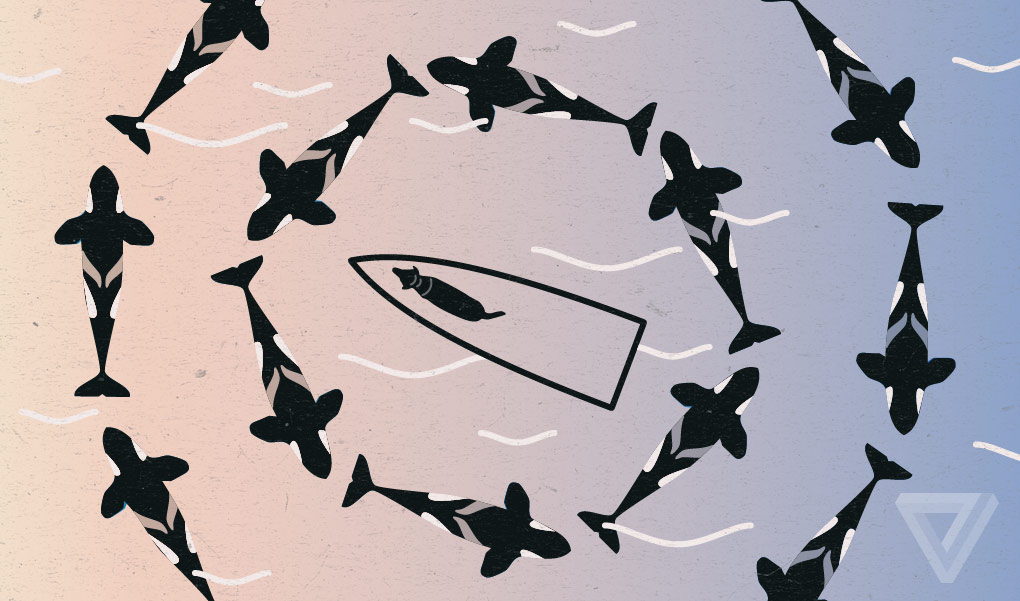
<img alt="" data-caption="orcas" data-portal-copyright="" data-has-syndication-rights="1" src="https://platform.theverge.com/wp-content/uploads/sites/2/chorus/uploads/chorus_asset/file/13068043/orcas.1419979958.jpg?quality=90&#038;strip=all&#038;crop=0,0,100,100" />
	<figcaption>
	orcas	</figcaption>
</figure>
<p>The dog is steering the boat, and the humans on board are pretty sure he&rsquo;s leading it astray.</p>

<p>Tucker, a nine-year-old black lab mix, is an improbable character in a high-stakes detective story: the case of the declining orcas. He&rsquo;s sniffing for a needle in a haystack &mdash; a small plastic container filled with the feces of a killer whale, floating somewhere in the vastness of the Strait of Juan de Fuca in northwestern Washington state. With his body language &mdash; pacing across the bow, leaning over its edge, the angle of his nose &mdash; he tells his handler, Liz Seely, and Deborah Giles, who sits behind the wheel, where to steer.</p>

<p>He seems firm on the scent. He&rsquo;s directing the boat in the opposite direction of where we floated the sample before motoring away to set up this test of his abilities. &ldquo;Oh no, this is so embarrassing,&rdquo; Seely later admitted to thinking.</p>

<p>But suddenly, there it is ahead of us: the pink plastic bowl, bobbing on the surface of the water, just where Tucker knew it would be. The wind and current have moved it far from where we placed it, but Tucker picked up the scent from more than half a mile away. He&rsquo;s rewarded with applause and his favorite thing in the world: a few minutes of play with a ball. He barks, whips it around, throws it overboard. He&rsquo;s so overcome he&rsquo;s practically dancing.</p>

<p>But this isn&rsquo;t a game. The whales whose poop Tucker pursues across the Salish Sea belong to an endangered population, the Southern Residents &mdash; a genetically and behaviorally distinct group of orcas that feeds here each summer and whose population is at its lowest in years. The scientists on board believe that Tucker&rsquo;s impressive olfactory feats may help them figure out what&rsquo;s wrong with the whales, and what can be done to help them.</p>
<div class="snippet-n"><div class="g12-1"><img src="http://cdn1.sbnation.com/assets/3322691/orcas_002.jpg" class="photo" alt="Orcas_002"></div></div><!-- ######## END SNIPPET ######## --><div class="snippet-n"><div class="g8-3"> <p>We probably shouldn&rsquo;t have doubted Tucker. He has spent more than 2,000 hours on the water and found hundreds of samples (&ldquo;fecals,&rdquo; the scientists call them) this way &mdash; some from as far as a nautical mile, and in one case some 45 minutes after a pod of whales had passed by. He&rsquo;s also trained to find the scat of other species: wolverines, arboreal iguanas, deer. The past few years, he&rsquo;s spent his winters in the deep snows of Alberta, searching for caribou and wolf poop.</p> <p>Here in the Salish Sea, the samples he finds currently come from just 82 individuals in three pods (some researchers say 81, since one whale hasn&rsquo;t been seen with his family group this summer). Southern Residents don&rsquo;t interbreed with other orcas, and they have a unique language and food source. They are perhaps the most studied group of orcas in the world, and yet in many ways they&rsquo;re still a mystery. We know little about where they go in the winter, when and how they die, or why birth rates are perilously low. </p> <p>&ldquo;The killer whale is a fantastic example of a very common problem in conservation,&rdquo; explains Dr. Samuel Wasser, who directs the University of Washington&rsquo;s Center for Conservation Biology, which runs the Conservation Canines program through which Tucker and his canine colleagues (mostly pound rescue dogs) are trained. Orcas have a number of intertwined stressors working against them: &ldquo;Almost never do you see one pressure curve by itself &mdash; there are generally many, and one opens the door to others.&rdquo;</p> <p>Culprits include a decrease in their main food source, Chinook salmon. Then there&rsquo;s the stress caused by boats: at any given time, there are an average of 40 cargo ships longer than a football field plying the orcas&rsquo; territory, and pods are chased daily by a fleet of whale-watching boats, their own personal paparazzi, which may inhibit their use of echolocation to hunt. </p> <div class="snippet-n float-left"> <img src="http://cdn3.sbnation.com/assets/3322795/orcas_clouds.png" class="photo" alt="Orcas_clouds"><q> &#8220;Poop has everything in it. It&rsquo;s got a whole suite of reproductive, stress, and nutrition hormones.&#8221; </q> </div> <!-- ######## END SNIPPET ######## --><p>And there&rsquo;s the impact of toxic chemicals, from PCBs (polychlorinated biphenyls) to fire retardants, which build up in orcas&rsquo; blubber, lowering their sperm count and disease immunity as well as disrupting their hormonal and developmental processes. As apex marine predators, eating toxins that have bioaccumulated throughout the food chain, orcas carry one of the highest toxic loads of any animal. </p> <p>Another potential problem is inbreeding. In the 1960s and &lsquo;70s, aquariums and parks seeking killer whales for their collections turned to the Southern Residents, which were assumed to be a much larger population than they actually were. Perhaps a third of the whales were captured or killed, resulting in a drastic reduction in genetic diversity. </p> <p>It can be very difficult to parse what factors are having what effect. Previous researchers, Wasser says, have tried to analyze orcas&rsquo; breath by holding a petri dish on a stick over their blowholes, or examined tissue by performing biopsies. But poop, says Wasser, is not only &ldquo;the most accessible wildlife product,&rdquo; it&rsquo;s a treasure trove of detailed information when analyzed in a lab. That&rsquo;s where Tucker and the &ldquo;fecals&rdquo; he finds come in. </p> <p>&ldquo;[Poop] has everything in it. It&rsquo;s got a whole suite of reproductive, stress, and nutrition hormones. All the major toxins are present in there,&rdquo; Wasser says. &ldquo;It&rsquo;s got DNA from the host, it&rsquo;s got DNA from the prey that it&rsquo;s eating. So you can get an incredible picture from just a single sample.&rdquo; Get a lot of samples spread over time, and you can begin to map how different stressors affect the health of the animals, and how they interact. Hopefully, you can find out what changes to make to have the most positive impact.</p> <p>During the summer season, the researchers are out looking for whale poop nearly every day the orcas are in the area of the San Juan islands, where their boat is based. Orca poop, they say, can vary dramatically depending on the sample. It may sink quickly, making collection impossible, or float for more than half an hour, allowing them to skim it off the surface with a long-handled scoop. It may be brown, beige, white, yellow, even greenish or speckled with blood. One volunteer memorably described a sample as looking like egg drop soup with chili flakes. The consistency may be akin to cooked lentils or to snot, and pieces can range in size from pea to pancake. The smell is sometimes mild; other times, says Seely, &ldquo;you actually feel like you&rsquo;re ingesting the fecal matter because it smells so bad.&rdquo;</p> <p>The scat samples have turned up new information. For example, previously, researchers generally didn&rsquo;t know that a female orca was pregnant until she turned up with a calf &mdash; a disturbingly rare occurrence in recent years. But hormones in scat revealed that many more orcas get pregnant than researchers once thought; the problem is that most of the pregnancies fail. This may be the result of toxins (female orcas pass much of their toxic load onto calves) or of inbreeding, which may make an orca&rsquo;s body reject a pregnancy. In one pod, says Wasser, 10 of the last 11 births have been male &mdash; higher male sex ratios are common in cases of inbreeding, because females are often rejected as too genetically similar to the mother.</p> <div class="snippet-n float-right"><q>&ldquo;Is that Tucker? The whale dog?&rdquo;</q></div> <!-- ######## END SNIPPET ######## --><p>Wasser believes that while boat stress and toxic loads are serious problems, fish availability is the main driver of the current decline &mdash; tracking stress hormones across time has revealed that they&rsquo;re highest when fish availability is low. But everything interacts: toxins disrupt how the hormones that govern metabolism function; and when food is scarce, the whales burn blubber, releasing more toxins into their bloodstreams. Ideally, says Wasser, all these factors should be addressed. &ldquo;The boats need to be regulated, the fish need to be recovered, the toxins need to be cleaned up.&rdquo; </p> <p>The Southern Residents, in short, are facing a tough future &mdash; one that can be hard to imagine while you&rsquo;re watching their acrobatic breaching and spyhopping alongside your whale watching boat. But there, too, Tucker has a role to play: he&rsquo;s become an attraction of his own, fascinating tourists who watch him work and prompting whale-tour operators to explain the threats to orcas he&rsquo;s helping researchers understand.</p> <p>In the marina, a woman recognizes a local celebrity &mdash; &ldquo;Is that Tucker? The whale dog?&rdquo; &mdash; and asks to take her picture with him. &ldquo;We did not plant this,&rdquo; laughs one of the researchers. &ldquo;That happens all the time.&rdquo;</p> </div></div><!-- ######## END SNIPPET ######## -->

						]]>
									</content>
			
					</entry>
			<entry>
			
			<author>
				<name>Brooke Jarvis</name>
			</author>
			
			<title type="html"><![CDATA[Come and get it: how sperm became one of America&#8217;s hottest exports]]></title>
			<link rel="alternate" type="text/html" href="https://www.theverge.com/2013/4/2/4145560/come-and-get-it-how-sperm-became-one-of-americas-hottest-exports" />
			<id>https://www.theverge.com/2013/4/2/4145560/come-and-get-it-how-sperm-became-one-of-americas-hottest-exports</id>
			<updated>2013-04-02T11:00:03-04:00</updated>
			<published>2013-04-02T11:00:03-04:00</published>
			<category scheme="https://www.theverge.com" term="Features" />
							<summary type="html"><![CDATA[I&#8217;d been friends with Chris for years when he mentioned, casually, that he&#8217;s a father. Or probably is &#8212; as a sperm donor, he has no way of knowing when a woman decides to buy what he has to offer, much less where she is, whether she actually got pregnant, or whether her pregnancy was [&#8230;]]]></summary>
			
							<content type="html">
											<![CDATA[

						
<figure>

<img alt="" data-caption="spermies lede" data-portal-copyright="" data-has-syndication-rights="1" src="https://platform.theverge.com/wp-content/uploads/sites/2/chorus/uploads/chorus_asset/file/13067199/lede-image.1419979408.jpg?quality=90&#038;strip=all&#038;crop=0,0,100,100" />
	<figcaption>
	spermies lede	</figcaption>
</figure>
<p>I&rsquo;d been friends with Chris for years when he mentioned, casually, that he&rsquo;s a father.</p>

<p>Or probably is &mdash; as a sperm donor, he has no way of knowing when a woman decides to buy what he has to offer, much less where she is, whether she actually got pregnant, or whether her pregnancy was successful. His only information about the status of his paternity comes when he gets additional checks from the sperm bank, which let him know that past donations have come out of quarantine, certified as high quality, disease free, and ready to go on the market.</p>

<p>Chris doesn&rsquo;t feel particularly odd about this. He tends to refer to sperm donation as a job, with a regular commitment and a regular payout. He&rsquo;s glad that it helps women who want to be mothers, but doesn&rsquo;t often think about the details. &ldquo;It&#8217;s so impersonal. It goes in a plastic cup, then it goes to a lab, and at some indeterminate time in the future, some person might have a child. But I don&#8217;t think of it as mine. It&#8217;s a pretty distant relationship.&rdquo;</p>
<div>.mobile-layout .mobile-hide { display: none; }</div><div class="snippet feature-snippet feature-snippet1 clearfix"><div class="sset clearfix"> <div class="column grid_6"> <p>And it is: Every Tuesday, or nearly so, Chris visits the office, fills out a short questionnaire (how many hours since last ejaculation? any new partners, injections, tattoos, piercings, or illnesses since the last visit?) and then visits one of the three small donor rooms, cup in hand. (&#8220;Do I know any of the other donors? No. Do we make eye contact? No.&#8221;) The whole thing usually takes less than 15 minutes. In return, he gets cash on the spot, plus the bonus when a &ldquo;specimen&rdquo; (in this business, polite euphemisms are ubiquitous) is declared fit for sale.</p> <p>But &ldquo;distant&rdquo; is also true in a much more literal sense: If they make it into the world, it&rsquo;s likely that most of Chris&rsquo;s donor children will be born thousands of miles away from the Seattle sperm bank where he did his part.</p> <p>That&rsquo;s because sperm has become a vigorous (ahem), multi-million dollar global industry. The sperm trade is growing ever larger and ever more international, with more and more kids being born via unknown fathers on distant continents. By some estimates, the United States is the world&rsquo;s largest exporter of sperm, sending vials to dozens of countries every year.</p> <p>It&rsquo;s a surreal state of affairs: an anonymous global industry that deals in the most intimate of moments.</p> </div> <div class="column grid_4">By some estimates, the United States is the world&rsquo;s largest exporter of sperm</div> </div></div><!-- ######## END SNIPPET ######## --><div class="snippet review-snippet1 clearfix"> <div class="sset clearfix"> <a name="section_1" class="entry-section-title">Section 1</a><div class="column grid_9"></div> </div> <div class="sset clearfix"> <div class="column grid_4"><div class="snimage"><img src="https://platform.theverge.com/wp-content/uploads/sites/2/chorus/assets/2397719/IMG_8970.jpg"></div></div> <div class="column grid_6"> <p><strong>To get to the <a href="http://www.seattlespermbank.com/" target="new">Seattle Sperm Bank</a></strong>, you take (or at least I did) a city bus that winds its way through the campus of the University of Washington. The bus was full of students, and through the window I watched a tour group and a game of Frisbee. Two stops off campus, I left the bus and headed toward a glassy office building &mdash; just like hundreds of young, male college students before me.</p> <p>The sperm bank is at the end of the hall on the second floor, and looks, at first, a lot like the dentist and orthodontist offices you pass on the way in, down to the issues of <em>Time</em> and <em>The Nature Conservancy Magazine</em> in the waiting area.</p> <p>It&rsquo;s every bit the local business, conveniently located for university students and other regular donors; it even makes some deliveries by custom-designed, sperm-shaped electric bicycle.</p> <p>But in another sense, it&rsquo;s anything but local. Most of the sperm that passes through Seattle Sperm Bank doesn&rsquo;t stay in Seattle; in fact, some 60 percent ends up outside the United States. The business even has two names and two websites: donors know it as Seattle Sperm Bank, but clients &mdash; the women and couples who buy the sperm &mdash; do business with European Sperm Bank USA.</p> <p>In this way, it&rsquo;s indicative of the split nature of the modern sperm trade: local and global, intimate and impersonal, all at the same time.</p> <p>Angelo Allard is the general supervisor of SSB. At dinner parties, he jokes, &ldquo;I tell people I&rsquo;m a swim coach.&rdquo; He gets to the office at seven every morning, has been known to make deliveries on weekends to help a client meet the strict schedules of hormone treatment, and seems to genuinely love his job. &ldquo;The most satisfying part is getting to help people have children,&rdquo; he says. &ldquo;But I&rsquo;m not just in the business of making babies; more than anything I desire making healthy babies.&rdquo;</p> <p>The day I visited, there was a sign on the front desk offering a $200 bonus for referring a friend who ends up donating. SSB is on a constant lookout for new donors, in part because of the restrictions of the industry. Because the bank deals only in frozen, not fresh, sperm, donors have to be exceptionally &ldquo;fecund&rdquo; (another of those euphemisms) &mdash; otherwise not enough sperm will be able to survive the freeze and wake up for the thaw. Of all the men who walk in hoping to donate, only one in ten passes the initial assessment, which looks at the number and viability of sperm. &ldquo;Some donors you wouldn&rsquo;t want to shake hands with if you didn&rsquo;t want to get pregnant,&rdquo; Allard jokes.</p> </div> </div> <div class="sset clearfix"><div class="column grid_9"></div></div> <div class="sset clearfix"> <div class="column grid_6"> &#8220;Sometimes they just have bad samples. They didn&rsquo;t sleep well, they&rsquo;re stressed out over their tests or whatever&rsquo;s going on at work, they&rsquo;re underhydrated.&#8221;<p>Of those men who do pass, another nine-tenths are knocked out in the next stages of screening, which include a physical, blood analysis, counseling, and histories of family health and travel (for FDA screening, too much time in Europe can make a donor ineligible, due to fears about mad cow disease). As with blood donation, FDA regulations still prohibit men who have sexual histories with other men from donating, except under certain exemptions. In the end, only one in a hundred applicants is accepted.</p> <p>Each of the donor rooms at SSB is outfitted with a sink, hand sanitizer, paper towels, and stacks of magazines and DVDs. I had a vague expectation that sperm bank porn (sorry, &ldquo;materials&rdquo;) would be institutional or generic, somehow, but there were issues of <em>Maxim</em> and <em>Hustler</em> and <em>Hung</em> and a basket full of DVDs: <em>Easy Ride Her</em>, <em>30 Rock: A XXX Parody</em>, <em>Big Black Bubble Butts 6</em>. It seems porn is porn wherever you go.</p> <p>Once a &ldquo;sample&rdquo; is produced, it&rsquo;s counted under a microscope &mdash; how many motile sperm, how many dead &mdash; to see if it&rsquo;s of good quality. I took a peek and was amazed just how much real-life sperm look like the cartoon versions of themselves. The sample in question was a poor one: far more dead sperm than usual. Allard shrugged. &ldquo;Sometimes they just have bad samples. They didn&rsquo;t sleep well, they&rsquo;re stressed out over their tests or whatever&rsquo;s going on at work, they&rsquo;re underhydrated. There could be a lot of reasons why a sample wouldn&rsquo;t be up to par with what it has been in the past. And sometimes, they&rsquo;re not 100 percent honest with their abstention.&rdquo; (Donors are supposed to abstain from sex or masturbation for 48 hours before coming in.) &ldquo;Sometimes!&rdquo; responded Claire, the biological analyst counting the sample. &ldquo;Like a guy earlier today who had 60 hours written down and there was <em>nothing</em>. You can definitely tell.&rdquo;</p> <p>The good samples are &ldquo;washed&rdquo; in a centrifuge that removes blood cells, seminal fluid &mdash; anything other than live sperm &mdash; and frozen in liquid nitrogen. A storage room down the hall from the main office holds row after row of tanks &mdash; in all, some 15,000 samples, each containing millions of individual sperm. Some is still under the industry-standard six-month quarantine, after which the donor must pass a new blood test to prove he&rsquo;s still healthy; some is waiting to be bought and then delivered locally or shipped around the world. The day I visited, a canister was being prepped to be sent to a hospital in Hong Kong.</p> </div> <div class="column grid_4"><img src="https://platform.theverge.com/wp-content/uploads/sites/2/chorus/assets/2397725/IMG_9013.jpg" class="photo" alt="5635223149_a481edd9f9_o"></div> </div> </div><!-- ######## END SNIPPET ######## --><div class="snippet feature-snippet feature-snippet5 clearfix"><div class="snimage snimage-1020"> <img src="https://platform.theverge.com/wp-content/uploads/sites/2/chorus/assets/2383035/wall.jpg" class="photo mobile-hide" alt="Wall"><div class="card"> <div class="front"></div> <div class="back"></div> </div> </div></div><!-- ######## END SNIPPET ######## --><div class="snippet review-snippet5 clearfix"> <div class="sset clearfix"><div class="column grid_9"><a name="section_5" class="entry-section-title">Section TOC Title</a></div></div> <div class="sset clearfix"> <div class="column grid_6"> <p><strong>SSB&rsquo;s other name</strong> comes via its partnership with European Sperm Bank, a Copenhagen-based company that&rsquo;s one of the largest sperm banks in Europe. Its owner helped found SSB in 2008, and ESB now helps distribute sperm donated in Seattle to would-be mothers across Europe. SSB also works with local distributors in other countries; the bulk of the sperm produced and processed at the Seattle clinic ends up in Denmark, the UK, Canada, and Australia.</p> <p>&ldquo;There are babies from our donors all over the world,&rdquo; says Allard. &ldquo;It is so interesting to think about. Eighteen years from now, I&rsquo;m going to have someone from Australia contacting me to make contact with their genetic father. I&rsquo;m super excited for that.&rdquo;</p> <p>But by then, with tens of thousands of vials departing the US every year, that interaction won&rsquo;t be quite so unusual.</p> <p>While SSB is unusual among US sperm banks in having such a high percentage of its clients overseas, international demand for American sperm is increasing. California Cryobank, the largest sperm bank in the country, reports that 10 percent of its sales are international.</p> <p>&ldquo;There is always more demand,&rdquo; says Allard. &ldquo;Always. We&rsquo;re only limited by our donor pool.&rdquo;</p> <p>Why is US sperm so popular? It&rsquo;s not about the superior fitness of American males, exactly. One reason is that the US&rsquo;s immigration history means lots of ethnic diversity. For some would-be mothers from other parts of the world, this can give US product a leg up over places like Denmark, another sperm exporting powerhouse.</p> <p>Another is all that tracking and testing: the U.S. has some of the world&rsquo;s highest standards for disease testing and donor screening. The FDA defines sperm as human tissue, and regulates it much as it does the donation of organs. (Allard finds the tissue designation somewhat amusing. &ldquo;I don&rsquo;t know of any tissue you just throw away. Semen doesn&rsquo;t require hazmat, it doesn&rsquo;t require biohazard. Most of the time, for a lot of these guys, it goes through the laundry.&rdquo;)</p> </div> <div class="column grid_4">  International demand for American sperm is increasing<div class="snimage"><img src="https://platform.theverge.com/wp-content/uploads/sites/2/chorus/assets/2397723/IMG_9085.jpg" class="photo" alt="Img_9085"></div> </div> </div> <div class="sset clearfix"> <div class="column grid_4"><div class="snimage"><img src="https://platform.theverge.com/wp-content/uploads/sites/2/chorus/assets/2397343/spermies-dish-animated.gif" class="photo" alt="Spermies-dish-animated"></div></div> <div class="column grid_6"> <p>But while medical testing requirements are comparatively strong, other US regulations are much looser than in some other nations &mdash; a fact that has been a boon to the US industry, but has also led to controversy. Though donor insemination has been legally recognized in the US since the 1970s, it&rsquo;s still sometimes referred to as a legal Wild West in need of more policing.</p> <p>Unlike many countries, the US allows men to donate anonymously and to be paid for doing so, leading to a comparatively larger donor pool; sperm donations in other countries plummeted following laws prohibiting anonymous donation or payment. After Britain ended anonymity for sperm donors in 2005, the wait for sperm could take years &mdash; in part because <a href="http://www.guardian.co.uk/uk/2008/jun/26/women.health" target="new">fewer men agreed</a> to share their sperm with multiple women or with women they didn&rsquo;t know personally. In Canada, concerns about the commercialization of human reproduction led to a ban on paying donors in 2005; by 2011 a single sperm bank with 35 active donors made up the entire national supply, according to the Toronto magazine <a href="http://www.thegridto.com/city/local-news/down-for-the-count/" target="new"><em>The Grid</em></a>. (In contrast, SSB alone has more than 140 active donors). Today, more than 90 percent of donor sperm used in Canada is imported from the US.</p> <p>But loose regulations can also lead to complications. Something else the U.S. doesn&rsquo;t regulate is family size &mdash; how many children can be born to a single donor. While there are nonbinding guidelines (the American Society of Reproductive Medicine suggests no more than 25 offspring per population of 800,000) and many US sperm banks operate under their own limits, there is no law limiting how often, or at how many sperm banks, a man can donate.</p> <p>Other countries have much stricter rules. Some restrict the total number of children, while others place their limits on numbers of &ldquo;families&rdquo; &mdash; how many different mothers are involved. The UK prohibits more than 10 families for a single donor, while France caps at six, China at five, and New Zealand only allows four.</p> <p>Since banks that hope to sell internationally have to abide by the limits of whatever countries import their sperm, those laws can sometimes serve as a check on the wilder U.S. market. SSB&rsquo;s default is a global maximum of 25 families, but selling in some areas requires further restrictions. &ldquo;There are certain areas of Australia where, once I send a donor there, that&rsquo;s the only place they can go,&rdquo; says Allard.</p> <p>But not all sperm banks are as careful. Over the past several years, a number of stories of men with dozens of donor children have appeared in the media. One man is known to have sired over <a href="http://www.nytimes.com/2011/09/06/health/06donor.html?pagewanted=all&amp;_r=0" target="new">150 children</a> via two separate sperm banks, though that fact only emerged once mothers and children used his donor number (every donor has a unique one) to track each other down via the Internet. Some are simply interested in connecting with other families with whom they share an important bond, but others are motivated by worries about consanguinity &mdash; what happens if unwitting half-siblings end up falling for each other down the road? Advice columnist Emily Yoffe <a href="http://www.slate.com/articles/life/dear_prudence/2013/02/dear_prudence_my_wife_and_i_came_from_the_same_sperm_donor.html" target="new">received a question</a> from a man who claimed to have discovered that he and his wife, the happily married parents of three children, share the same donor father. (Yoffe advised him to tell his wife, then try to make peace with the information).</p> <p>Some groups are pushing for an end to anonymous donation, but any U.S. sperm banks, conscious of the donor drop-off in other countries, are resistant to the idea. Instead, some of the largest are reportedly attempting to create a national, centralized registry of sperm and egg donors, which would allow donors to remain anonymous but also make them easier to track.</p> <p>Other scandals have recently brought attention to more of the potential downsides of gaps in regulation. The U.S. requires screening for infectious diseases like HIV and Hepatitis, but not for genetic diseases &mdash; and sperm donors are known to have inadvertently passed such diseases onto children. Many sperm banks do screen for diseases such as cystic fibrosis, but there&rsquo;s no federal requirement for them to do so.</p> <p>Wendy Kramer, a mother who conceived her son with donated sperm and later founded the Donor Sibling Registry, a site that helps donor-conceived children find their siblings, is an outspoken advocate for more regulation, including required genetic testing, an end to donor anonymity, limits on the number of children per donor, and a mandatory, centralized system for tracking recipients, donors and successful births. She says her goal is to make the industry more responsive to the needs of those conceived via donation. &ldquo;Again and again,&rdquo; <a href="https://www.donorsiblingregistry.com/contact" target="new">she says</a>, &ldquo;we have heard on the site from donor-conceived adults who have a strong desire to understand this invisible side of themselves.&rdquo;</p> </div> </div> </div><!-- ######## END SNIPPET ######## --><div class="snippet feature-snippet feature-snippet5 clearfix"><div class="snimage snimage-1020"><img alt="Spermbanks_912_2" class="photo" src="https://platform.theverge.com/wp-content/uploads/sites/2/chorus/assets/2409829/spermbanks_912_2.jpg"></div></div><!-- ######## END SNIPPET ######## --><!-- ######## END SNIPPET ######## --><div class="snippet review-snippet6 clearfix"><div class="sset clearfix grid_9"> <p><strong>Sperm donation has changed</strong> significantly since 1954, when an Illinois court ruled it &#8220;contrary to public policy and good morals, and considered adultery on the mother&#8217;s part.&#8221; And it&rsquo;s continuing to change alongside the way we understand and define families.</p> <p>Not all that long ago, heterosexual, married couples experiencing trouble with fertility were the only market for donor sperm. In a surprising number of countries, you still have to be straight and married to be legally allowed to buy it. Still, the reason the industry is growing so quickly nowadays is that it&rsquo;s opening to new demographics. It&rsquo;s now very common, and becoming ever more so, for clients to be single women or lesbian couples. In the five months since Washington state voted to legalize gay marriage, Allard says he&rsquo;s already seen a notable increase in the number of lesbian couples contacting SSB for donor sperm.</p> <p>Rene Almeling, a sociologist at Yale, spent four years interviewing sperm and egg donors and the staff who work with them while researching her book <em>Sex Cells: The Medical Market for Eggs and Sperm</em>. She found that egg donors are often encouraged to think about their involvement as giving a gift to another women, while sperm donation is most often framed as an easy job. Most egg donors she spoke to said they didn&rsquo;t think of themselves as mothers &mdash; but sperm donors did tend to think of themselves as fathers. This may be because we have some experience thinking of fatherhood as a distant, genetically defined role, but are less used to dissociating motherhood and pregnancy. Regardless, it&rsquo;s an interesting window into the ways we reconcile the fertility industry with our notions of family.</p> Most egg donors said they didn&rsquo;t think of themselves as mothers &mdash; but sperm donors did tend to think of themselves as fathers<p>Like all donors to Seattle Sperm Bank, Chris has given his permission for any future children to contact him if they choose once they turn 18, a system called Open ID. Allard believes that this requirement strengthens the program. &ldquo;Some guys might think this is just an easy way to make a quick buck. Open ID brings in guys who are caring enough to want to be part of a program, not just think about compensation.&rdquo;</p> <p>For Chris, considering the prospect still feels pretty theoretical. &#8220;I could see myself wanting to meet them,&rdquo; he says of future kids. &ldquo;Especially if it could be sort of informal. I would be curious &mdash; to see if they were like my kids, or if I don&rsquo;t have kids, to think about what might have happened. And what if we got along really well?&rdquo; He laughs. &ldquo;I&rsquo;d be hanging out with my son from my former job.&rdquo;</p> <p>On the website for European Sperm Bank USA &mdash; SSB&rsquo;s &ldquo;client-side&rdquo; portal&mdash;women looking for sperm can browse information about the men who donated it. It&rsquo;s strictly anonymous: No photos other than baby pictures, no identifying information, false names chosen by the staff.</p> <p>I tried to find Chris in the system but couldn&rsquo;t be sure I had the right person. I asked if he knew his website alter ego, but it had never occurred to him to look. A few hours later, I got an email with a link: Chris had found the profile, and it wasn&rsquo;t the one I had guessed.</p> <p>You have to be a paying client to read a detailed profile or listen to an audio interview with a donor, but a short description by a staff member is free. I read the paragraphs about my friend, which were vague but perfectly accurate, and both recognized him and didn&rsquo;t. I tried to imagine a couple or a single woman, perhaps in a distant country, pouring over the information, debating it, thinking about what they wanted for their future child&hellip; and referring to Chris by the fake name he&rsquo;d been assigned. I began to understand, a little bit, that feeling of distance he had described. Two sets of strangers, two very different, very intimate experiences &mdash; and between them, a vast and anonymous industry. And at the end of it all, a child and a new family. Just not for Chris.</p> <p class="credit"><em>Photographs by <a target="new" href="http://www.devin-e.com/">Jon Deviny</a></em></p> </div></div><!-- ######## END SNIPPET ######## -->
						]]>
									</content>
			
					</entry>
	</feed>