<?xml version="1.0" encoding="UTF-8"?><feed
	xmlns="http://www.w3.org/2005/Atom"
	xmlns:thr="http://purl.org/syndication/thread/1.0"
	xml:lang="en-US"
	>
	<title type="text">Carrie Arnold | The Verge</title>
	<subtitle type="text">The Verge is about technology and how it makes us feel. Founded in 2011, we offer our audience everything from breaking news to reviews to award-winning features and investigations, on our site, in video, and in podcasts.</subtitle>

	<updated>2014-02-28T14:00:01+00:00</updated>

	<link rel="alternate" type="text/html" href="https://www.theverge.com/author/carrie-arnold" />
	<id>https://www.theverge.com/authors/carrie-arnold/rss</id>
	<link rel="self" type="application/atom+xml" href="https://www.theverge.com/authors/carrie-arnold/rss" />

	<icon>https://platform.theverge.com/wp-content/uploads/sites/2/2025/01/verge-rss-large_80b47e.png?w=150&amp;h=150&amp;crop=1</icon>
		<entry>
			
			<author>
				<name>Carrie Arnold</name>
			</author>
			
			<title type="html"><![CDATA[The next flu drug might already be in your medicine cabinet]]></title>
			<link rel="alternate" type="text/html" href="https://www.theverge.com/2014/2/28/5454536/the-next-flu-drug-might-already-be-in-your-medicine-cabinet" />
			<id>https://www.theverge.com/2014/2/28/5454536/the-next-flu-drug-might-already-be-in-your-medicine-cabinet</id>
			<updated>2014-02-28T09:00:01-05:00</updated>
			<published>2014-02-28T09:00:01-05:00</published>
			<category scheme="https://www.theverge.com" term="Report" /><category scheme="https://www.theverge.com" term="Science" />
							<summary type="html"><![CDATA[On January 31st, billions around the world rang in the Chinese Lunar New Year. Hualan Chen, a scientist with the Chinese Academy of Agricultural Science, however, celebrated from her office. Like so many days before, Chen got to work and immediately checked the number of new cases of H7N9 flu that had been recorded overnight. [&#8230;]]]></summary>
			
							<content type="html">
											<![CDATA[

						
<figure>

<img alt="" data-caption="Lipitor" data-portal-copyright="" data-has-syndication-rights="1" src="https://platform.theverge.com/wp-content/uploads/sites/2/chorus/uploads/chorus_asset/file/14636352/lipitor.1419980371.png?quality=90&#038;strip=all&#038;crop=0,0,100,100" />
	<figcaption>
	Lipitor	</figcaption>
</figure>
<p>On January 31st, billions around the world rang in the Chinese Lunar New Year. Hualan Chen, a scientist with the Chinese Academy of Agricultural Science, however, celebrated from her office. Like so many days before, Chen got to work and immediately checked the number of <a href="http://www.theverge.com/2013/4/24/4261190/h7n9-outbreak-of-a-mysterious-new-strain-of-bird-flu">new cases of H7N9 flu</a> that had been recorded overnight. After a small outbreak in 2013 the virus had gone quiet, only to resurge with a vengeance in December.</p>
<p><!-- extended entry --></p><hr class="widget_boundry_marker hidden page_break">
<p>The situation is changing so rapidly that Chen can hardly keep up. &#8220;I think this virus is a bigger problem than people realize. There is a high chance of a pandemic if it continues to spread because no one has immunity to this virus,&#8221; she told attendees at a recent conference. &#8220;If there is sustained human-to-human transmission, it won&#8217;t just be a problem for China, it will be a disaster for the world.&#8221;</p>
<p><q class="right">&#8220;It will be a disaster for the world.&#8221;</q></p>
<p>Indeed, health officials worry that the H7N9 cases in China are the beginnings of yet another pandemic &mdash; one for which we&#8217;re woefully unprepared. Although the public health community <a href="http://www.theverge.com/2013/4/17/4227570/project-bioshield-vaccine-stockpiling-bird-flu-avian-influenza">has been readying</a> for The Next Big One, recent history shows that even smaller pandemics can cause serious problems. In 2009, for instance, the H1N1 pandemic popped up seemingly out of nowhere and showed that our ability to rapidly distribute vaccine and antiviral medication wasn&#8217;t nearly effective enough.</p>

<p>&#8220;Even just this little pipsqueak of an epidemic showed that we couldn&#8217;t get vaccines to the people who needed it in time, even in the US &mdash; the country with one of the most advanced health systems in the world,&#8221; says David Fedson, a retired infectious disease and vaccine expert from the University of Virginia. &#8220;The vaccine prevented maybe 2 to 4 percent of swine flu deaths.&#8221;</p>

<p>The 2009 epidemic and stirrings of a potential H7N9 epidemic have mobilized Fedson and other public health experts to look for new ways to decrease the effects of seasonal and pandemic flu. And according to Fedson, one surprising group of drugs, called statins, might serve just that purpose. Typically used to reduce cholesterol, they might also turn down the body&#8217;s immune response to the virus responsible for many flu-related hospitalizations and deaths.</p>
<p><q class="left">Statins are cheap, safe, and widely available</q></p>
<p>Statins are cheap, safe, and widely available even in developing countries, which gives them a huge advantage over traditional vaccines and antivirals. Preliminary studies have hinted that people who take statins are less likely to die from influenza complications. But not everyone is convinced. Other scientists have pointed out flaws in the studies and say sufficient data doesn&#8217;t yet exist.</p>

<p>Fedson, though, thinks we can&#8217;t afford to wait. &#8220;Desperate circumstances will call for desperate measures,&#8221; he says. &#8220;If there is a pandemic and people are sick, doctors will want to use anything they can get their hands on, and statins are everywhere.&#8221;</p>
<h2 class="wp-block-heading" id="not-just-for-the-birds">Not just for the birds</h2><p><img alt="Birdmarket" class="photo" src="http://cdn1.sbnation.com/assets/4064825/birdmarket.jpg"><br id="1393537290193"></p>
<p>For thousands of years, humans have been battling influenza. Every winter, as temperatures drop and humidity declines, flu season starts like clockwork. Normal cases of seasonal influenza in the US are serious enough, causing 200,000 hospitalizations and anywhere from 3,000 to 49,000 deaths each year.</p>

<p>Every decade or two, however, a new strain pops up among the slew of viruses in birds and pigs. Our bodies respond most strongly to two proteins on the outside of the influenza virus: hemaglutinin (H) and neuraminidase (N). Flu viruses have countless varieties of Hs and Ns that mix together in birds and pigs in a process known as reassortment, which allows different Hs to match with different Ns. The result is a brand-new flu named after its specific combination of Hs and Ns such as H5N1 or H7N9.</p>
<p><q class="right">The flu shot is far from perfect</q></p>
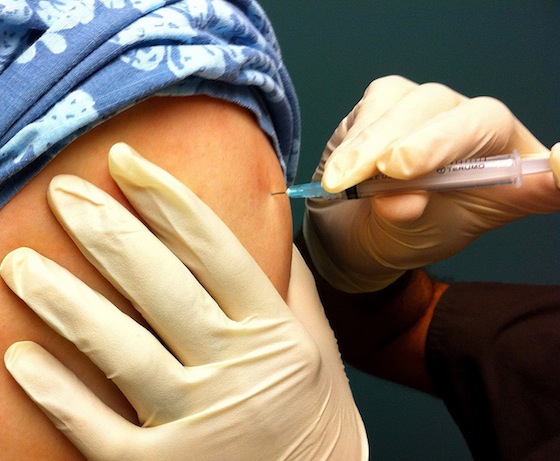
<p>The predominant mode of preventing infection is the flu shot, but it&#8217;s far from perfect. It takes around six months to manufacture the vaccine, which means scientists have to take an educated guess in the spring about which strains are going to be circulating in the fall. It also means flu shots need to be repeated on a yearly basis. And antiviral medications aren&#8217;t much better. To be effective they need to be taken within 48 hours of the first flu symptoms, and they&#8217;re only available by prescription. They&#8217;re also relatively pricey: around $120 for a 10-day course. It might not sound like much to people in the US, but the cost is out of reach for many in resource-poor countries.</p>
<h2 class="wp-block-heading" id="dialing-down-the-immune-system">Dialing down the immune system</h2><p><img alt="Flushot" class="photo" src="http://cdn0.sbnation.com/assets/4064833/flushot.jpg"><br id="1393537495619"></p>
<p>Both the vaccine and antiviral agents focus their efforts on the flu itself.</p>

<p>&#8220;What makes you feel so sick isn&#8217;t the virus itself, but your immune system&#8217;s attempts to kill the flu virus,&#8221; says Jeff Kwong, a public health physician at the University of Toronto.</p>

<p>Since it&#8217;s not the virus itself that&#8217;s directly responsible for so many hospitalizations and deaths, Fedson began to contemplate drugs that could turn down the body&#8217;s immune reaction just enough to keep it from causing life-threatening symptoms. Existing studies have shown that statins save lives not by decreasing cholesterol, but by decreasing the inflammation caused by low-density lipoproteins (LDLs, or &#8220;bad&#8221; cholesterol). Since inflammation is part of the immune response, Fedson believed that statins might also help turn down that reaction in people with influenza. Despite repeatedly making his case to the World Health Organization (WHO) and other health authorities, no one seemed interested. &#8220;Flu scientists are so focused on the virus that they don&#8217;t see anything else that might be going on,&#8221; Fedson says.</p>
<p><q class="left">On the surface, it seemed a victory for statins</q></p>
<p>Kwong was one of the first people to examine Fedson&#8217;s ideas. Since most people on statins are older adults, and this is the group most frequently hospitalized for complications from influenza, it would be easy to look back and determine if statins were beneficial. In a <a href="http://www.plosone.org/article/info%3Adoi%2F10.1371%2Fjournal.pone.0008087">study</a> published in <em>PLOS One</em>, he and his colleagues compared around 1 million older Canadians who had been prescribed statins with an equal number of non-statin takers and measured how frequently they were hospitalized for pneumonia or influenza-related complications each flu season. The team found a small but significant benefit to statin takers: they were slightly less likely to be hospitalized for pneumonia, die from pneumonia, or die from any cause.</p>

<p>On the surface, it seemed a victory for statins. But Kwong still isn&#8217;t so sure. &#8220;We don&#8217;t know if the people who took the statins were hospitalized less and died less often because of the statin, or because they were healthier to begin with,&#8221; he points out.</p>

<p>Not long after, Ann Thomas, an epidemiologist with the Oregon Public Health Division, did a <a href="http://jid.oxfordjournals.org/content/early/2011/12/12/infdis.jir695.abstract">similar look-back</a> at influenza-related hospitalization and statin use in 59 counties during the 2007-2008 flu season. Her results, published in <em>The Journal of Infectious Diseases</em>, were remarkably similar to Kwong&#8217;s. Older adults already taking statins when they were hospitalized for influenza were significantly less likely to die from influenza.</p>

<p>Initially, Thomas says she was convinced by the data and thought statins seemed extremely promising. Today, however, she&#8217;s less convinced. &#8220;I think what we&#8217;re seeing may be the Healthy User Effect &mdash; that people who take statins are healthier overall than those who don&#8217;t,&#8221; Thomas concludes.</p>
<p><q class="right">&#8220;The potential payoff is huge.&#8221;</q></p>
<p>Still, Fedson and some other scientists remain hopeful that more rigorous studies will reveal statins&#8217; helpful nature for influenza. &#8220;The idea is appealing,&#8221; says Lester Kobzik, a professor of pathology at the Harvard School of Public Health. &#8220;The potential payoff is huge for pandemic scenarios, if it works &#8230; but it remains an idea that needs more proof before it&#8217;s ready for prime-time in the clinic.&#8221; That proof, Kobzik says, would come in the form of randomized clinical trials &mdash; the gold standard for rigorous drug testing.</p>

<p>The problem, Fedson says, is getting funding for such trials &mdash; especially if the WHO and CDC aren&#8217;t interested. And because many statins are now available in generic form &mdash; that&#8217;s part of their appeal &mdash; pharmaceutical companies have little motivation to make an investment. &#8220;These drugs could save lives,&#8221; Fedson says. &#8220;And we&#8217;re just not paying attention.&#8221;</p>
						]]>
									</content>
			
					</entry>
			<entry>
			
			<author>
				<name>Carrie Arnold</name>
			</author>
			
			<title type="html"><![CDATA[Gut feelings: the future of psychiatry may be inside your stomach]]></title>
			<link rel="alternate" type="text/html" href="https://www.theverge.com/2013/8/21/4595712/gut-feelings-the-future-of-psychiatry-may-be-inside-your-stomach" />
			<id>https://www.theverge.com/2013/8/21/4595712/gut-feelings-the-future-of-psychiatry-may-be-inside-your-stomach</id>
			<updated>2013-08-21T12:00:07-04:00</updated>
			<published>2013-08-21T12:00:07-04:00</published>
			<category scheme="https://www.theverge.com" term="Features" /><category scheme="https://www.theverge.com" term="Science" />
							<summary type="html"><![CDATA[Her parents were running out of hope. Their teenage daughter, Mary, had been diagnosed with a severe case of obsessive&#8211;compulsive disorder (OCD), as well as ADHD. They had dragged her to clinics around the country in an effort to thwart the scary, intrusive thoughts and the repetitive behaviors that Mary felt compelled to perform. Even [&#8230;]]]></summary>
			
							<content type="html">
											<![CDATA[

						
<figure>

<img alt="" data-caption="Microbiome Assets" data-portal-copyright="" data-has-syndication-rights="1" src="https://platform.theverge.com/wp-content/uploads/sites/2/chorus/uploads/chorus_asset/file/13067743/microbiome_bg1.1419979788.jpg?quality=90&#038;strip=all&#038;crop=0,0,100,100" />
	<figcaption>
	Microbiome Assets	</figcaption>
</figure>
<p>Her parents were running out of hope. Their teenage daughter, Mary, had been diagnosed with a severe case of obsessive&ndash;compulsive disorder (OCD), as well as ADHD. They had dragged her to clinics around the country in an effort to thwart the scary, intrusive thoughts and the repetitive behaviors that Mary felt compelled to perform. Even a litany of psychotropic medications didn&rsquo;t make much difference. It seemed like nothing could stop the relentless nature of Mary&rsquo;s disorder.</p>

<p>Their last hope for Mary was Boston-area psychiatrist James Greenblatt. Arriving at his office in Waltham, MA, her parents had only one request: help us help Mary.</p>

<p>Greenblatt started by posing the usual questions about Mary&rsquo;s background, her childhood, and the onset of her illness. But then he asked a question that no psychiatrist ever had: How was Mary&rsquo;s gut? Did she suffer digestive upset? Constipation or diarrhea? Acid reflux? Had Mary&rsquo;s digestion seemed to change at all before or during her illness? Her parents looked at each other. The answer to many of the doctor&rsquo;s questions was, indeed, &ldquo;Yes.&rdquo;</p>

<p>That&rsquo;s what prompted Greenblatt to take a surprising approach: besides psychotherapy and medication, Greenblatt also prescribed Mary a twice-daily dose of probiotics, the array of helpful bacteria that lives in our gut. The change in Mary was nothing short of miraculous: within six months, her symptoms had greatly diminished. One year after the probiotic prescription, there was no sign that Mary had ever been ill.</p>

<p>Her parents may have been stunned, but to Greenblatt, Mary&rsquo;s case was an obvious one. An imbalance in the microbes in Mary&rsquo;s gut was either contributing to, or causing, her mental symptoms. &ldquo;The gut is really your second brain,&rdquo; Greenblatt said. &ldquo;There are more neurons in the GI tract than anywhere else except the brain.&rdquo;</p>
<div class="snippet-n"><div class="g8-3"> <p>Greenblatt&rsquo;s provocative idea &mdash; that psychiatric woes can be solved by targeting the digestive system &mdash; is increasingly reinforced by cutting-edge science. For decades, researchers have known of the connection between the brain and the gut. Anxiety often causes nausea and diarrhea, and depression can change appetite. The connection may have been established, but scientists thought communication was one way: it traveled from the brain to the gut, and not the other way around.</p> <p>But now, a new understanding of the trillions of microbes living in our guts reveals that this communication process is more like a multi-lane superhighway than a one-way street. By showing that changing bacteria in the gut can change behavior, this new research might one day transform the way we understand &mdash; and treat &mdash; a variety of mental health disorders.</p> <div class="snippet-n float-right"><q>For decades, researchers have known of the connection between the brain and the gut</q></div> <!-- ######## END SNIPPET ######## --><p>For Greenblatt, this radical treatment protocol has actually been decades in the making. Even during his psychiatric residency at George Washington University, he was perplexed by the way mental disorders were treated. It was as if, he said, the brain was totally separate from the body. More than 20 years of work treating eating disorders emphasized Greenblatt&rsquo;s hunch: that the connection between body and mind was more important than conventional psychiatry assumed. &ldquo;Each year, I get more and more impressed at how important the GI tract is for healthy mood and the controlling of behavior,&rdquo; Greenblatt said. Among eating disorder patients, Greenblatt found that more than half of psychiatric complaints were associated with problems in the gut &mdash; and in some patients, he says he has remedied both using solely high-dose probiotics, along with normalizing eating.</p> <p>Greenblatt&rsquo;s solution might strike us as simple, but he&rsquo;s actually targeting a vast, complex, and mysterious realm of the human body: around 90 percent of our cells are actually bacterial, and bacterial genes outnumber human genes by a factor of 99 to 1. But those bacteria, most of which perform helpful functions, weren&rsquo;t always with us: a baby is essentially sterile until it enters the birth canal, at which point the bacteria start to arrive &mdash; and they don&rsquo;t stop. From a mother&rsquo;s vaginal microbes to hugs and kisses from relatives, the exposures of newborns and toddlers in their earliest years is critical to the development of a robust microbiome.</p> <div class="snippet-n float-left"><q>Greenblatt&#8217;s actually targeting a vast, complex, and mysterious realm of the human body</q></div> <!-- ######## END SNIPPET ######## --><p>In fact, recent research suggests that early microbiome development might play a key role in at least some aspects of one&rsquo;s adult mental health. One 2011 <a target="_blank" href="http://onlinelibrary.wiley.com/doi/10.1111/j.1365-2982.2010.01620.x/full">study out of McMaster University</a> compared the behaviors of normal eight-week-old mice and mice whose guts were stripped of microbes. Bacteria-free mice exhibited higher levels of risk-taking, and neurochemical analysis revealed higher levels of the stress hormone cortisol and altered levels of the brain chemical BDNF, which has been implicated in human anxiety and depression. &ldquo;This work showed us that anxiety was normal, and that the gut-brain axis was involved in that,&rdquo; Jane Foster, the study&rsquo;s lead author, said. &ldquo;Everybody knew that stress and anxiety could lead to gastrointestinal symptoms, but we looked at it from the bottom up and showed that the gut could communicate with the brain. It was the first demonstration that the gut itself could influence brain development.&rdquo;</p> <p>Subsequent <a target="_blank" href="http://www.sciencedirect.com/science/article/pii/S001650851100607X">research out of McMaster</a> further enforces those findings, by showing that swapping one mouse&rsquo;s gut bacteria with that of another can significantly alter behavior. Researchers transplanted microbes from one group of mice, which were characterized by timidity, into the guts of mice who tended to take more risks. What they observed was a complete personality shift: timid mice became outgoing, while outgoing mice became timid. &ldquo;It&rsquo;s good evidence that the microbiota houses these behaviors,&rdquo; Foster said.</p> <p>While researchers have established a compelling link between gut bacteria and mental health, they&rsquo;re still trying to figure out the extent to which the human microbiome &mdash; once it&rsquo;s populated in early childhood &mdash; can be transformed. &ldquo;The brain seems to be hardwired for anxiety by puberty and early adolescence,&rdquo; Foster said. If the microbiome is part of that hardwiring, then it would suggest that once we pass a certain threshold, the impact of bacterial tweaks on problems like depression and anxiety might wane.</p> <p>In <a target="_blank" href="http://onlinelibrary.wiley.com/doi/10.1113/jphysiol.2004.063388/full">one Japanese study</a>, for instance, researchers were only able to change the baseline stress characteristics of germ-free mice until nine weeks of age. After that, no variety of bacterial additions to the mice&rsquo;s guts could properly regulate stress and anxiety levels. The explanation for this phenomenon might lie in what&rsquo;s known as &ldquo;developmental programming&rdquo; &mdash; the idea that various environmental factors, to which we&rsquo;re exposed early on, greatly determine the structure and function of organs including the gut and the brain.</p> <p>&ldquo;There are changes that happen early in life that we can&rsquo;t reverse,&rdquo; said John Cryan, a neuroscientist at the University of Cork in Ireland and a main investigator at the Alimentary Pharmabiotic Centre. &ldquo;But there are some changes that we can reverse. It tells us that there is a window when microbes are having their main effects and, until this closes, many changes can be reversed.&rdquo;</p> </div></div><!-- ######## END SNIPPET ######## --><p><img alt="Microbiome_bottom" class="photo" src="https://platform.theverge.com/wp-content/uploads/sites/2/chorus/assets/3017417/microbiome_bottom.gif"></p><div class="snippet-n"><div class="g8-3"> <p>Even if our gut bacteria carries the biggest influence when we&rsquo;re young, experts like Greenblatt and Cryan are still convinced that tweaking these bacteria later in life can yield profound behavioral and psychological changes. In a <a href="http://www.ncbi.nlm.nih.gov/pmc/articles/PMC3179073/" target="_blank">study led by Cryan</a>, anxious mice dosed with the probiotic bacterium <em>Lactobacillus rhamnosus (JB-1)</em> showed lower levels of anxiety, decreased stress hormones, and even an increase in brain receptors for a neurotransmitter that&rsquo;s vital in curbing worry, anxiety, and fear.</p> <p>John Bienenstock, a co-author on that study, compared the probiotics&rsquo; effects to benzodiazepines like Valium and Xanax. &ldquo;The similarity is intriguing. It doesn&rsquo;t prove they both use the same pathway [in the brain], but it&rsquo;s a possibility.&rdquo;</p> <p>Although plenty of questions remain, the benefits of using probiotics to treat human behavior are becoming increasingly obvious. Yogurts like Dannon&rsquo;s Activia have been marketed with much success as a panacea for all of our intestinal ills. Other probiotic supplements have claimed to support immune health. Probiotics&rsquo; potential to treat human behavior is increasingly apparent, but will manufacturers one day toss an anxiety-fighting blend into their probiotic brews?</p> <q>Experts are convinced that tweaking these bacteria later in life can yield profound behavioral and psychological changes</q><p>It&rsquo;s a distinct possibility: in one 2013 <a target="_blank" href="http://onlinelibrary.wiley.com/doi/10.1113/jphysiol.2004.063388/full">proof-of-concept study</a>, researchers at UCLA showed that healthy women who consumed a drink with four added probiotic strains twice daily for four weeks showed significantly altered brain functioning on an fMRI brain scan. The women&rsquo;s brains were scanned while they looked at photos of angry or sad faces, and then asked to match those with other faces showing similar emotions.</p> <p>Those who had consumed the probiotic drink showed significantly lower brain activity in the neural networks that help drive responses to sensory and emotional behavior. The research is &ldquo;groundbreaking,&rdquo; Cryan said, because it&rsquo;s the first trial to show that probiotics could affect the functioning of the human brain. Still, he notes that the results need to be interpreted with care.</p> <p>As the research community increasingly lends credence to Greenblatt&rsquo;s ideas, and public awareness about gut bacteria grows, he&rsquo;s confident we&rsquo;ll soon know more about the power of probiotics. &ldquo;Because of the commercials and the other information that&rsquo;s out there, patients are beginning to ask,&rdquo; he said. &ldquo;They&rsquo;re much more aware of how important probiotics are.&rdquo;</p> <p>Whether all of our mental woes respond to probiotic treatment as dramatically as Greenblatt&rsquo;s patient Mary remains to be seen. &ldquo;We have to be very cautious in this field not to be too hyperbolic about what we promise,&rdquo; Cryan said. Indeed, scientists still aren&rsquo;t sure exactly which microbial species are part of a healthy microbiome, nor do they know whether certain bacterial strains are absolutely vital to mental functioning, or whether the right balance is what&rsquo;s key. Furthermore, research still hasn&rsquo;t parsed which illnesses might be affected by the microbiome and, therefore, treatable using probiotics. &ldquo;There are beginning to be suggestions that this type of probiotic treatment is worth pursuing,&rdquo; Bienenstock said. &ldquo;Whether we can use this to improve people&rsquo;s lives, well, the door is just beginning to open on this.&rdquo;</p> <h3>Read next:</h3> </div></div><!-- ######## END SNIPPET ######## --><div class="snippet-n tiles"> <div class="row"> <a href="http://www.theverge.com/2013/4/25/4264742/new-research-the-brains-of-psychopaths" class="cell"><div class="hgroup"> <h2>Controversial update to &#8216;bible&#8217; of psychiatry fuels debate over foundations of mental health</h2> <h3 class="meta"><span class="byline">Amar Toor</span></h3> </div></a> <a href="http://www.theverge.com/2013/4/25/4264742/new-research-the-brains-of-psychopaths" class="cell"><div class="hgroup"> <h2>Dangerous minds: new research unravels the brains of psychopaths</h2> <h3 class="meta"><span class="byline">Katie Drummond</span></h3> </div></a> <a href="http://www.theverge.com/2013/8/14/4618718/hacker-depression-def-con" class="cell"><div class="hgroup"> <h2>Cracking suicide: hackers try to engineer a cure for depression</h2> <h3 class="meta"><span class="byline">Adrianne Jeffries</span></h3> </div></a> </div> <div class="row"> <a href="http://www.theverge.com/2013/8/9/4605758/memory-observation-and-manipulation-techniques#" class="cell"><div class="hgroup"> <h2>Matter over mind: scientists begin to observe and manipulate memories</h2> <h3 class="meta"><span class="byline">Carl Franzen</span></h3> </div></a> <a href="http://www.theverge.com/2013/4/10/4208444/transparent-brains-could-transform-neuroscience" class="cell"><div class="hgroup"> <h2>Technique to create transparent brains could transform neuroscience</h2> <h3 class="meta"><span class="byline">Katie Drummond</span></h3> </div></a> <a href="http://www.theverge.com/2013/6/4/4381890/carmen-tarleton-the-incredible-story-of-a-face-transplant" class="cell"><div class="hgroup"> <h2>Beyond recognition: the incredible story of a face transplant</h2> <h3 class="meta"><span class="byline">Katie Drummond</span></h3> </div></a> </div> </div><!-- ######## END SNIPPET ######## -->
						]]>
									</content>
			
					</entry>
	</feed>