<?xml version="1.0" encoding="UTF-8"?><feed
	xmlns="http://www.w3.org/2005/Atom"
	xmlns:thr="http://purl.org/syndication/thread/1.0"
	xml:lang="en-US"
	>
	<title type="text">Duncan Geere | The Verge</title>
	<subtitle type="text">The Verge is about technology and how it makes us feel. Founded in 2011, we offer our audience everything from breaking news to reviews to award-winning features and investigations, on our site, in video, and in podcasts.</subtitle>

	<updated>2014-07-16T15:09:07+00:00</updated>

	<link rel="alternate" type="text/html" href="https://www.theverge.com/author/duncan-geere" />
	<id>https://www.theverge.com/authors/duncan-geere/rss</id>
	<link rel="self" type="application/atom+xml" href="https://www.theverge.com/authors/duncan-geere/rss" />

	<icon>https://platform.theverge.com/wp-content/uploads/sites/2/2025/01/verge-rss-large_80b47e.png?w=150&amp;h=150&amp;crop=1</icon>
		<entry>
			
			<author>
				<name>Duncan Geere</name>
			</author>
			
			<title type="html"><![CDATA[The scuba diver social network that could save your life]]></title>
			<link rel="alternate" type="text/html" href="https://www.theverge.com/2014/7/16/5904733/this-underwater-social-network-will-make-scuba-diving-safer" />
			<id>https://www.theverge.com/2014/7/16/5904733/this-underwater-social-network-will-make-scuba-diving-safer</id>
			<updated>2014-07-16T11:09:07-04:00</updated>
			<published>2014-07-16T11:09:07-04:00</published>
			<category scheme="https://www.theverge.com" term="Report" /><category scheme="https://www.theverge.com" term="Science" />
							<summary type="html"><![CDATA[For divers swimming hundreds of feet beneath the ocean&#8217;s surface, communication is a notorious challenge. Crews have developed an extensive language of hand signals to express their needs, but they&#8217;re hampered by one obvious caveat: the signals rely on people looking at each other. A flat hand making a cutting motion at a throat to [&#8230;]]]></summary>
			
							<content type="html">
											<![CDATA[

						
<figure>

<img alt="" data-caption="" data-portal-copyright="&lt;a href=&quot;https://www.flickr.com/photos/skuds/10177790983&quot;&gt;Flickr/Skuds&lt;/a&gt;" data-has-syndication-rights="1" src="https://platform.theverge.com/wp-content/uploads/sites/2/chorus/uploads/chorus_asset/file/14778891/10177790983_cac0720ac8_k.0.1410398451.jpg?quality=90&#038;strip=all&#038;crop=0,0,100,100" />
	<figcaption>
		</figcaption>
</figure>
<p>For divers swimming hundreds of feet beneath the ocean&#8217;s surface, communication is a notorious challenge. Crews have developed an <a href="http://en.wikipedia.org/wiki/Diver_communications#Hand_signals">extensive language of hand signals</a> to express their needs, but they&#8217;re hampered by one obvious caveat: the signals rely on people looking at each other. A flat hand making a cutting motion at a throat to indicate &#8220;I&#8217;m running out of air&#8221; is no good if your dive partner is distracted by a shoal of fish. Such challenges help explain why suffocation is the <a href="http://www.alertdiver.com/No_Accident">leading cause of diving fatalities</a>, alongside being trapped in underwater caves or wrecks and equipment defects.</p>
<p><!-- extended entry --></p><hr class="widget_boundry_marker hidden page_break">
<p>But improving underwater communication is hard. Electromagnetic waves, used in surface communication networks almost exclusively, fade out over long ranges in salt water, meaning that sound waves need to be used for data transmission instead. Hydrophones, essentially microphones designed to be used underwater, were developed in the early 20th century by noted physicist Ernest Rutherford to communicate with submarines, and both the US and Russian Navy have hydrophones installed in seabeds, connected by cable to land stations. But sound waves have very limited bandwidth, which means low data transfer rates compared to terrestrial communication.</p>
<p><q class="right">Ultrasonic, subaquatic networks</q></p>
<p>All of which means that recreational divers don&#8217;t have much in the way of foolproof communication. Now, a Swedish startup called <a href="https://aqwary.com/">Aqwary</a> hopes to change that. The company has developed a new approach to underwater communication: allowing divers to create ultrasonic, subaquatic networks that passively share information like their location and air supply status.</p>

<p>&#8220;It allows you to be more alert about what&#8217;s happening around you,&#8221; explains Anders Brodin, the company&#8217;s founder and managing director, in an interview with <em>The Verge</em>. He came up with the concept while diving with his kids and worrying about the state of their air supply. &#8220;I realized that there has to be a technical solution that could help me do this,&#8221; he says. The result is the Smart Console, a palm-sized unit with a 3.7-inch OLED display that connects to your air tank with a thick rubber tube.</p>

<p>&#8220;It&#8217;s basically a small computer designed to withstand 50 meters [164 feet] of depth,&#8221; Brodin says. &#8220;It&#8217;s integrated with your air supply, so you see how much gas you have left in your tank, and it also has all kinds of sensors.&#8221; Those include a magnetometer, accelerometer, external temperature sensor, depth meter, and air pressure (to measure the amount of breathing gas left in the tank), internal pressure, and internal temperature sensors.</p>

<p>But the most notable feature of the Smart Console is that it also communicates with any other unit nearby through four ultrasonic hydrophones. On its screen, you see the name, position, depth, temperature, and air supply status of up to 70 other divers within 328 feet. If any run low on air, an alert is sent over the network and to a boat on the surface. If they get trapped underwater, they can broadcast a distress signal manually.</p>
<p><img src="https://platform.theverge.com/wp-content/uploads/sites/2/chorus/assets/4764026/conceptaqwary.jpg" class="photo" alt="Conceptaqwary"> <br id="1405519351121"></p>
<p><em><em>A mockup of the Smart Console. (Aqwary)</em></em></p>

<p>Each diver&#8217;s signals are sent over ultrasound. &#8220;If you&#8217;re old enough to remember the old-fashioned modems you used on your telephone line, it&#8217;s pretty much the same basic technology,&#8221; Brodin says. Those sound waves are modulated, sent through water, and then demodulated by another unit. This type of underwater communication has a theoretical range of around 3.7 miles, but the Smart Console has a shorter range of just 328 feet. The reason is battery life &mdash; &#8220;We have designed it so you can get 10 hours of usage out of the unit,&#8221; says Brodin.</p>
<p><q class="left">Save your dive data to the cloud</q></p>
<p>But battery life isn&#8217;t the only concern when you&#8217;re blaring out high-pitched noises across the sea floor. Many marine creatures, dolphins included, use ultrasound to communicate and locate prey, and there are fears that noise pollution associated with human activity underwater is disrupting marine life. Brodin says they&#8217;ve seen no evidence of any adverse effects on animals from the Smart Console: &#8220;When we did the first trials in early 2013, we spent time trying to annoy fishes at the reefs with it, and they didn&#8217;t react at all. You could almost poke it at them and they wouldn&#8217;t react.&#8221;</p>

<p>Underneath the rather utilitarian waterproof exterior, the Smart Console has 32GB of memory, a 536MHz processor, and built-in Wi-Fi to save your dive data to the cloud. It&#8217;s also equipped with an app store, where divers can download digital compasses, more advanced dive computers, and dictionaries of fish and dive sites. Unfortunately, it&#8217;s not open to third-party developers because the device is &#8220;classified as <a href="http://ec.europa.eu/enterprise/policies/european-standards/harmonised-standards/personal-protective-equipment/index_en.htm">personal protective equipment</a>,&#8221; Brodin says. &#8220;That means we have to be careful that we don&#8217;t get code in there that would somehow risk people&#8217;s lives.&#8221;</p>
<p><q class="right">&#8220;They asked us if we could play movies or show Netflix on it.&#8221;</q></p>
<p>The apps available were chosen by beta testers, and one of the biggest requests from users was something to do during decompression. When you dive deep, you have to stop on the way up for 15 to 20 minutes to avoid decompression sickness, commonly known as &#8220;the bends.&#8221; &#8220;Right now one of the developers is working on a version of Snake,&#8221; Brodin says. &#8220;They asked us if we could play movies or show Netflix on it, but unfortunately we don&#8217;t have the bandwidth.&#8221; Nor can you tweet from the bottom of the sea just yet &mdash; the devices can&#8217;t connect to the wider web from below the waves. But that may change, Brodin says. &#8220;That&#8217;s actually in the makings for something we will launch in a year from now.&#8221;</p>

<p>The company will ship its first orders in July, with the unit running around $800 USD. Ultimately, Brodin hopes that the Smart Console makes diving safer. &#8220;Having full access to your buddies&#8217; data will support your decisions during the dive to make sure that you keep within limits,&#8221; he says. With studies showing that diving is <a href="http://archive.rubicon-foundation.org/xmlui/handle/123456789/6770">40 to 60 times more dangerous</a> than driving a car, perhaps the Smart Console will make the sea a safer place to be for those who want to experience its beauty first-hand.</p>
						]]>
									</content>
			
					</entry>
			<entry>
			
			<author>
				<name>Duncan Geere</name>
			</author>
			
			<title type="html"><![CDATA[Freezing Sochi: how Russia turned a subtropical beach into a Winter Olympics wonderland]]></title>
			<link rel="alternate" type="text/html" href="https://www.theverge.com/2014/2/4/5377356/sochi-winter-olympics-2014-subtropical-transformation" />
			<id>https://www.theverge.com/2014/2/4/5377356/sochi-winter-olympics-2014-subtropical-transformation</id>
			<updated>2014-02-04T12:30:59-05:00</updated>
			<published>2014-02-04T12:30:59-05:00</published>
			<category scheme="https://www.theverge.com" term="Report" /><category scheme="https://www.theverge.com" term="Science" />
							<summary type="html"><![CDATA[The Olympic Village in Sochi, Russia, on the shores of the Black Sea. ( Wikipedia) Sochi is not the most obvious place to host the Winter Olympics. The Russian resort, on the eastern shore of the Black Sea, is humid and subtropical. Temperatures average out at about 52 degrees Fahrenheit in the winter, and 75 [&#8230;]]]></summary>
			
							<content type="html">
											<![CDATA[

						
<figure>

<img alt="" data-caption="Sochi Olympic Village" data-portal-copyright="" data-has-syndication-rights="1" src="https://platform.theverge.com/wp-content/uploads/sites/2/chorus/uploads/chorus_asset/file/14612153/Village_Olympique_Sochi.1419980307.jpg?quality=90&#038;strip=all&#038;crop=0,0,100,100" />
	<figcaption>
	Sochi Olympic Village	</figcaption>
</figure>
<p><em><em>The Olympic Village in Sochi, Russia, on the shores of the Black Sea. ( Wikipedia)</em></em></p>

<p>Sochi is not the most obvious place to host the Winter Olympics.</p>

<p>The Russian resort, on the eastern shore of the Black Sea, is humid and subtropical. Temperatures average out at about 52 degrees Fahrenheit in the winter, and 75 degrees in the summer. Palm trees line the streets, and it&#8217;s the only part of Russia warm enough to grow tea leaves. In other words, it&#8217;s a lovely spot if you&#8217;re planning a beach holiday &mdash; Stalin had his favorite summer house there &mdash; but it wouldn&#8217;t be most people&#8217;s first choice for a ski trip.</p>
<p><!-- extended entry --></p><hr class="widget_boundry_marker hidden page_break">
<p>&#8220;There is almost no snow here &mdash; at the moment it&#8217;s raining,&#8221; says Olga Mironova, a local resident. That&#8217;s exactly the problem that derailed the last Winter Olympics in Vancouver in 2010 &mdash; buckets of snow had to be airlifted to top up the slushy covering on the hay bales that were being used to create artificial mounds in the tracks. Those emergency measures proved successful, but organizers admitted afterwards that they&#8217;d seriously underestimated the impact of climate change.</p>

<p>Sochi was awarded the XXII Olympic Winter Games and Paralympic Winter Games in 2007 following an unsuccessful bid for the 2002 event. Russia beat rival bids from Salzburg in Austria and Pyeongchang in South Korea thanks mainly to its existing tourist infrastructure and strong public and political support for the bid. Russian president Vladimir Putin even flew to the elections in Guatemala City to deliver a speech in support of Sochi, telling the jury: &#8220;We have never won the honor to celebrate the Winter Olympic Games. You know we can turn sports competitions into a really spectacular show and we are good at it.&#8221;</p>
<p><q class="right">Best known for tulip fields and productive honeybees</q></p>
<p>The key to convincing the jury was the nearby Krasnaya Polyana mountains, an hour&#8217;s drive from Sochi itself. Here, nestled among the peaks of the Western Caucasus under the Aigba Ridge, an Olympic village has since been built in the new resort of Rosa Khutor, which hosted the Alpine Ski World Cup races in 2012.</p>

<p>However, the resort of Rosa Khutor is only three years old itself. Until two decades ago it had no road or telephone access, and when Russia won the bid in 2007 it was best known for its tulip fields and the generous productivity of its honeybees. The resort was almost unknown in the US for skiing, though French heli-skiers had been exploring its terrain for some years.</p>

<p>So it shouldn&#8217;t come as much surprise that transforming Rosa Khutor into an Olympic venue has been a rapid, expensive process. It&#8217;s estimated that the cost of staging the Olympics in Sochi has been greater than the previous three Winter Games combined &mdash; ballooning to a whopping $51 billion. A sizable chunk of that money has gone to dealing with the &#8220;whims of the weather,&#8221; as a spokesperson for Sochi 2014 put it in an email to <em>The Verge</em>.</p>

<p>Due to the region&#8217;s rural heritage, there&#8217;s no history of meteorological data to analyze &mdash; weather stations were only installed in 2010. Locals also say that temperatures tend to be wildly unpredictable &mdash; it&#8217;s not uncommon for 3 feet of snow to fall overnight, but in February, 2013 several World Cup events were canceled due to lack of snow.</p>
<p><img alt="Sochi-village" class="photo" src="http://cdn2.sbnation.com/assets/3955881/sochi-village.png"><br id="1391526831691"></p>
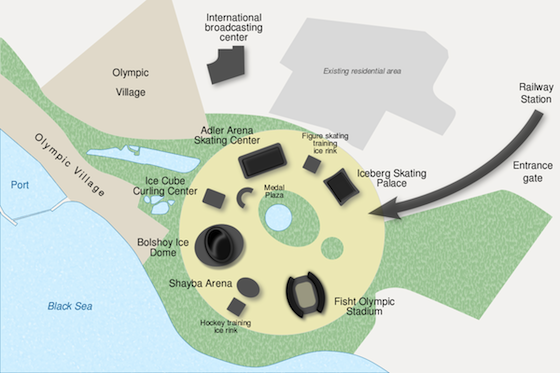
<p><em><em>A map of Sochi&#8217;s Olympic venues. (Wikipedia)</em></em></p>

<p>But the Olympics can&#8217;t be canceled, and with the eyes of the world on Russia, it&#8217;s imperative that the former superpower gets this right. As such, Sochi 2014&#8217;s management team has put together a comprehensive plan to make absolutely sure that the Winter Games won&#8217;t be a washout. &#8220;Taken together, these measures will mean that snow is guaranteed, whatever the weather,&#8221; the Sochi spokesperson said.</p>

<p>Though Sochi&#8217;s management team refused to disclose the technical details of the program, they did detail an extensive system of safeguards that should mean there&#8217;ll be sufficient snow in Sochi for the games. These include the implementation of one of the largest snowmaking systems in Europe, comprising of two huge water reservoirs that feed 400 snow cannons installed along the slopes.</p>
<p><q class="left">&#8220;These measures will mean that snow is guaranteed.&#8221;</q></p>
<p>If that snow isn&#8217;t enough, then the authorities will fall back on 710,000 cubic meters of snow collected during the winters of previous years leading up to the games. To keep it from melting in the region&#8217;s hot summers, the 10 separate stockpiles have been kept packed tight under insulating covers high up in the mountains, safe from the sun&#8217;s rays. If the snow cannons aren&#8217;t sufficient to keep the tracks open, then a stockpile will be unsealed and the resulting mini-avalanche will be guided down the mountain, using half-pipes, to where it&#8217;s needed.</p>

<p>Speaking of avalanches, <a href="http://www.issw2008.com/papers/P__8009.pdf">careful preparation</a> has also gone into making sure that a natural disaster doesn&#8217;t overwhelm the young resort as the rapid pace of construction means that its landscapes have seen dramatic change in a very short space of time. Risk mapping, structural protection and explosive avalanche control techniques that trigger small, harmless flows before enough snow can collect for a huge, devastating event, are all being employed in the complex terrain that surrounds Rosa Khutor.</p>

<p>When the Olympics are over, this snowmaking and safety infrastructure won&#8217;t be dismantled. Instead, it&#8217;ll be used to extend Rosa Khutor&#8217;s ski season to between 140 and 180 days a year &mdash; far longer than many resorts are able to open for.</p>

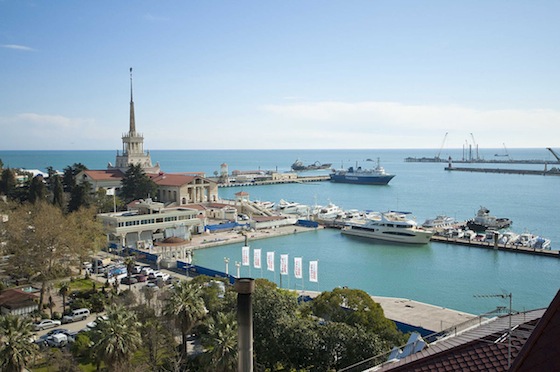
<p>Down in Sochi itself, on the coast of the Black Sea, the other half of the games will be held. Here, the weather is less of a factor &mdash; five indoor arenas will host figure skating, speed skating, hockey, and curling, and an additional outdoor area will host the opening and closing ceremonies. The Olympic Park in Sochi will also play double-duty: it&#8217;s been carefully designed so that it can also act as a home for the Formula 1&#8217;s first Russian Grand Prix in October, 2014.</p>

<p>In each of these indoor arenas, underfloor cooling systems are installed so that the ice stays frozen above it. Like in other ice rinks around the world, this will be accomplished using a substance called <a href="http://en.wikipedia.org/wiki/Propylene_glycol">propylene glycol</a>, which doesn&#8217;t freeze until temperatures reach 8.6 F. The chemical is cooled in a refrigeration system and then pumped through pipes in aluminum panels that sit directly below the ice. The panels are chilled by the coolant, and the ice stays frozen.</p>
<p><img alt="Sochi-port" class="photo" src="http://cdn2.sbnation.com/assets/3955849/sochi-port.jpg"><br id="1391526647250"></p>
<p>While Sochi is expending a tremendous amount of effort and money on ensuring the XXII Olympic Winter Games goes smoothly, the scale of the undertaking may be dwarfed by that required to keep the Winter Olympics going in the coming decades.</p>

<p>Climatologists predict that even under a best-case scenario, almost half the venues that have hosted the Winter Olympics over the last century would be unable to do so by 2080 without resorting to extensive and expensive artificial snowmaking techniques. In a business-as-usual scenario, which climatologists warn that we&#8217;re facing unless global legislation is swiftly enacted, the same outcome would be expected in just 40 years.</p>

<p>The mechanics of climate change mean that polar regions are warming much faster than those at the equator. The February daytime temperature of Winter Games locations averaged out at 32.7 F between the 1920-&#8217;50s, but have soared to 46.0 F at Olympics held this millennium. &#8220;Despite technological advances, there are limits to what current weather risk management strategies can cope with,&#8221; said Daniel Scott from the University of Waterloo, who led the <a href="https://uwaterloo.ca/news/sites/ca.news/files/uploads/files/oly_winter_games_warmer_world_2014.pdf">research</a>. &#8220;By the middle of this century, these limits will be surpassed in some former Winter Olympic host regions.&#8221;</p>
<p><q class="right">&#8220;It will be more problematic than ever to find suitable and snow-safe places.&#8221;</q></p>
<p>Hans Linderholm, a climatologist at the University of Gothenburg, told <em>The Verge</em>: &#8220;It will be more problematic than ever to find suitable and snow-safe places. It&#8217;s likely the use of indoor arenas will become more common in the future. Then the Winter Games can be held almost anywhere &mdash; even Qatar!&#8221;</p>

<p>With mere days left before the Games begin in Sochi, the last pieces of the puzzle are being put into place. Plenty of factors could derail the Winter Olympics &mdash; Circassian terrorists, protests over Russia&#8217;s anti-gay laws, the absence of high-profile western leaders, corruption allegations, <a href="http://deadspin.com/staying-in-sochi-is-a-hilarious-adventure-1515722114">dodgy accommodations</a>, and catastrophic damage to the region&#8217;s delicate ecosystems are only a few examples.</p>

<p>But a lack of snow shouldn&#8217;t be one of them.</p>
						]]>
									</content>
			
					</entry>
			<entry>
			
			<author>
				<name>Duncan Geere</name>
			</author>
			
			<title type="html"><![CDATA[Bottle rockets: water could propel tiny satellites of the future into deep space]]></title>
			<link rel="alternate" type="text/html" href="https://www.theverge.com/2013/12/2/5166398/cubesat-kickstarter-water-for-satellite-propulsion" />
			<id>https://www.theverge.com/2013/12/2/5166398/cubesat-kickstarter-water-for-satellite-propulsion</id>
			<updated>2013-12-02T12:05:02-05:00</updated>
			<published>2013-12-02T12:05:02-05:00</published>
			<category scheme="https://www.theverge.com" term="Report" /><category scheme="https://www.theverge.com" term="Science" />
							<summary type="html"><![CDATA[Since the CubeSat specification was developed in 1999 by Stanford and California Polytechnic, low-cost satellites have become a reality for academic institutions and companies around the world. Their standardized dimensions and off-the-shelf components make for simpler design and production, but there&#8217;s a problem: these 10-centimeter cubes, used widely in fields such as meteorology, communications, and [&#8230;]]]></summary>
			
							<content type="html">
											<![CDATA[

						
<figure>

<img alt="" data-caption="CubeSat" data-portal-copyright="" data-has-syndication-rights="1" src="https://platform.theverge.com/wp-content/uploads/sites/2/chorus/uploads/chorus_asset/file/14546268/CubeSat-lead.1419980130.png?quality=90&#038;strip=all&#038;crop=0,0,100,100" />
	<figcaption>
	CubeSat	</figcaption>
</figure>
<p>Since the <a href="http://en.wikipedia.org/wiki/CubeSat">CubeSat</a> specification was developed in 1999 by Stanford and California Polytechnic, low-cost satellites have become a reality for academic institutions and companies around the world. Their standardized dimensions and off-the-shelf components make for simpler design and production, but there&#8217;s a problem: these 10-centimeter cubes, used widely in fields such as meteorology, communications, and aeronautics, are limited by Earth&#8217;s orbit. Now, a team of researchers wants to change that &mdash; making interplanetary exploration more affordable by <a href="http://www.kickstarter.com/projects/longmier/cat-launch-a-water-propelled-satellite-into-deep-s">crowdfunding</a> the development of a novel thruster that uses water as its propellant.</p>
<p><!-- extended entry --></p><hr class="widget_boundry_marker hidden page_break">
<p>Their CubeSat Ambipolar Thruster, or CAT, works in a similar way to existing rocket thrusters &mdash; by heating up a propellant and expelling it through a nozzle. In this case, however, the CAT will heat its propellant &#8220;to millions of degrees instead of thousands of degrees,&#8221; says project leader Ben Longmier from the University of Michigan. That heat turns it into plasma, which is then guided with a magnetic nozzle to where it needs to be. &#8220;This extremely high temperature,&#8221; Longmier says, &#8220;allows for the high efficiency of the engine.&#8221; That efficiency, combined with its small size and simple components, also makes it very cheap.</p>
<p><q class="left">Leaving the safety of Earth&#8217;s orbit has been an expensive task</q></p>
<p>That&#8217;s important because leaving the safety of Earth&#8217;s orbit has traditionally been an expensive task. India&#8217;s recent mission to Mars, widely referred to as &#8220;low-budget,&#8221; cost the country $72 million. NASA&#8217;s <a href="http://solarsystem.nasa.gov/missions/profile.cfm?MCode=MarsObserver">Mars Observer</a> cost 10 times as much when it launched in 1992. Longmier and his team are seeking just $50,000 to develop their thruster, which can then be attached to a regular CubeSat to send it far beyond Earth&#8217;s orbit. &#8220;It would usher in a whole new capability for small satellites,&#8221; Longmier says.</p>

<p>There are hundreds of potential uses for the technology. A fleet of satellites observing the atmospheres of other planets could be as dense as those tracking Earth&#8217;s. Scientists could gather far more data on solar flares, making space weather more predictable. A proliferation of CubeSats would also help identify and tag objects in the asteroid belt for mining or exploration, not to mention the search for life on the watery moons of Saturn and Jupiter or even the creation of an <a href="http://en.wikipedia.org/wiki/Interplanetary_Internet">interplanetary internet</a>.</p>
<p><q class="right">&#8220;Space is a risky business.&#8221;</q></p>
<p>However, there are plenty of things that could go wrong between then and now. &#8220;Space is a risky business,&#8221; Longmier acknowledges. &#8220;Things will break. We are pursuing this model of research and development and using space as our new laboratory. In the lab, things break and arc and melt. It&#8217;s easy to fix and you&#8217;re off running again. In space, if it breaks, it&#8217;s likely dead.&#8221;</p>

<p>This isn&#8217;t so much of a problem with the CAT thruster as with a billion-dollar craft, as another model can be launched at low cost. But running out of funding before the engine becomes operational is a real risk, Longmier says. That&#8217;s why the team has taken to Kickstarter to raise funds for its endeavor.</p>
<p><img alt="Cubesat-inline" class="photo" src="http://cdn0.sbnation.com/assets/3663097/cubesat-inline.JPG"><br id="1386002477888"></p>
<p>A <a href="http://www.kickstarter.com/projects/longmier/cat-a-thruster-for-interplanetary-cubesats">first attempt</a> at raising $200,000 for the project failed this past August, managing to gather just $68,000 before the deadline. Now, the team has launched a <a href="http://www.kickstarter.com/projects/longmier/cat-launch-a-water-propelled-satellite-into-deep-s">second crowdfunding</a> drive with a lower target of $50,000 that&#8217;ll allow &mdash; with the help of some private investors &mdash; for the creation of a minimum viable thruster. The idea is to get the project moving, then worry about the rest of the funding later.</p>

<p>Of course, if the team surpasses that figure, this preliminary thruster can become more advanced. Raising $80,000 means increased efficiency of the nozzle, while $500,000 will allow the team to increase the throttle range. And if funding reaches $1,750,000, topping the funding gathered for the <a href="http://www.kickstarter.com/projects/1458134548/arkyd-a-space-telescope-for-everyone-0">Arkyd Space Telescope</a>, then the team will send CAT into deep space, allowing backers to vote on its destination.</p>
<p><q class="left">&#8220;We should be developing space technologies with ambitious goals.&#8221;</q></p>
<p>These goals may sound ambitious, but Sara Seager, a professor of Planetary Science and Physics at MIT, applauds the team for its ambition. &#8220;As a society we should be developing space technologies with ambitious goals,&#8221; says Seager, who isn&#8217;t involved in the project. &#8220;This is a highly credible team and a sound concept. By giving interplanetary capability to small satellites, they&#8217;ll open up interplanetary space to a wide variety of people [including] traditionally non-space-faring nations.&#8221;</p>

<p>&#8220;Getting a plasma thruster small enough to propel a CubeSat would be very useful,&#8221; adds Lucy Rogers, project coordinator at the British Interplanetary Society and the author of <a href="http://www.amazon.co.uk/Its-ONLY-Rocket-Science-Introduction/dp/038775377X"><em>It&#8217;s Only Rocket Science</em></a>. Rogers was surprised by the choice of water as propellant, however. &#8220;Xenon, the heavy inert gas which is the industry standard for electric propulsion, is 1.7 times more dense than water,&#8221; she says. &#8220;It takes up less volume for the same amount of oomph. Also, water freezes below zero, so the tank will have to be kept warm.&#8221;</p>
<p><q class="right">&#8220;We could refuel at asteroids or depots.&#8221;</q></p>
<p>Longmier plans to start out with xenon, using it to benchmark the thruster&#8217;s performance. He says it&#8217;ll take around $300,000 in funding to complete the development of a water-propellant system. &#8220;Water is everywhere in the solar system,&#8221; he says in defense of the tactic. &#8220;Long term, we could refuel at asteroids or depots. Short term, water is easy to store and launch. We can even have astronauts launch our little engines from the ISS without any safety concerns.&#8221;</p>

<p>For their support, backers of the Kickstarter drive can secure anything from a silk bow-tie to having their name laser-etched onto one of the spacecraft. Pledge $10,000 and the team will fly you from anywhere in the US to press the button that triggers the first firing of the thruster in space. &#8220;With this technology, we can explore deep space and other planets faster and cheaper than ever before,&#8221; Longmier says. &#8220;First, we would like to make space exploration affordable and sustainable. And second, we&#8217;d like to open it up to the community and have people be a part of the process.&#8221;</p>
						]]>
									</content>
			
					</entry>
			<entry>
			
			<author>
				<name>Duncan Geere</name>
			</author>
			
			<title type="html"><![CDATA[Kickstarter bans project creators from giving away genetically-modified organisms]]></title>
			<link rel="alternate" type="text/html" href="https://www.theverge.com/2013/8/2/4583562/kickstarter-bans-project-creators-from-giving-GMO-rewards" />
			<id>https://www.theverge.com/2013/8/2/4583562/kickstarter-bans-project-creators-from-giving-GMO-rewards</id>
			<updated>2013-08-02T17:17:23-04:00</updated>
			<published>2013-08-02T17:17:23-04:00</published>
			<category scheme="https://www.theverge.com" term="Report" /><category scheme="https://www.theverge.com" term="Science" /><category scheme="https://www.theverge.com" term="Tech" /><category scheme="https://www.theverge.com" term="Web" />
							<summary type="html"><![CDATA[Kickstarter is clamping down on genetically-modified organisms following the success of a project to genetically engineer glowing plants for use as additional lighting in people&#8217;s homes. Earlier this week and without explanation, the crowdfunding website quietly altered its guidelines for project creators, introducing a new term that bans creators from giving away genetically-modified organisms (GMOs) [&#8230;]]]></summary>
			
							<content type="html">
											<![CDATA[

						
<figure>

<img alt="" data-caption="Glowing Plants on Kickstarter (credit: Glowing Plants)" data-portal-copyright="" data-has-syndication-rights="1" src="https://platform.theverge.com/wp-content/uploads/sites/2/chorus/uploads/chorus_asset/file/14409796/glowing-plants-kickstarter-credit-glowing-plants.1419979778.jpg?quality=90&#038;strip=all&#038;crop=0,0,100,100" />
	<figcaption>
	Glowing Plants on Kickstarter (credit: Glowing Plants)	</figcaption>
</figure>
<p>Kickstarter is clamping down on genetically-modified organisms following the success of a <a href="http://www.kickstarter.com/projects/antonyevans/glowing-plants-natural-lighting-with-no-electricit">project to genetically engineer glowing plants</a> for use as additional lighting in people&#8217;s homes. Earlier this week and without explanation, the crowdfunding website quietly altered its <a href="http://www.kickstarter.com/help/guidelines">guidelines for project creators</a>, introducing a new term that bans creators from giving away genetically-modified organisms (GMOs) as rewards to their online backers. &#8220;Projects cannot offer genetically modified organisms as a reward,&#8221; the new language states. The prohibition is effective July 31st, meaning that the popular glow-in-the-dark plant project is safe, but that any future projects like it can&#8217;t offer GMOs to their backers.</p>
<p><!-- extended entry --></p><hr class="widget_boundry_marker hidden page_break"><p><q class="right">&#8220;Projects cannot offer genetically modified organisms as a reward.&#8221;</q></p>
<p>When asked about the change by <em>The Verge</em>, the company provided only the following canned statement: &#8220;we aim to be as open as possible while protecting the health and creative spirit of Kickstarter for the long term.&#8221; Yet the move comes just days after a project called <a href="http://www.kickstarter.com/projects/antonyevans/glowing-plants-natural-lighting-with-no-electricit">&#8220;Glowing Plants&#8221;</a> successfully raised nearly half-a-million dollars.</p>

<p>The project was launched by a team of trained synthetic biologists, who want to insert bioluminescence genes from bacteria and fireflies into several types of plans &mdash; arabidopsis and roses&mdash; to make them glow in the dark. Project backers who pledged $40 or more were promised packets of seeds of the final glowing plant products. Similar glowing plants have been created separately by other biologists going back to the 1980s. But the Kickstarter project creators are hopeful that their effort will go further, and that future iterations of their plants can replace some electric lighting altogether.</p>
<p><iframe frameborder="0" src="http://www.kickstarter.com/projects/antonyevans/glowing-plants-natural-lighting-with-no-electricit/widget/video.html" height="420" width="560"> </iframe></p>
<p>&#8220;For us, [Kickstarter&rsquo;s move] doesn&rsquo;t change anything,&#8221; said Omri Amirav-Drory, one of the project&rsquo;s creators, a biochemist who is also CEO of a biotech company Genome Compiler. &#8220;We already have the money, and we&rsquo;re working on the project as we speak, transforming plants using DNA. But for me, I&rsquo;m very sorry to see this, because it puts synthetic biology in the same category on Kickstarter as hate crimes and tobacco.&#8221; Amirav-Drory said he had not been in touch with Kickstarter about the change in policy, but expressed puzzlement about it, because his glowing plant project had been featured repeatedly on Kickstater&rsquo;s editor-curated project sections.</p>
<p><q class="center">&#8220;it puts synthetic biology in the same category on Kickstarter as hate crimes and tobacco.&#8221;</q></p>
<p>The creators maintain their project is legal under US law, and that the risk of cross-pollination is low because the main plant they&rsquo;re engineering, arabidopsis, is not native to the US. However, they also say they won&rsquo;t be able to send the seeds to countries in the European Union and other areas where GMO crops are widely curtailed. Meanwhile, <a href="http://www.avaaz.org/en/petition/Tell_Kickstarter_not_to_allow_bioengineered_organisms">Environmental advocates</a> and some scientists outside of the project have expressed concerns that it may lead to a negative perception of synthetic biology, or set a worrisome precedent for unsupervised release of GMOs. One researcher recently told <a href="http://www.nature.com/news/glowing-plants-spark-debate-1.13131"><em>Nature</em></a> that the plants were &#8220;frivolous.&#8221;</p>

<p>As for Kickstarter, the website seems to be trying to insulate itself against critics of the glowing plants project and GMOs more generally. But as Amirav-Drory noted to <em>The Verge,</em> Kickstarter&rsquo;s new stance may lead scientists like himself to choose other crowdfunding platforms for their projects going forward.</p>

<p><em>Carl Franzen contributed to this report.</em></p>
						]]>
									</content>
			
					</entry>
			<entry>
			
			<author>
				<name>Duncan Geere</name>
			</author>
			
			<title type="html"><![CDATA[Inside the insane 50,000-watt Ibiza speaker stack built by LCD Soundsystem&#8217;s James Murphy]]></title>
			<link rel="alternate" type="text/html" href="https://www.theverge.com/2013/7/19/4537724/lcd-soundsystem-frontman-returns-to-his-roots-with-amazing-custom-speaker-set" />
			<id>https://www.theverge.com/2013/7/19/4537724/lcd-soundsystem-frontman-returns-to-his-roots-with-amazing-custom-speaker-set</id>
			<updated>2013-07-19T09:32:23-04:00</updated>
			<published>2013-07-19T09:32:23-04:00</published>
			<category scheme="https://www.theverge.com" term="Report" />
							<summary type="html"><![CDATA[Image credit: Robert Martin The sound system is the foundation on which entire genres of music have been built. A hulking, pulsating, blinking mass of wood, metal and plastic that delivers one crucial thing to any party &#8212; volume. Without the sound system, we wouldn&#8217;t have reggae, ska, dub, disco, or funk. We wouldn&#8217;t have [&#8230;]]]></summary>
			
							<content type="html">
											<![CDATA[

						
<figure>

<img alt="" data-caption="Despacio" data-portal-copyright="" data-has-syndication-rights="1" src="https://platform.theverge.com/wp-content/uploads/sites/2/chorus/uploads/chorus_asset/file/14396091/despacio-008-1020.1419979732.jpg?quality=90&#038;strip=all&#038;crop=0,0,100,100" />
	<figcaption>
	Despacio	</figcaption>
</figure>
<p><em>Image credit: Robert Martin</em></p>

<p>The sound system is the foundation on which entire genres of music have been built. A hulking, pulsating, blinking mass of wood, metal and plastic that delivers one crucial thing to any party &mdash; volume. Without the sound system, we wouldn&#8217;t have reggae, ska, dub, disco, or funk. We wouldn&#8217;t have house, techno, synthpop, trance, hip-hop or dubstep. Without the sound system, we&#8217;d still be dancing the <a href="http://en.wikipedia.org/wiki/Fox-trot">fox-trot</a>.</p>

<p>No one knows that better than James Murphy, the frontman of sadly defunct LCD Soundsystem, who spent his 20s working as an audio engineer before getting distracted by becoming a rockstar. But Murphy&#8217;s going back to his roots, working with mashup pioneers David and Stephen Dewaele &mdash; better known as Soulwax and 2manyDJs &mdash; to put together his dream sound-system for a three-night residency in Manchester named <a href="http://www.mif.co.uk/event/despacio">Despacio</a>.</p>
<p><!-- extended entry --></p><hr class="widget_boundry_marker hidden page_break"><p><q class="right">Tuned for optimum sound quality, not maximum loudness</q></p>
<p>Despacio is Spanish for &#8220;slow,&#8221; which the Dewaele brothers originally intended to use for a night in Ibiza playing records between 95 and 115 bpm. &#8220;We&#8217;ve really been into the concept of taking records and slowing them down on the turntables to produce this swampy, sexier effect,&#8221; explains David. &#8220;When we moved it to Manchester we just stuck with it.&#8221;</p>

<p>A huge 50,000-watt rig has been designed by the trio down to the very last detail, consisting of eight enormous 11-foot speaker stacks, positioned in a circle pointing at the audience in the center. It&#8217;s been tuned for optimum sound quality, not maximum loudness. &#8220;The system is like a dinosaur, if dinosaurs had survived and evolved along with modern creatures,&#8221; James says.</p>
<p><img alt="Despacio-003-560" class="photo" src="https://platform.theverge.com/wp-content/uploads/sites/2/chorus/assets/2934027/despacio-003-560.jpg"><small>Image credit: Ellis Reid</small> <br id="1374239097827"></p>
<p>He explains: &#8220;The old disco systems were just sound systems, really. Big hi-fis, and similar in design to sound reinforcement systems, live systems, public address systems, and jamaican dub systems. Dub systems were the first to get really specific about large masses of people moving around to pre-recorded music. And then disco systems like the <a href="http://en.wikipedia.org/wiki/Paradise_Garage">Paradise Garage</a> system started using some of the hi-fi and dub techniques to make big noises.&#8221;</p>

<p>&#8220;As time went on, smaller, more efficient boxes and drivers were built with minor compromises to the quality but massive advantages in size, power requirements, et cetera. Each time one of these small evolutions happened, there was another small compromise (in my mind) and eventually we wound up with the modern club system. That can range anywhere from a bunch of shit piled up and run in the red to make drunk people not hear other drunk people very clearly, all the way to the modern awesome-sounding club / dance PA rigs, which, to my old-dude ears sound totally sweet if you play modern dance music, but don&#8217;t tend to reproduce <a href="http://en.wikipedia.org/wiki/Hells_Bells_(song)">&lsquo;Hells Bells&rsquo;</a> particularly satisfyingly.&#8221;</p>

<p>Despacio, on the other hand, has been designed specifically to reproduce both modern dance music and &#8220;Hells Bells&#8221; as accurately as possible. To that end, the trio will only be playing vinyl through the system. &#8220;Vinyl sounds better,&#8221; James says, simply, when quizzed why he&#8217;s rejecting digital music. &#8220;Why do things the easy way?&#8221; asks Stephen.</p>
<p><q class="center">&#8220;Vinyl sounds better.&#8221;</q></p>
<p>Getting the components right is important, too. They&#8217;ve been supplied by McIntosh, an audio equipment company founded in 1949, just before the very first sound systems were beginning to take shape in Jamaica. Its heritage includes supplying amplifiers for the Woodstock festival in 1969, and creating the Grateful Dead&#8217;s <a href="http://en.wikipedia.org/wiki/Wall_of_Sound_(Grateful_Dead)">Wall of Sound</a>. &#8220;Those amps are &#8216;banuts,'&#8221; says James. &#8220;Which is a combination of bananas and nuts. All three of us have old Mcintosh amps in our studios and homes. We&#8217;re longtime fans.&#8221; David adds: &#8220;James is forgetting another very important reason: they look amazing! Those front plates with the blue VU meters are a design classic, and eight humongous stacks with the amps built in and the meters moving in unison will look better than most modern club lighting.&#8221;</p>

<p>Once the three nights are complete, the system won&#8217;t be dismantled. &#8220;We may eventually find a sacred space on a mystical island and build a shrine where it will live forever,&#8221; says James. Stephen adds: &#8220;We&#8217;d love to do a US tour with the sound system, and we imagine that due to the sheer size and weight of the system, we will need three trucks like <a href="http://en.wikipedia.org/wiki/Emerson,_Lake_%26_Palmer">Emerson, Lake, and Palmer</a> had. The flyer should be a helicopter shot of the three trucks driving on the turnpike saying MURPHY, DEWAELE and DEWAELE on the roof.&#8221;</p>
<p><img src="https://platform.theverge.com/wp-content/uploads/sites/2/chorus/assets/2934035/despacio-010-560.jpg" class="photo" alt="Despacio-010-560"><small>Image credit: Robert Martin</small> <br id="1374239283736"></p>
<p>Of course, given the collective musical talent involved in the project and how often they&#8217;ve worked together in the past, it seems churlish not to ask if there might be some collaboration in their future. &#8220;We&#8217;ve been making some &#8216;stuff&#8217; and &#8216;things&#8217; together for fun over the past few years, but we haven&#8217;t made any decisions about if / when / how to inflict these dubious mongrel creations onto the world,&#8221; says James. &#8220;The truth is that we&#8217;ve made some amazing music together but &lsquo;someone&rsquo; has been too &lsquo;busy&rsquo; tasting wine and producing popular music, so none of it has been finished yet,&#8221; David adds.</p>

<p>Despacio is running for three consecutive nights in the ballroom of New Century House during the <a href="http://www.mif.co.uk/event/despacio">Manchester International Festival</a>, from July 18th to the 20th.</p>
						]]>
									</content>
			
					</entry>
			<entry>
			
			<author>
				<name>Duncan Geere</name>
			</author>
			
			<title type="html"><![CDATA[The science of tornado prediction: can technology keep us safe from future storms?]]></title>
			<link rel="alternate" type="text/html" href="https://www.theverge.com/2013/5/23/4358728/the-science-of-tornado-prediction-moore-oklahoma" />
			<id>https://www.theverge.com/2013/5/23/4358728/the-science-of-tornado-prediction-moore-oklahoma</id>
			<updated>2013-05-23T11:48:21-04:00</updated>
			<published>2013-05-23T11:48:21-04:00</published>
			<category scheme="https://www.theverge.com" term="Report" /><category scheme="https://www.theverge.com" term="Science" />
							<summary type="html"><![CDATA[A satellite image of this week&#8217;s tornado in Moore, Oklahoma, captured by NASA&#8217;s Moderate Resolution Imaging Spectroradiometer. (Credit: NASA.) It&#8217;s been nearly 150 years since scientists first made efforts to forecast the arrival of tornadoes. But as indicated by this week&#8217;s storm in Moore, Oklahoma &#8212; which killed 24 people and ravaged thousands of homes [&#8230;]]]></summary>
			
							<content type="html">
											<![CDATA[

						
<figure>

<img alt="" data-caption="A satellite image of this week&#039;s tornado in Moore, Oklahoma, captured by NASA&#039;s Moderate Resolution Imaging Spectroradiometer." data-portal-copyright="" data-has-syndication-rights="1" src="https://platform.theverge.com/wp-content/uploads/sites/2/chorus/uploads/chorus_asset/file/14342999/tornado1.1419979581.jpg?quality=90&#038;strip=all&#038;crop=0,0,100,100" />
	<figcaption>
	A satellite image of this week's tornado in Moore, Oklahoma, captured by NASA's Moderate Resolution Imaging Spectroradiometer.	</figcaption>
</figure>
<p><em>A satellite image of this week&#8217;s tornado in Moore, Oklahoma, captured by NASA&#8217;s Moderate Resolution Imaging Spectroradiometer. (Credit: NASA.)</em></p>

<p>It&#8217;s been nearly 150 years since scientists first made efforts to forecast the arrival of tornadoes. But as indicated by this week&#8217;s storm in Moore, Oklahoma &mdash; which killed 24 people and ravaged thousands of homes &mdash; they still can&#8217;t anticipate these potentially deadly weather events with much time to spare. In Moore, residents only had 16 minutes notice that a tornado was forming.</p>

<p>The <a href="http://celebrating200years.noaa.gov/magazine/tornado_forecasting/finley_rules.html">first guide to tornado forecasting</a>, published in 1888, set the basis for predicting the storms. But today, with new technology that offers a closer glimpse at weather conditions, the complexity of tornado forecasting is greater than ever. &#8220;Tornadoes are predicted by looking at present and near-future conditions &mdash; including moisture and wind throughout the atmosphere&#8221; explains James Elsner, PhD, a climate and weather researcher from Florida State University.</p>
<p><!-- extended entry --></p><hr class="widget_boundry_marker hidden page_break"><p><q class="left">Meteorologists still have to rely on observations</q></p>
<p>Data is collected from a number of sources &mdash; radar, observation stations, weather balloons, planes and satellites, and a network of <a href="http://www.nws.noaa.gov/skywarn/">290,000 volunteer storm spotters</a> &mdash; and then fed into vast mathematical simulations that churn out detailed local forecasts of what may happen in a few hours&#8217; time. While it&#8217;s relatively easy to say that an area half the size of a state may experience tornadoes, pinning down exactly where a twister will touch down is a much tougher job, and can only be done on a timescale of minutes &mdash; computer simulations aren&#8217;t yet reliable enough at the scale of an individual storm, so meteorologists still have to rely on observations.</p>

<p>&#8220;Tornadoes can form in different ways,&#8221; says Elsner. The same conditions that spawn a tornado during one storm might not do so in another. Plus, once the conditions are finally right, the tornado is often down on the ground before anyone has time to react. &#8220;They can form quickly and become violent in a matter of minutes,&#8221; Elsner adds.</p>

<p>Tornado-generating storms need very specific conditions to form &mdash; moisture, temperature, and something known as wind shear, where the wind changes in strength and direction with height. The atmosphere also needs to be &#8220;unstable&#8221; &mdash; a term that indicates that if you give a bubble of air a shove, it&#8217;ll accelerate upward. When you have those ingredients, the stage is set for the development of a thunderstorm that rotates, known as a supercell.</p>
<p><q class="right">Plenty of supercells never spawn a tornado</q></p>
<p>Even when all those factors align, the chances of a tornado hitting the ground are very small. The number of strong, violent tornadoes that occur in a 10,000 square mile area, per year, is 0.1 across the entire US, and only 0.6 in Tennessee, the state with the highest frequency. In other words, plenty of supercells never spawn a tornado, as many a disgruntled stormchaser will tell you.</p>

<p>The average time between a tornado warning being issued and a twister touching down has been refined from 5 minutes to 13 minutes over the last couple of decades. It&#8217;s an improvement, but hardly adequate to keep everyone in a tornado&#8217;s path safe from harm.</p>
<p><img src="https://platform.theverge.com/wp-content/uploads/sites/2/chorus/assets/2667185/four4stormcell.png" class="photo" alt="Four4stormcell"><br id="1369319268141"><small>NOAA image from four-dimensional storm sell investigator. (Credit: NOAA.)</small></p>
<p>But new techniques to ameliorate that timeframe are on the way. In 2007, meteorologists at the US government&#8217;s National Severe Storm Laboratory (NSSL) developed a prototype, called the <a href="http://www.nws.noaa.gov/mdl/fsi/">four-dimensional storm cell investigator</a>. This radar can create and manipulate dynamic, 3D cross-sections, so that meteorologists can &#8220;slice and dice&#8221; storms and view that data from multiple angles and across time. &#8220;Scanning up and down with our radar helps,&#8221; says Elsner. By looking at that structure, it&#8217;s also possible to see common tornado signatures signatures, like the &#8220;hook echo&#8221; &mdash; a hook-shaped feature that indicates tornadogenesis.</p>
<p><q class="center">A debris ball signature can verify tornadoes with 70 to 80 percent accuracy</q></p>
<p>This new radar has also helped forecasters establish more accurate tornado signatures, like the &#8220;<a href="http://fox41blogs.typepad.com/wdrb_weather/2012/03/learning-about-weather-radar-the-debris-ball.html">debris ball</a>,&#8221; wherein material being carried in the vortex of a tornado can be spotted before the storm touches down. A debris ball signature can verify tornadoes with 70 to 80 percent accuracy. The four-dimensional storm cell investigator is still being tweaked and improved, but it&#8217;s hoped that the technology will roll out to more radar stations across the US in the coming decade.</p>
<p><img src="https://platform.theverge.com/wp-content/uploads/sites/2/chorus/assets/2667201/WedgeTornadoDebrisBall.png" class="photo" alt="Wedgetornadodebrisball"><br id="1369319532519"><small>NOAA image of a debris ball in a storm. (Credit: NOAA.)</small></p>
<p>In addition to better radar, other investigators are working on more sophisticated computer modeling systems &mdash; capable of incorporating an unpredictable melee of variables into accurate predictions. &#8220;There&#8217;s pressure, there&#8217;s temperature, and none of the radars and current sensing instruments can get that at the resolution we really need to fundamentally understand the tornadoes,&#8221; project leader Amy McGovern, PhD, a meteorologist at the University of Oklahoma, told <a href="https://www.youtube.com/watch?v=X0aGw0vLoB4"><em>Science Nation</em></a> earlier this year.</p>

<p>Her computer models include these variables, giving meteorologists new opportunities to spot signatures that indicate the formation of a tornado &mdash; and potentially warn of tornadoes much sooner. This approach is being extensively tested by the research meteorologists at the NSSL, who are keen to get their hands on as many new tools as they can for their forecasting arsenal. Right now it&#8217;s pumping out much more data than the forecasters need, so getting it to show the usable information and hide the junk is the next important step.</p>
<p><q class="left">None of this burgeoning technology is foolproof</q></p>
<p>Unfortunately, none of this burgeoning technology is foolproof. Modeling storm systems is a promising technique, but because storms are incredibly sensitive to tiny changes, using a model &mdash; rather than observations &mdash; means that forecasters will inevitably lose accuracy. It&#8217;s these tiny changes that tip a storm between forming a tornado or not, making McGovern and co.&#8217;s job incredibly difficult.</p>
<p><img src="https://platform.theverge.com/wp-content/uploads/sites/2/chorus/assets/2667193/NOAA-tornado-oklahoma-2008.jpg" class="photo" alt="Noaa-tornado-oklahoma-2008"><br id="1369319558480"><small>NOAA photo of a 2008 Oklahoma tornado. (Credit: Sean Waugh NOAA/NSSL.)</small></p>
<p>Piling on the pressure is the fact that false positives can do a tremendous amount of harm to residents&#8217; confidence in forecasts. Even when urgent warnings are issued, many people don&#8217;t immediately seek shelter &mdash; sometimes because they don&#8217;t have one, but often because they ignore sirens.</p>
<p><q class="center">&#8220;A lot of times people don&#8217;t react until they see it.&#8221;</q></p>
<p>&#8220;We&#8217;d like to think that as soon as we say there is a tornado warning, everyone would run to the basement,&#8221; Ken Harding, a weather service official in Kansas City, told the <a href="http://www.huffingtonpost.com/2012/03/31/new-tornado-warnings_n_1393994.html"><em>Huffington Post</em></a> last year. &#8220;That&#8217;s not how it is. They will channel flip, look out the window or call neighbours. A lot of times people don&#8217;t react until they see it.&#8221;</p>

<p>To address that problem, meteorologists are experimenting with issuing new warnings in Kansas and Missouri that use words like &#8220;mass devastation,&#8221; &#8220;unsurvivable&#8221; and &#8220;catastrophic&#8221; to get people to pay attention. Two tiers of warnings for thunderstorms and three tiers for tornadoes have been created, based on severity. It&#8217;s hoped that this might give people more context on the level of the danger that the storm poses, making them less likely to ignore it.</p>
<p><q class="right">More accurate, effective forecasts being issued further in advance</q></p>
<p>If these techniques &mdash; improved radar analysis, better computer models and refined warnings &mdash; can be combined, we should see more accurate, effective forecasts being issued further in advance. And that might very well be increasingly important: no long-term trends have yet been established that indicate more tornadoes in the years to come, but Elsner suspects that tornado tracks, at least, are getting longer and wider. That usually means more powerful tornadoes. &#8220;Climate change increases the available energy for tornadoes through a warmer and moister atmosphere,&#8221; he says. &#8220;We&#8217;re battling the critics on this now. Stay tuned.&#8221;</p>
						]]>
									</content>
			
					</entry>
	</feed>