<?xml version="1.0" encoding="UTF-8"?><feed
	xmlns="http://www.w3.org/2005/Atom"
	xmlns:thr="http://purl.org/syndication/thread/1.0"
	xml:lang="en-US"
	>
	<title type="text">Shruti Ravindran | The Verge</title>
	<subtitle type="text">The Verge is about technology and how it makes us feel. Founded in 2011, we offer our audience everything from breaking news to reviews to award-winning features and investigations, on our site, in video, and in podcasts.</subtitle>

	<updated>2014-02-19T17:55:07+00:00</updated>

	<link rel="alternate" type="text/html" href="https://www.theverge.com/author/shruti-ravindran" />
	<id>https://www.theverge.com/authors/shruti-ravindran/rss</id>
	<link rel="self" type="application/atom+xml" href="https://www.theverge.com/authors/shruti-ravindran/rss" />

	<icon>https://platform.theverge.com/wp-content/uploads/sites/2/2025/01/verge-rss-large_80b47e.png?w=150&amp;h=150&amp;crop=1</icon>
		<entry>
			
			<author>
				<name>Shruti Ravindran</name>
			</author>
			
			<title type="html"><![CDATA[Pesticides are everywhere, and more dangerous than you realize]]></title>
			<link rel="alternate" type="text/html" href="https://www.theverge.com/2014/2/19/5423480/popular-poison-pyrethroid-health-risks" />
			<id>https://www.theverge.com/2014/2/19/5423480/popular-poison-pyrethroid-health-risks</id>
			<updated>2014-02-19T12:55:07-05:00</updated>
			<published>2014-02-19T12:55:07-05:00</published>
			<category scheme="https://www.theverge.com" term="Report" /><category scheme="https://www.theverge.com" term="Science" />
							<summary type="html"><![CDATA[Most of us think we&#8217;re protecting ourselves from noxious chemicals with half-superstitious gestures: filtering the water we drink a pitcher at a time, or confining ourselves to the organic aisles of supermarkets. But we forget that aside from the frightening array of incidental toxins we take in every day, there&#8217;s a class of intentionally harmful [&#8230;]]]></summary>
			
							<content type="html">
											<![CDATA[

						
<figure>

<img alt="" data-caption="Pesticides" data-portal-copyright="" data-has-syndication-rights="1" src="https://platform.theverge.com/wp-content/uploads/sites/2/chorus/uploads/chorus_asset/file/14626761/pesticides.1419980344.jpg?quality=90&#038;strip=all&#038;crop=0,0,100,100" />
	<figcaption>
	Pesticides	</figcaption>
</figure>
<p>Most of us think we&#8217;re protecting ourselves from noxious chemicals with half-superstitious gestures: filtering the water we drink a pitcher at a time, or confining ourselves to the organic aisles of supermarkets. But we forget that aside from the frightening array of incidental toxins we take in every day, there&#8217;s a class of intentionally harmful chemicals we&#8217;re constantly exposed to: insecticides. A specific group of bug-killers, pyrethroids and pyrethrins, have been soaring in popularity in recent years and now account for more than a quarter of the global market.</p>
<p><!-- extended entry --></p><hr class="widget_boundry_marker hidden page_break">
<p>Pyrethroids are chemical simulations of pyrethrins, naturally occurring compounds in dried chrysanthemum flowers that incapacitate insect nervous systems. They&#8217;ve been around since the late 19th century, but had long been passed over for quicker-acting compounds &mdash; namely organochlorines like DDT, and organophosphates. But a curious reverse relay race has been in progress since the 1960s, wherein these powerful, fast-acting, more harmful chemicals are being replaced by slower, less persistent ones, presumed to be less toxic to humans.</p>

<p>Notwithstanding organophosphates&#8217; sinister origin story &mdash; they were developed alongside deadly nerve agents like sarin during the Nazi regime &mdash; in the 1970s they were considered a safer substitute for DDT since they degraded rapidly in the environment and the human system was thought to be capable of detoxifying them. That presumed safety was revealed to be&nbsp;<a href="http://www.ncbi.nlm.nih.gov/pubmed/2238694">false</a> two decades later, when organophosphate poisoning was found to have caused 200,000 deaths worldwide in a single year. In 2001, the EPA banned them from households due to the risks they posed to the developing brains and nervous systems of children. Pyrethroids and pyrethrins have since taken their place.</p>
<p><q class="right">Sprinkled over lawns, soaped onto pets, sprayed on offending vermin</q></p>
<p>Across cities and suburbs, pyrethroids and pyrethrins are sprinkled over lawns, soaped onto pets, sprayed on offending vermin, and occasionally applied to our own persons in the form of lice-killing shampoos or mosquito repellents. They&#8217;re also used in landscaping, in fumigating drives against mosquitoes, and in agricultural crops and nurseries. In 2009, the US Environmental Protection Agency (EPA) found pyrethroids and pyrethrins in more than 3,500 registered commercial products. This tally didn&#8217;t include the many hundreds of illegal pest-control products that stream in from elsewhere, like the wildly popular &#8220;<a href="http://www.nytimes.com/2011/09/24/nyregion/chinatown-case-puts-focus-on-illegal-pesticides-in-ny.html?_r=0">miraculous insecticide chalk</a>&#8221; from China.</p>

<p>This month, a&nbsp;<a href="http://pubs.acs.org/doi/abs/10.1021/es403661a">study</a> out of the University of California, Davis, showed that the use of these pesticides is soaring. Of the urinary samples taken from adults and children in 90 California families, two-thirds had breakdown products of pyrethroids. Pyrethroids and pyrethrins are just as popular on the East Coast. A&nbsp;<a href="http://ehp.niehs.nih.gov/1206015/">study</a> published last September in <em>Environmental Health Perspectives</em> examined urine samples from 1,452 New York City residents for breakdown products of pyrethroids, and found that participants were disproportionately exposed to chemicals. Going by one breakdown product, trans-DCCA, New Yorkers were more than twice as exposed to pyrethroids than people living in the rest of the country.</p>
<p><img src="http://cdn1.sbnation.com/assets/4021995/pesticide-inline-use.jpg" class="photo" alt="Pesticide-inline-use"><br id="1392758627068"></p>
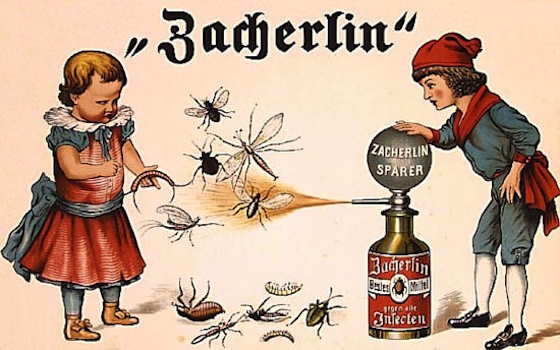
<p><em><em>A 1907 advertisement for pyrethrum spray, which was originally developed by Austrian inventor Johann Zacherl.</em> <em>(Wikimedia Commons)</em></em></p>

<p>Pyrethroids and pyrethrins are thought to be safe due to their botanical origins &mdash; even though some of them are just chemical simulations of those compounds. Nonetheless, in November 2011, the EPA reinforced that perception by&nbsp;<a href="http://www.epa.gov/oppfead1/cb/csb_page/updates/2011/pyrethrins.html">stating</a> that pyrethroids &#8220;posed health risks below the agency&#8217;s level of concern.&#8221; This assessment was based on experiments with adult rats, not long-term studies of humans or children exposed to pyrethroids, so the presumption of their comparative safety has largely gone untested so far.</p>
<p><q class="left">Burning and tingling skin, respiratory trouble, involuntary twitching</q></p>
<p>And there are signs that this gap urgently needs to be addressed. In 2008, the Center for Public Integrity analyzed 90,000 adverse reaction reports and&nbsp;<a href="http://www.publicintegrity.org/2008/07/30/8936/safe-pesticides-now-first-poisonings">found</a> that health problems linked to pyrethroids had increased 300 times in 10 years. The problems included burning and tingling skin, respiratory trouble, involuntary twitching, dizziness, nausea, fainting, convulsions and seizures. In Australia, a union representing transport workers is even mulling a class action lawsuit on behalf of air stewards who allege they suffer neurodegenerative diseases as a result of exposure to the insecticides.</p>

<p>Indeed, two recent studies have linked pyrethroid use to adverse changes in the developing brain. This September, a&nbsp;<a href="http://ehp.niehs.nih.gov/1306667/">study</a> on Canadian children found that exposure to pyrethroid insecticides was linked to behavioral problems reported by parents, while a&nbsp;<a href="http://pediatrics.aappublications.org/content/127/3/e699.full">2011 study</a> of mothers in New York found a strong association between prenatal exposure to piperonyl butoxide &mdash; an additive commonly used in pyrethroid sprays &mdash; and delayed mental development in toddlers.</p>

<p>Youssef Oulhote, the lead author of the first study, analyzed concentrations of organophosphate and pyrethroid breakdown products in urine samples from 779 children across Canada, comparing them with mental and behavioral difficulties. The results were startling. Oulhote found that a tenfold elevation in urinary levels of cis-DCCA, a breakdown product of common pyrethroids, was associated with a doubling in the odds of behavioral problems. &#8220;It&#8217;s consistent with findings from experimental studies in animals, which found that pyrethroids led to brain damage and behavioral problems,&#8221; says Oulhote. &#8220;Pyrethroids are considered less harmful than other pesticides &mdash; but that doesn&#8217;t mean they&#8217;re safe.&#8221;</p>
<p><q class="center">&#8220;Pyrethroids are considered less harmful than other pesticides &mdash; but that doesn&#8217;t mean they&#8217;re safe.&#8221;</q></p>
<p>From his research, Oulhote says that pyrethroids likely interfere with the regular functioning of the central nervous system, and introduce alterations in the microanatomy of the brain. Robin Whyatt, an expert on environmental exposures at the Columbia Center for Children, and the co-author of the 2011 study, points out that &#8220;the brain is the most highly developed organ in the body, and fetal brain development unfolds in a very precise, very controlled manner in time and space. Any interruption can have a far greater effect &mdash; a fully developed brain will have nowhere near the same impacts.&#8221;</p>

<p>Why, then, the dearth of research? Megan Horton, an epidemiologist at the Mailman School of Public Health who led the 2011 study, has a few ideas. &#8220;Pyrethroids are considered more difficult to study, since they rapidly metabolize, and are harder to measure in samples,&#8221; she says. &#8220;Then, they&#8217;re spun [by marketers] as a sort of natural compound, when in fact they&#8217;re chemically manipulated to be more persistent, more toxic.&#8221; And while translational studies on rodents could point to some biologically plausible clues about how poisons exert their force, mice are not people or babies.</p>
<p><q class="left">&#8220;We rely on a snapshot: one time, one urine sample.&#8221;</q></p>
<p>The biggest challenge lies in the inherently restrictive nature of studies examining long-term exposures in humans, which are time-consuming, expensive, and strictly observational. &#8220;A regulatory system that utilizes animal studies can&#8217;t simulate the effect of toxins on children,&#8221; says Melissa Perry, an expert in environmental and occupational health at GWU&#8217;s School of Public Health. &#8220;We can&#8217;t use experimental methods with humans,&#8221; she notes. &#8220;So we rely on &#8230; a snapshot: one time, one urine sample.&#8221; Oulhote agrees. &#8220;Our main limitation is the design of the study,&#8221; he says. &#8220;It draws an association, not a causal link.&#8221; To actually change policy, observational studies need the backing of mechanistic work &mdash; studies that reveal the biochemical tricks that poisons deploy on cells, tissues, and organs.</p>

<p>Whyatt, who recently received an NIH grant to study the effect of prenatal pyrethroid exposure on children&#8217;s mental development, is planning a study she hopes will fill that gap. In 2011, she and Horton found a significant association between the concentration of piperonyl butoxide and mental development. But since there were no previous studies on piperonyl butoxide, they didn&#8217;t know if the effect was due specifically to piperonyl butoxide or more broadly to pyrethroid exposure. &#8220;With this grant, we&#8217;re teasing apart that finding, since we&#8217;re looking at metabolized pyrethroids in mother&#8217;s urine,&#8221; says Whyatt. &#8220;But as in any epidemiological study, it&#8217;ll be a long time before we have any answers.&#8221;</p>
						]]>
									</content>
			
					</entry>
			<entry>
			
			<author>
				<name>Shruti Ravindran</name>
			</author>
			
			<title type="html"><![CDATA[Hot and bothered in the tropics: meet the early casualties of climate change]]></title>
			<link rel="alternate" type="text/html" href="https://www.theverge.com/2013/11/6/5070462/climate-change-tropical-species" />
			<id>https://www.theverge.com/2013/11/6/5070462/climate-change-tropical-species</id>
			<updated>2013-11-06T10:18:13-05:00</updated>
			<published>2013-11-06T10:18:13-05:00</published>
			<category scheme="https://www.theverge.com" term="Report" /><category scheme="https://www.theverge.com" term="Science" />
							<summary type="html"><![CDATA[A lone polar bear picking its way through nubs of sea-ice. Or an island carpeted with thousands of walruses that can no longer find permafrost patches to rest on. They&#8217;re the images most people associate with global warming, but a growing number of studies and observations from scientists suggest that this Pole-centric picture should be [&#8230;]]]></summary>
			
							<content type="html">
											<![CDATA[

						
<figure>

<img alt="" data-caption="Frog" data-portal-copyright="" data-has-syndication-rights="1" src="https://platform.theverge.com/wp-content/uploads/sites/2/chorus/uploads/chorus_asset/file/14515111/froggie.1419980060.jpg?quality=90&#038;strip=all&#038;crop=0,0,100,100" />
	<figcaption>
	Frog	</figcaption>
</figure>
<p>A lone polar bear picking its way through nubs of sea-ice. Or an island carpeted with thousands of walruses that can no longer find permafrost patches to rest on. They&#8217;re the images most people associate with global warming, but a growing number of studies and observations from scientists suggest that this Pole-centric picture should be replaced with something more like a planet-wide panorama &mdash; one that includes tropical species like lizards, bats, birds, and insects. All of whose chances of surviving a warming planet might be as bad or worse than the polar bear or walrus.</p>
<p><!-- extended entry --></p><hr class="widget_boundry_marker hidden page_break">
<p>Climate change is making the planet inhospitable for tropical creatures in numerous ways. It&#8217;s changing their ranges and migration patterns, and driving more of them towards the poles and tops of mountains, where they battle over limited food and real estate. It&#8217;s making them retreat into the shade for increasingly long spells to conserve energy, which means they feed less and in some cases stop reproducing. It&#8217;s also quite simply killing them off through dehydration and hyperthermia, consequences of longer and increasingly frequent droughts and heat waves.</p>

<p>All of these paths lead to one fate: extinction. And ecologists say that extinctions in the tropics could be catastrophic, since the regions are home to the highest concentration and variety of species on the planet.</p>
<h2 class="wp-block-heading" id="trauma-in-the-tropics">Trauma in the tropics</h2><p><img src="http://cdn3.sbnation.com/assets/3517587/lizard.jpg" class="photo" alt="Lizard"><br id="1383692690984"></p>
<p>Research on the impact of climate change on tropical species is only about a decade old. Before that, experts reasoned that since climate change was&nbsp;<a href="http://www.nasa.gov/topics/earth/features/warmingpoles.html">swifter at the poles</a>, arctic and alpine species would be hit first and hardest. Not to mention the effect of proximity bias: the best-funded institutions (and ecologists) tend to be located in North America and Europe.</p>

<p>But in recent years, an increasing number of researchers have recognized the urgent need to assess the damage that&#8217;s already underway in the Amazons, the cloud forests of Costa Rica, and the wet tropical rainforests of Australia.</p>

<p>A few more might soon be headed south after the publication of an&nbsp;<a href="http://www.nature.com/nature/journal/v502/n7470/full/nature12540.html">apocalyptic paper</a> in <em>Nature</em> last month. Polar regions might be experiencing the largest amount of change in absolute terms, the paper warned, but unprecedented and extreme climate change was coming to the tropics first, and within the next 10 years. The study&#8217;s lead author, Camilo Mora,&nbsp;<a href="http://www.nytimes.com/2013/10/10/science/earth/by-2047-coldest-years-will-be-warmer-than-hottest-in-past.html">told</a> the <em>New York Times</em>: &#8220;Go back in your life to think about the hottest, most traumatic event you have experienced. What we&#8217;re saying is that very soon, that event is going to become the norm.&#8221;</p>

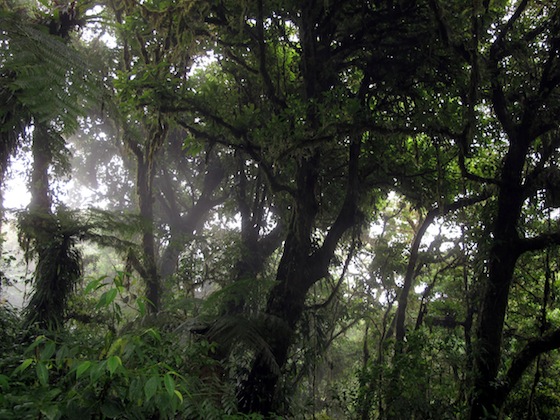
<p>That norm could be a death sentence for tropical species. These species are ill suited to spiking temperatures or fluctuations, as they&#8217;ve evolved in canopy-shaded forests where the temperature and humidity were stable year-round. These animals also have a low optimum temperature &mdash; where they function most comfortably &mdash; which they&#8217;re already close to, so small changes affect them intensely. It doesn&#8217;t help that the tropics are the fastest-changing regions on the planet: vast tracts of old-growth forests are giving way to pastures and fields, and the influx of pollutants and carbon emissions is making tropical forests hotter, dryer, and vulnerable to fires and disease.</p>
<h2 class="wp-block-heading" id="the-plight-of-the-flying-fox">The plight of the flying fox</h2><p><img src="http://cdn3.sbnation.com/assets/3517595/flying-foxes.jpg" class="photo" alt="Flying-foxes"><br id="1383692717791"></p>
<p>Ten years ago, another <em>Nature</em> paper made a drastic pronouncement when it suggested that climate change was leaving an indelible mark &mdash; a &#8220;fingerprint&#8221; &mdash; on ecosystems across the world.</p>

<p>The authors of that paper observed that over the past 25 years, hundreds of species had been inching towards the poles at the rate of 3.7 miles per decade. Mountain-dwelling species were retreating uphill at the rate of 20 feet every 10 years. Meanwhile, spring rites like the blossoming of flowers, breeding of frogs, and arrival of migrating birds had advanced by 2.3 days every decade.</p>

<p>Such gradual trends eventually yield a torrent of unpredictable problems, including increased competition for scarce resources. But higher temperatures and a variable climate also yield more extreme weather events &mdash; and some tropical species can&#8217;t take the heat.</p>

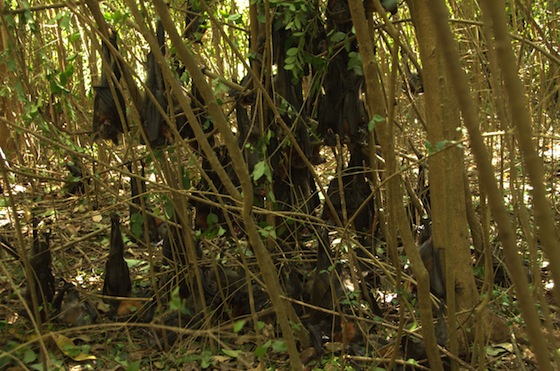
<p>Justin Welbergen, an ecologist, witnessed this firsthand in 2002 when he found the objects of his study &mdash; fruit bats known as gray-headed and black flying foxes, which are native to Australia &mdash; dropping dead at his feet. During a heatwave when temperatures soared to 109&deg;F, Welbergen was walking through a flying-fox colony when he saw its residents behaving oddly. The animals clambered down the trees, panting vigorously, licking their wings. They clung to trunks or clustered in shadows, flapping their wings like accordionists playing for their lives. At least 1,361 died in that colony alone.</p>

<p>Welbergen has since been studying the impact of extreme heat on flying foxes. The animals roost on the exposed branches of canopy trees and live packed together. So when they&#8217;re distressed by heat and die, it&#8217;s out in the open. Welbergen says this visibility makes them &#8220;function as alarm systems&#8221; for ecosystems perturbed by climate change. And he&#8217;s determined that their alarm goes off at 108&ordm;F.</p>

<p>The alarm has been sounding non-stop since 2002. Between that year and 2013, Welbergen has witnessed unprecedented die-offs. Climate change, he says, is bringing more flying foxes in discomfiting proximity to their lethal thermal range. &#8220;Today, the chances that an individual flying fox encounters its temperature mortality threshold have increased three-fold,&#8221; he says. &#8220;Since 2000, it&#8217;s out of control. My work has become one big post-mortem &mdash; just looking at who&#8217;s died.&#8221;</p>

<p>Flying foxes aren&#8217;t the only species to experience the impact of climate change. Birds like budgerigars and zebra finches have also been casualties of heat waves in Australia. &#8220;Birds in hot deserts are very much the canaries in the coal mine,&#8221; says Andrew McKechnie, an ecologist who has documented several die-offs. &#8220;With them, it&#8217;s not 90 days at 95&ordm;F that kill, but one day at 113&ordm;F. And those days are going to occur a lot more frequently in the future.&#8221;</p>

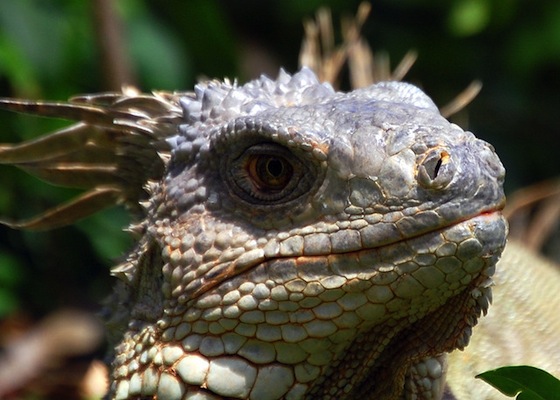
<p>For lizards, that future is already here. &#8220;We may have begun to detect the beginning of the sixth mass extinction,&#8221; says Barry Sinervo, a Santa Cruz-based ecologist and lead author of a 2010 study which found that climate change had rendered 4 percent of the world&#8217;s lizards locally extinct since 1975. Sinervo anticipates around 20 percent of the world&#8217;s lizards may disappear by 2080. &#8220;Most of them &mdash; maybe even half of them &mdash; would be in the tropics,&#8221; he adds. Sinervo is now setting up partnerships with about a hundred ecologists in an effort to hone in on lizard extinction. &#8220;It&#8217;s such an enormous problem,&#8221; he says, &#8220;that only a global army can figure out how bad things really are.&#8221;</p>
<h2 class="wp-block-heading" id="the-magnitude-of-the-damage">The magnitude of the damage</h2><p><img src="http://cdn1.sbnation.com/assets/3517635/jungle.jpg" class="photo" alt="Jungle"><br id="1383692859820"></p>
<p>How bad are things, really? How far-reaching are the consequences if the world loses one gecko, and two mega-bats? Ecologically and agriculturally, the tropics are the most productive regions in the world. Local extinctions would snowball into widespread, disastrous collapses in ecosystems everywhere. &#8220;The vast majority of species that are going extinct are all in tropical ecosystems,&#8221; Sinervo says. &#8220;So our fixation on polar species is a bit of a red herring.&#8221;</p>

<p>Take lizards, for example. &#8220;They&#8217;re at the base of the food chain, found at high density,&#8221; says Sinervo, &#8220;So they&#8217;re pretty darn important.&#8221; With frogs going extinct already, lizards have come to dominate the diets of snakes and birds. If they went, so would snakes and birds, and that&#8217;d cascade into collapses in ecosystem links across the tropics and elsewhere.&#8221;</p>

<p>Indeed, some ecologists emphasize the importance of taking a holistic view of climate change&#8217;s impact on species around the world &mdash; rather than focusing on one region.&nbsp;&#8220;We need to look at how species are directly affected by increases in mean temperature and extremes, and also how their interactions with other species are affected,&#8221; says ecologist Joel Kingsolver. &#8220;That can give us surprising outcomes that we don&#8217;t understand very well at this point.&#8221;&nbsp;Ultimately, Kingsolver and others agree, it&#8217;s not so important to figure out who gets hurt worse. The real and crucial challenge is to figure out the true magnitude of the damage, in all its complex, interlocking dimensions.</p>
						]]>
									</content>
			
					</entry>
	</feed>