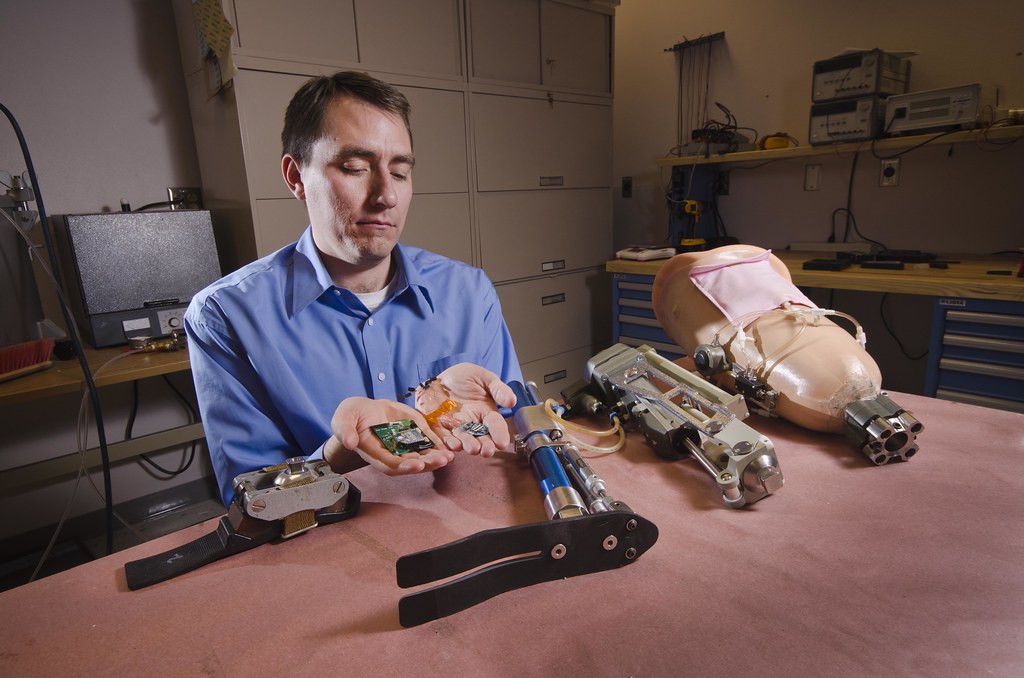
A new technique for connecting prosthetic devices could one day give amputees better control over their replacement limbs. While researchers have long hoped to find a way to make arms or legs that can directly respond to signals from the brain, Sandia engineer Steve Buerger says that a major stumbling block is allowing nerves to actually connect to the prosthetics. To fix this problem, a joint project by Sandia, the University of New Mexico, and the MD Anderson Cancer Center in Houston has focused on developing a scaffold-like structure that nerves will ideally grow into naturally. Besides providing a substrate for nerves, the scaffold also needs to be conductive enough to relay signals to the prosthetics, something the team fine-tuned with electrodes and carbon nanotubes.
Neural interfacing research could hold key to better prosthetics
A collaborative research project has produced a scaffold-like structure that nerves can grow into, possibly allowing them to directly connect to a prosthetic limb.
A collaborative research project has produced a scaffold-like structure that nerves can grow into, possibly allowing them to directly connect to a prosthetic limb.

Two versions of the porous scaffold — made from different materials — were stitched to the legs of rats, then tested to see how well they were accepted by the body. The first, designed to partially dissolve after being attached, proved too thick, but an analysis of the second scaffold showed that nerve cells had begun to grow into the structure, and that the material wasn’t being rejected by the rats’ immune systems. A functional version of the product is years away, but this early research could be the start of a move towards direct interfacing rather than workarounds like using muscle contractions or brain implants to control a prosthesis. An initial paper was presented at the Materials Research Society’s Fall Meeting.