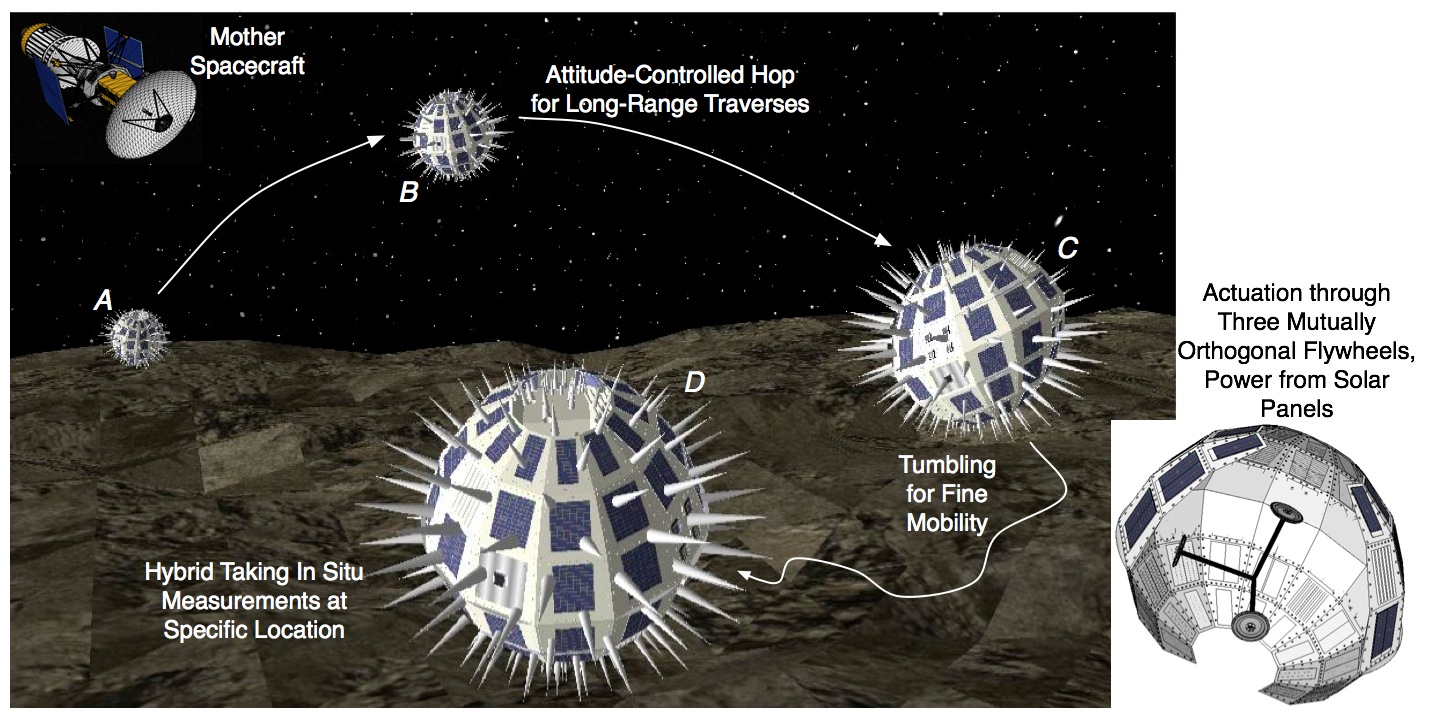
A team of researchers thinks that small, spiked robots might be our best option for exploring space. Stanford’s Marco Pavone, along with scientists from NASA and MIT, are working on prototype “hedgehogs” — autonomous rounded rovers a half-meter wide that could tumble over short distances and hop longer ones. Unlike current wheel- or tread-based rovers, the spheres would have greater freedom of movement and take advantage of a weak gravitational pull, using three rotating discs to shift its center of gravity. The ideal testing ground would be Phobos, a moon of Mars. Research on Phobos could yield information about Mars itself, laying groundwork for a future manned mission to the planet. As such, it’s being funded by NASA’s Innovative Advanced Concepts Program.
Rolling robotic ‘hedgehogs’ could explore Martian moon


is a senior tech and policy editor focused on online platforms and free expression. Adi has covered virtual and augmented reality, the history of computing, and more for The Verge since 2011.
According to a release from Stanford, a hypothetical mission would involve a total of five or six spheres held by a larger Surveyor craft. The Surveyor would gather general data from Phobos, while the spheres would be released one at a time to capture more fine-grained detail from the surface. That’s still, however, several years away. Currently, Pavone and his team are preparing to test a third generation of prototypes, first on Earth-bound terrain and later in a low-gravity aircraft. Tests of the Surveyor craft are planned in two to four years, with an actual flight closer to 10 or 20 years in the future. Updates — including video of the prototypes moving — are being posted at the project’s site.
Follow topics and authors from this story to see more like this in your personalized homepage feed and to receive email updates.