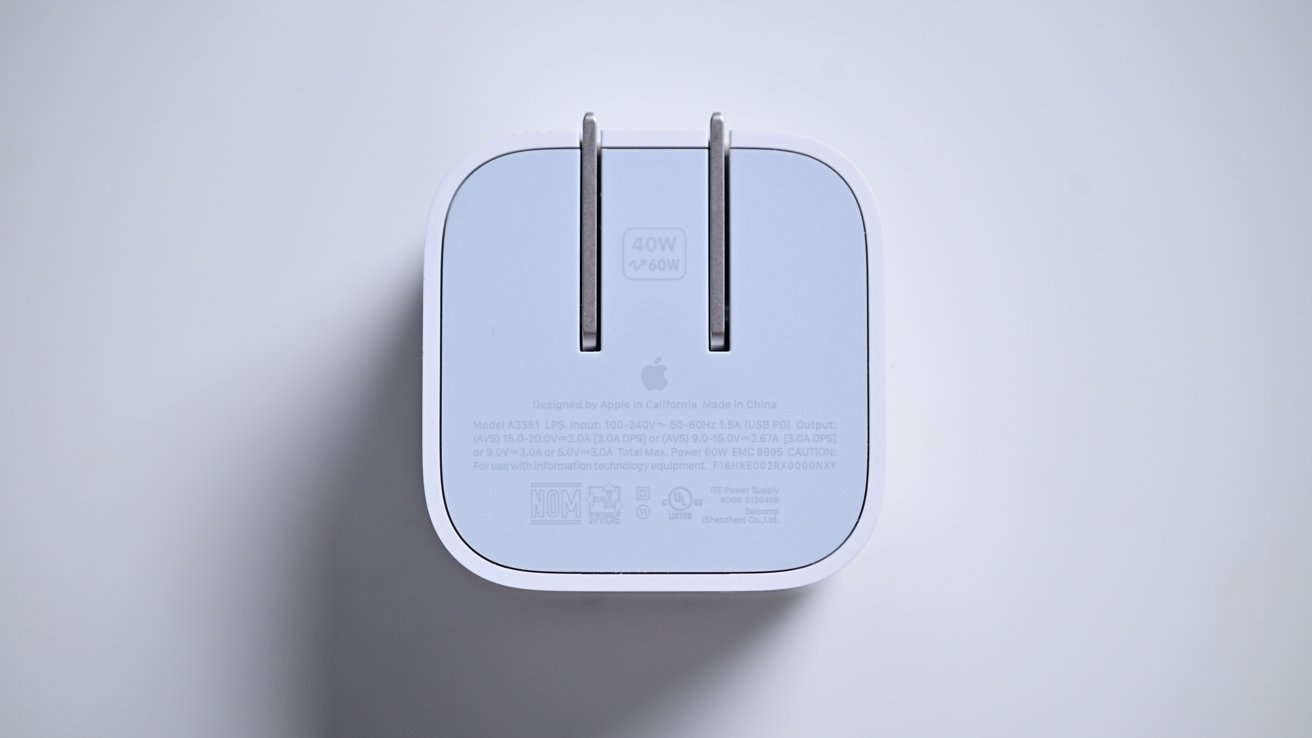
Alongside its new iPhone 17 lineup, Apple casually launched what looks like a world’s first charger to support USB PD 3.2 AVS and DPS to pack more power into a smaller package.
Apple’s new iPhone charger is a first of its kind
It’s dynamic!
It’s dynamic!


is a deputy editor and Verge co-founder with a passion for human-centric cities, e-bikes, and life as a digital nomad. He’s been a tech journalist for 20 years.
The very dull-sounding “Apple 40W Dynamic Power Adapter with 60W Max” supports AVS, or Adjustable Voltage Supply, just like Google’s equally mundane “Pixel Flex Dual Port 67W USB-C Fast Charger.” What makes Apple’s new charger unique is its embrace of DPS, or Dynamic Power Source. This is what allows it to be small like a 40W GaN charger, but still deliver a fast 60W charge for a limited amount of time to Apple’s newest iPhones.
A DPS charger offers a guaranteed continuous output power and a maximum output that can only be delivered when conditions like low ambient and internal temperatures are met. AVS provides granular voltage options, allowing the power source to offer more precise and efficient charging of devices like smartphones and laptops. USB PD 3.2 mandates AVS on chargers in the 27W – 100W range, and allows devices to fine-tune the charging voltage between 9V and 20V in small 100mV steps to enable more efficient power conversion and reduced heat. All new USB PD 3.2 chargers must support AVS, but not necessarily DPS as we understand it.
For reasons of safety, efficiency, and longevity, the batteries in our phones and laptops do not charge at their maximum possible input for the entirety of the charging cycle. Instead, it’s regulated at predefined voltages to slow down charging as the battery fills. With AVS, the power source can provide a very specific voltage that is closer to the ideal needed for the device being charged (for example, 12.3V instead of 9V or 15V), and DPS lets it hit the maximum power delivery allowed, speeding up charging with less energy waste.
You won’t find AVS or DPS mentioned on Apple’s product page but you can see both listed directly on the charger from Apple Insider’s hands-on. DPS kicks in at 3 amps and 20 volts for that 60 watt maximum when conditions are right.
However, unlike a true 60W charger, Apple’s little 40W GaN charger can not maintain that peak 60W rate forever — only 18 minutes, as demonstrated by Privaterbok over at the r/UsbCHardware subreddit. That makes it more suitable for fast charging a new iPhone 17 than a MacBook Pro, which is why Apple sells it as a 40W charger “with 60W Max” and not a 60W charger. The Reddit hands-on also notes that it will enable using a Switch 2 with the TV-out feature enabled, which requires a 60W charger, although it’s unclear how long they tested it that way.
We’ll need to do hands-on testing with Apple’s $39 Dynamic Power Adapter to better understand its limits. But if you need a compact charger for your new iPhone 17 that can meet Apple’s fast charging claim of “up to 50 percent in 20 minutes” then it seems Apple’s adapter with support for both USB PD 3.2 AVS and DPS is currently the only game in town.
Correction, September 17th: This story initially misstated what makes the new charger unique. It is DPS, not AVS. It later was updated to reference Google’s recent AVS charger, too.
Follow topics and authors from this story to see more like this in your personalized homepage feed and to receive email updates.